Enterprise Platform for
Data-Centric AI
At the core of Globik AI is iTera; a cloud-native, multi‑modal platform engineered for the complexities of modern AI. It enables seamless annotation, validation, and delivery of structured datasets for enterprise-grade AI.
Key Features and Capabilities

Handle every data type confidently. Images, audio, video, text, documents, spatial data, and more. Our platform unifies diverse data formats in one annotation environment.

Choose from over 50 templates built for common pipelines such as computer vision, NLP, conversational AI, multimodal systems, and synthetic data generation. Templates follow industry best practices, reducing ramp-up time and ensuring consistency.

Enabling automated annotation using your own models or foundational/LLMs with tight integration allows high-throughput and scalable labeling while retaining accuracy.

Leverage active learning strategies to bring human validation directly into the annotation cycle ensuring the platform focuses on data samples most uncertain to the model, and optimizing label quality iteratively.

Hosted in the cloud for global access, with role-based user management, integrated quality assurance workflows, and direct integration with enterprise data sources and project repositories.

Accelerate annotation workflows by up to 10× while reducing costs by up to 90 %—without compromising accuracy or scale. Every stage embeds QA metrics, benchmarking, and audit trails to maintain enterprise-grade output.
iTera at a Glance

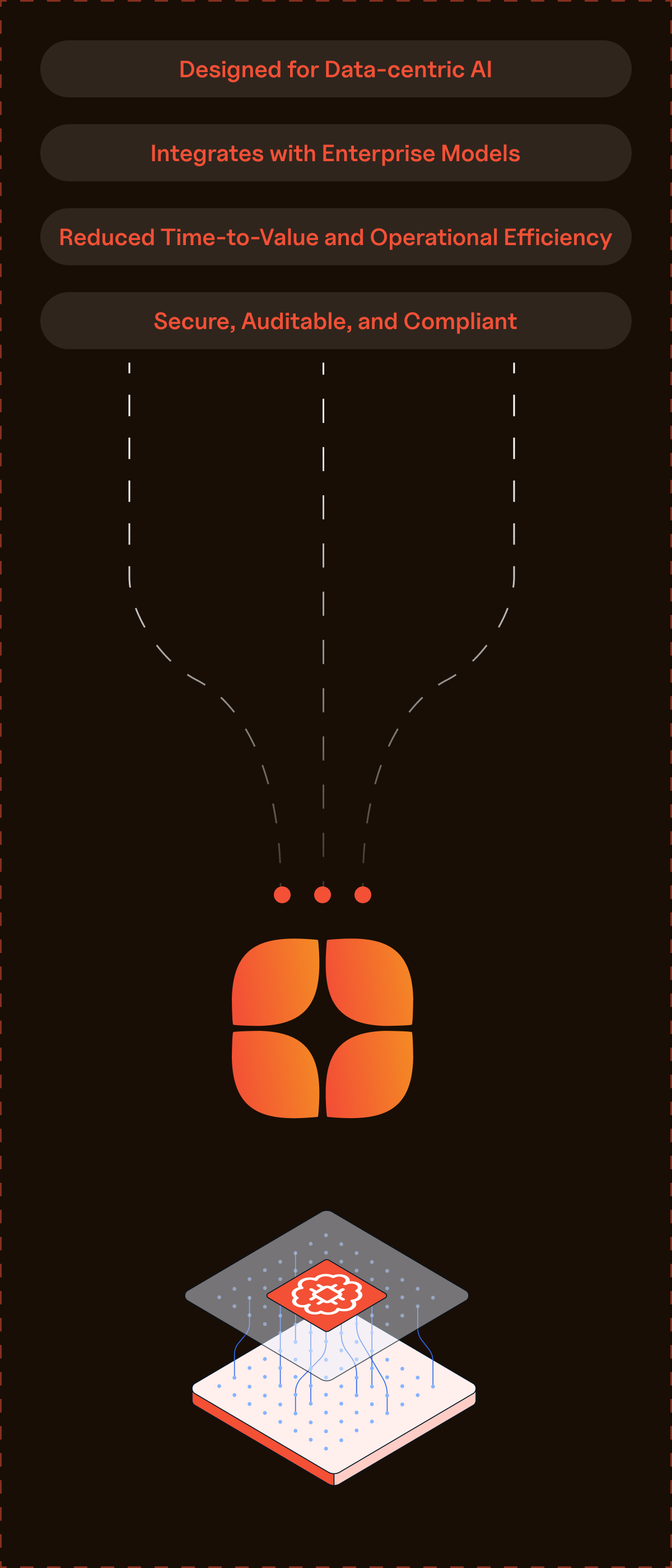
Focusing on the highest-quality inputs so your downstream models deliver maximum value.

Supports foundational models and your custom LLMs; including supervised fine‑tuning, preference‑based ranking, RLHF workflows, and synthetic data expansion.

By combining automated workflows with human-in-the-loop validation, companies achieve faster project turnaround and superior dataset reliability.

Designed for highly regulated industries; provides controlled access, audit logs, and supports enterprise standards including GDPR, HIPAA, SOC2.
Licensing and Deployment Models
We understand that different organizations have different needs. That’s why iTera is available in flexible models.

Enterprises can license iTera for internal annotation teams, with full workflow setup, automation, and integrations.

For clients who want full ownership, iTera can be deployed on-prem or in a private cloud — with customization and long-term support.

For governments, enterprises, or AI labs requiring controlled environments, we offer co-build and transfer models.
See How it Works in Streamlined Steps


Create and configure your annotation project with custom labels and templates.

Connect cloud storage, APIs, or on-prem data for seamless ingestion.

Choose use-case templates or define annotation guidelines manually.

Use integrated LLMs or domain models for programmatic labeling; custom model imports supported.

Experts interact with uncertain cases flagged by active learning; quality thresholds enforced.

Export structured datasets as per the required format into your data lake or ML pipeline.

Optionally fine-tune LLMs through supervised learning, RLHF, or ranking workflows.

Monitor label performance and retrain models to evolve accuracy.
Supported Use Cases
Each template includes industry best practices and QC workflows.


Frequently
Asked Questions
Will using iTera mean we must manually annotate everything, or is automation possible?
You don’t have to rely solely on manual annotation. iTera supports programmatic (automated) annotation using your own models or foundation/LLMs. At the same time, for quality and precision, there’s optional human-in-the-loop review and active-learning workflows for uncertain cases.
If our project grows - more data, more complexity - can iTera scale accordingly?
Suppose we need custom annotation workflows or domain-specific labels - can we configure iTera accordingly?
How does iTera support downstream model-building (e.g. LLM fine-tuning or computer-vision pipelines)?
If we already have existing data pipelines or storage, can iTera work with them directly?
How does iTera ensure annotation quality and reliability, especially for sensitive or regulated use cases?
What kind of cost or speed advantage can we expect if we use iTera for annotation compared to building in-house manually or via ad-hoc tools?
All Rights Reserved.