Computer Vision &
Visual AI Data
Globik AI delivers end-to-end Computer Vision and Visual AI data services that enable machines to interpret, reason, and act on visual information with accuracy and contextual depth, powered by computer vision data annotation services and scalable image data collection services. From foundational perception tasks to advanced scene understanding, Globik supports enterprises building vision systems across autonomous technologies, industrial automation, healthcare imaging, retail intelligence, and smart infrastructure.
Our visual AI datasets are created through SME-driven annotation workflows, multi-layer quality validation, and scalable data operations designed to meet production-grade model requirements.
Object detection
& tracking
Globik AI enables reliable identification and continuous tracking of objects across images and video sequences.
This capability supports models that must understand where objects are located, how they move, and how their behavior changes over time. Annotation includes bounding boxes, multi-object IDs, frame-to-frame continuity, occlusion handling, and motion consistency validation. Detection and tracking pipelines are designed to reflect real operational environments, including dynamic lighting, dense scenes, partial visibility, and long-tail object classes.
Typical applications include:

Autonomous driving perception systems

Smart surveillance and city monitoring

Warehouse automation and robotics

Retail footfall and movement analytics

Retail footfall and movement analytics
Semantic & instance
segmentation
Globik AI provides high-precision pixel-level segmentation that enables models to understand visual scenes at granular detail.Semantic segmentation assigns class labels to every pixel in an image, while instance segmentation differentiates individual objects within the same class. This allows models to perform spatial reasoning, boundary detection, and object differentiation at production accuracy, supported by image data preprocessing services and validated through computer vision model evaluation. Annotation workflows include polygon tracing, boundary refinement, occlusion logic, and multi-layer QA to ensure spatial correctness.
Common use cases include:
Autonomous navigation and lane understanding
Medical imaging and diagnostic modeling
Satellite and geospatial analysis
Manufacturing defect detection
Manufacturing defect detection
Keypoints, landmarks
& pose estimation
Globik AI delivers keypoint annotation for human pose estimation, facial landmarks, hand tracking, skeletal modeling, and object articulation. Datasets are reviewed by domain-specific SMEs to ensure anatomical, geometric, and motion accuracy.This data enables models to interpret posture, movement dynamics, gestures, and physical interactions.
Applied across:
Human activity and ergonomics analysis
Sports performance analytics
Driver monitoring systems
Facial recognition and emotion modeling
Healthcare movement and rehabilitation tracking
Action & activity
recognition
Globik AI annotates temporal sequences within video data, identifying actions, interactions, and event transitions across frames. This includes start-end boundaries, multi-actor interactions, and contextual labeling aligned with real-world behavior patterns.Annotation is supported by temporal QA frameworks to ensure consistency across long video sequences.
Widely used in:
Workplace and public safety monitoring
Smart surveillance and threat detection
Sports analytics and broadcast intelligence
Human computer interaction systems
Human computer interaction systems
Visual reasoning &
perception datasets
Globik AI builds visual reasoning datasets that capture relationships, spatial dependencies, object interactions, and contextual cues within complex environments. These datasets support higher-order perception tasks such as understanding cause-effect relationships, object hierarchies, and scene logic.This layer of data is critical for next-generation vision models that move beyond recognition toward interpretation and decision-making.
Key applications include:
Vision language model training
Autonomous system decision logic
Robotics task planning
Scene understanding and question answering
Multimodal AI systems
Real-World Application Example
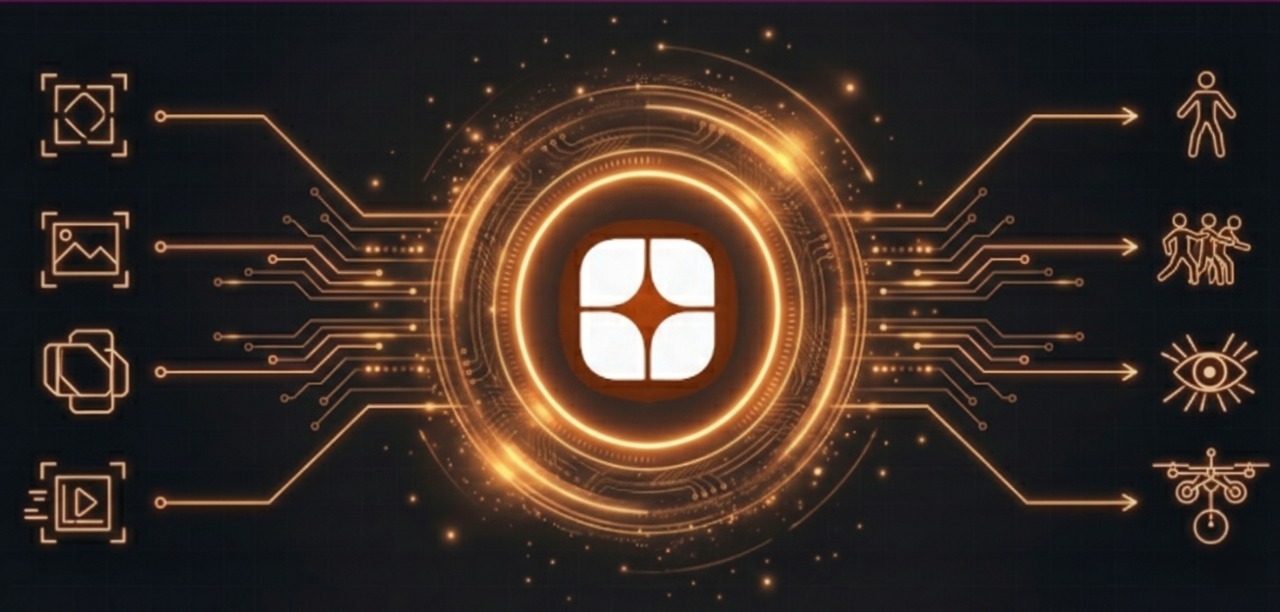
In autonomous driving systems, vehicles must simultaneously detect surrounding objects, segment lanes and road boundaries, track pedestrian movement, estimate human posture, and interpret complex interactions at intersections.
Globik AI supports such perception stacks by delivering multi-layer visual datasets that combine detection, segmentation, tracking, and temporal reasoning. This enables models to perform safely across challenging conditions such as night driving, adverse weather, dense traffic, and rare edge scenarios.
The same foundational vision datasets are also applied across industrial robotics, smart surveillance, and intelligent retail systems where real-time visual understanding directly impacts operational performance.
Why Enterprises Choose This Capability
Globik AI’s multimodal data annotation and labeling capability is designed for production environments where data diversity, scale, and quality determine success. By combining multimodal coverage, temporal understanding, cross-modal alignment, and targeted edge-case handling, this solution supports AI systems that perform reliably beyond controlled conditions.
Talk to an Expert
All Rights Reserved.