In the ever evolving landscape of Artificial Intelligence, the saying “Garbage in, garbage out” has never felt more personal. As we step into 2026, we aren’t just talking about data anymore. We are talking about the digital food that nourishes the systems managing our health, our finances, and our safety on the roads.
Every decision an AI system makes today traces back to something it was fed yesterday: a scan, a sentence, a frame of video, a line of transaction history. When that input is weak, rushed, biased, or misunderstood, the output does not fail loudly. It fails quietly, it fails at scale.
That quiet failure is what makes data quality feel less like a technical concern and more like a human one.
At Globik AI, we are entering this space at a pivotal moment. We are not a legacy firm stuck in old manual workflows or outdated assumptions about how data work should be done. We are a specialized team focused on solving the “Data Hunger” crisis that modern AI faces.
Because in 2026, the bottleneck is no longer computers, it is no longer in storage, it is not even talent - It is the quality of the fuel you are feeding your models.
We have watched companies spend millions on model architecture, only to starve those models with inconsistent, poorly contextualized data. We have seen failing promising systems stall not because the algorithm failed, but because the underlying data never reflected reality in the first place.
In this blog, we dive deep into the state of the data annotation market in 2026, Where it is growing? Why the human touch matters more now than it did five years ago? and where the biggest opportunities lie for businesses that are willing to treat data as a foundation, not an afterthought?
If 2023 was the year of Generative AI curiosity, 2026 is the year of AI operationalization.
Curiosity asks, Can this work? Operationalization asks, Can this work every day, for real users, without breaking things we cannot afford to break?
That shift alone explains why the data preparation market has exploded. The global market for these tools is no longer a niche industry supporting experimental projects, It is a core layer of the stack. A titan projected the growth from 2.14 billion dollars in 2026 to over 14 billion dollars by 2034, sustaining a growth rate of nearly 27 percent.
These numbers are not driven by hype, they are driven by friction. systems are moving out of demos and into hospitals, courtrooms, call centers, warehouses, and vehicles. The moment technology touches the real world, the cost of getting things wrong rises sharply.
Why the sudden explosion? It is not just about more data. It is about multimodal data.
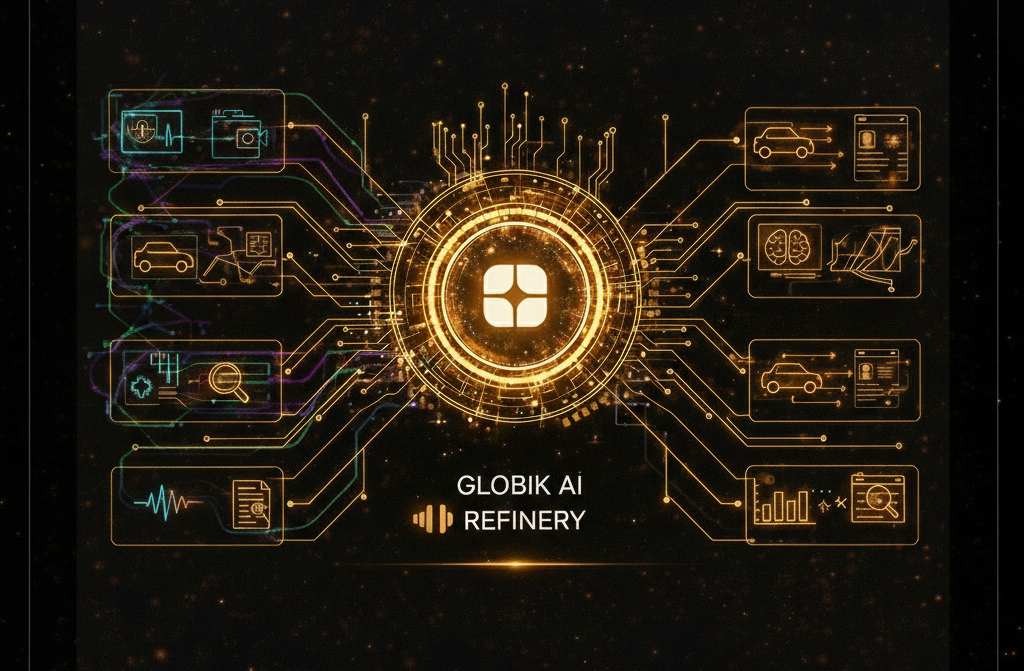
In 2026, AI models are no longer satisfied with reading text or seeing images in isolation. They are processing sensor fusion. Video, audio, LiDAR, radar, thermal feeds, timestamps, and environmental context, all stitched together to form a single understanding of what is happening.
That kind of understanding does not come for free.
Annotating a sentence is one thing annotating a moving world across time, perspective, and uncertainty is another entirely. This complexity has quietly transformed data annotation from a background service into core infrastructure.
1) Regionally, North America continues to lead in revenue, driven by enterprise adoption and regulatory pressure. At the same time, the Asia Pacific region has emerged as the fastest growing hub not just because of scale, but because of specialization, multilingual capability, and domain depth.
2) Sector-wise, Healthcare and Automotive, particularly ADAS and Level 3 plus autonomy remain the primary engines of demand. In these sectors, annotation errors are not cosmetic, they can be dangerous.
The annotation industry has undergone a radical transformation over the last 18 months. Here are the three pillars defining the "New Normal" in 2026:
The focus has shifted from "Is this a cat?" to "Is this answer helpful, safe, and unbiased?" Reinforcement Learning from Human Feedback (RLHF) is now the dominant annotation technique for Large Language Models (LLMs). This requires annotators who aren't just labelers, but educators People who understand context, nuance, and consequence, People who can compare responses and explain why one answer feels wrong even when it sounds fluent.
By 2026, the industry has realized that real-world data is often too scarce or too sensitive. In Synthetic Data, we are now using AI to generate "perfectly labeled" datasets for edge cases, like a car driving through a blizzard at midnight. However, at Globik AI, we believe in Human-in-the-Loop (HITL) Synthetic Data, where humans validate the synthetic outputs to prevent "model collapse."
As global regulations tighten, including expanded GDPR frameworks and new AI Acts, data can no longer move freely across borders or platforms.
This has reshaped how annotation work is delivered.
The rise of edge based and on premise annotation reflects a simple truth. Sensitive data should not travel, people should.
Companies now look for partners who can bring trained workforces into secure environments, operate within strict access controls, and leave no trace behind. Medical records, Financial histories, Legal documents, these datasets demand respect, not convenience.
The state of the market in 2026 presents a "Gold Rush" for those who know where to dig. If you are looking to scale your AI capabilities, these are the areas with the highest ROI:
The future is not just text. If your company isn't thinking about how to combine audio, video, and text you are already falling behind.
A customer support system that sees a damaged product and hears frustration in a voice tells a very different story than a chat transcript alone.
This space includes video annotation, LiDAR labeling, and full sensor fusion workflows. These pipelines are hard to build, expensive to maintain, and incredibly difficult to fake. That is exactly why they matter.
Training a model is just the beginning. The real opportunity lies in Instruction Tuning, Teaching a model how your industry speaks? How does your brand communicate? What should be emphasized and what should never be said?
This requires high quality, structured text datasets created deliberately, not scraped indiscriminately. The companies that treat this as a craft, rather than a checkbox, will see compounding returns.
As AI becomes more integrated into public life, the risk of bias is a board-level concern. There is a massive demand for Adversarial Annotation or Red Teaming, where humans intentionally try to break models to find vulnerabilities before they reach the public.
At Globik AI, we don't look at a dataset as a collection of zeros and ones, we look at it as the foundation of a relationship between a business and its customers.
Whether we are working on 3D Point Cloud annotation for autonomous vehicles or NER (Named Entity Recognition) for legal documents, our goal is to provide data that is:
In the past, data work was often treated as a commodity, a task for the lowest bidder. In 2026, that approach is a recipe for disaster. If you are building a legal system, you need people with legal backgrounds to review the data. If you are building a diagnostic tool, you need medical expertise in the loop. we prioritize domain depth over raw speed, because a single high-quality data point is worth more than a thousand mediocre ones.
As we move through the rest of 2026 and beyond, the most successful companies will not be the ones with the most processing power. They will be the ones with the best data.
We have watched companies spend millions on architecture, only to starve those systems with inconsistent, poorly contextualized fuel. We have seen promising projects stall not because the math failed, but because the underlying information never reflected reality in the first place.
Data preparation is no longer a manual chore to be outsourced and forgotten. It is a strategic asset, a discipline, and a responsibility. It is the bridge between a machine that calculates and a machine that understands.
The "Data Hunger" crisis is real, but it is also an opportunity. By treating your data as a foundation rather than an afterthought, you aren't just building better technology, you are building a more reliable and human-centric future.
Is your data ready for the future?
At Globik AI, we help you build AI that is reliable, responsible, and ready for the real world. Let’s build something intelligent together.