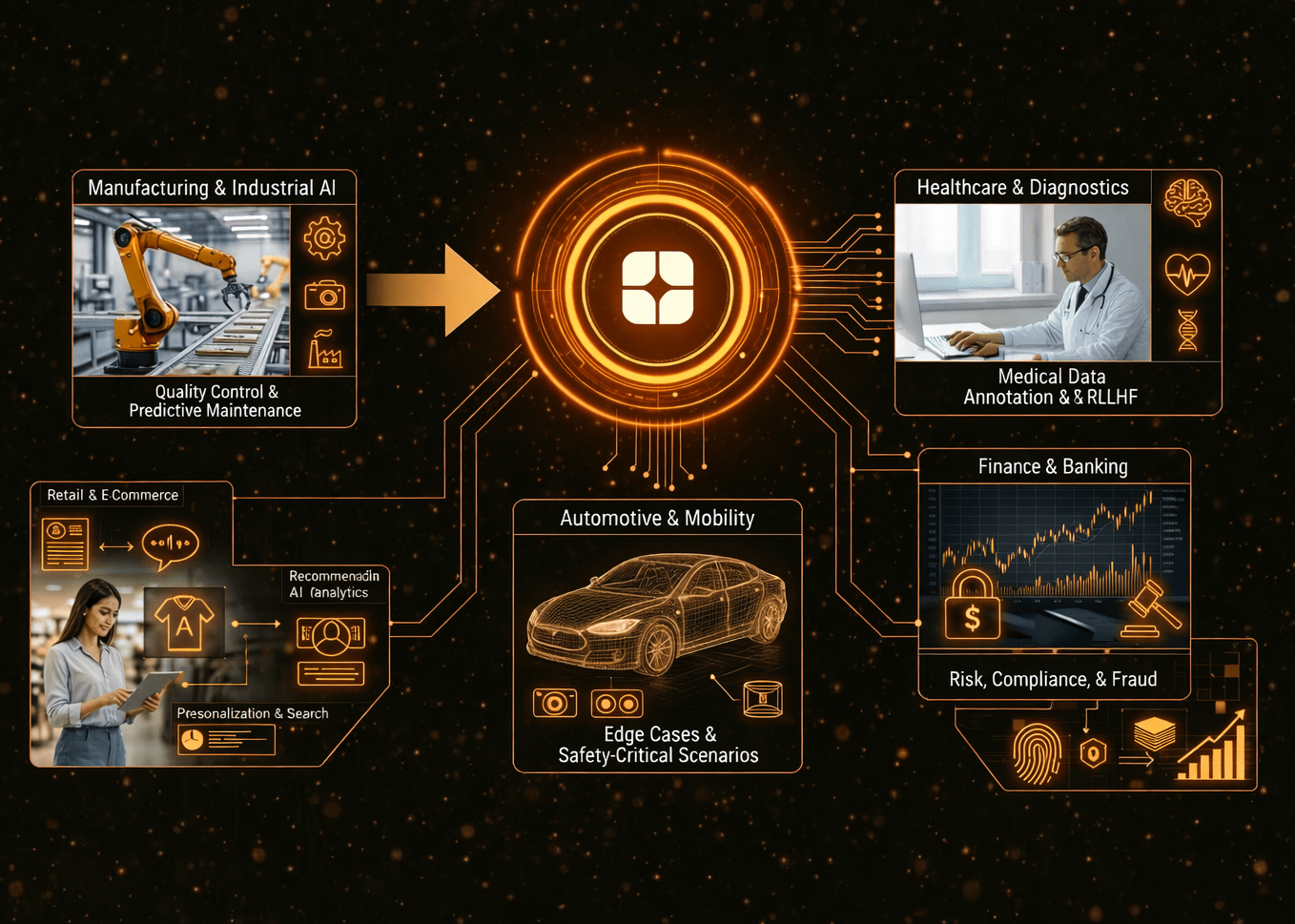
Artificial Intelligence is no longer an experimental technology sitting inside innovation labs. It has moved into hospitals, banks, factories, online stores, vehicles, and government systems. What has changed in the past few years is not just the speed of AI adoption, but the way it is being built.
Businesses are realizing that generic AI models are not enough. A chatbot trained on general internet data cannot safely assist a clinician. A computer vision model trained on random road images cannot reliably guide an autonomous vehicle. A language model that understands casual English may struggle with legal compliance language.
This is why domain specialized AI data services are rising across industries.
Companies today need AI systems trained on highly curated, context-rich, industry-specific datasets. They need AI that understands terminology, regulations, edge cases, workflows, and risk sensitivity within their domain. And that requires a different level of data strategy.
In this blog, we explore how domain specialized AI data services are transforming industries, why the ecosystem is shifting toward vertical AI, and how companies like Globik AI are helping organizations build trustworthy and production-ready AI systems.
In the early phase of AI adoption, most organizations experimented with general-purpose models. These models were powerful but broad. They could answer questions, summarize content, or classify data at a high level.
However, real-world enterprise deployment revealed gaps:
AI trained on open internet data cannot fully understand medical abbreviations, financial reporting structures, manufacturing defect patterns, or complex insurance underwriting guidelines. When businesses deploy AI in high-stakes environments, even small errors can lead to financial loss, compliance violations, or safety risks.
This has created strong demand for domain specialized AI data services that provide structured, validated, and industry-aligned training data.
Across the AI ecosystem, we are seeing a clear transition from horizontal AI tools to vertical AI systems. Major technology companies and startups alike are investing in industry-focused models.
For example:
The conversation in the industry has moved from “How powerful is the model?” to “How reliable is the model in my domain?”
At the same time, governments are tightening regulations around AI transparency and responsible data usage. This further increases the need for structured, traceable, and ethically sourced datasets. The AI industry is maturing, and with maturity comes specialization.
Domain specialized AI data services go far beyond simple data labeling. They combine domain expertise, structured data engineering, privacy safeguards, and model alignment strategies.
These services typically include:
The goal is simple, Deliver data that enables AI systems to perform accurately in real production environments.
This is where companies like Globik AI play a critical role. Instead of offering generic annotation pipelines, they provide vertical-ready AI data solutions built with domain understanding at the core.
Healthcare is one of the most demanding sectors for AI deployment. Clinical environments require precision, contextual awareness, and strict compliance with privacy regulations.
Medical language is complex. Diagnostic decisions depend on nuanced patterns in imaging, lab reports, and patient history. Generic AI systems often misunderstand clinical phrasing or miss subtle indicators in radiology images.
Domain specialized data services in healthcare include:
In one healthcare deployment scenario, a clinical support assistant was underperforming because it was trained on broad conversational data. After introducing curated, physician-validated datasets and domain-aware evaluation processes, the assistant’s accuracy in handling medical queries improved significantly. It began understanding contextual references such as dosage adjustments and diagnostic follow-ups.
This demonstrates how domain knowledge transforms model performance.
Financial institutions operate in one of the most regulated environments globally. AI systems in this space handle fraud detection, credit risk analysis, anti-money laundering processes, and customer interactions.
Financial data includes structured transaction logs, compliance documents, multilingual customer communication, and evolving fraud patterns. Generic AI models struggle with financial jargon and regulatory nuances.
Domain specialized AI data services support:
A digital banking platform needed an AI system to detect emerging fraud patterns. Generic anomaly detection models flagged too many false positives. After integrating domain-labeled transaction datasets and risk-specific tagging workflows, the system achieved higher precision and reduced operational burden on compliance teams. The difference was not in the algorithm alone, It was in the quality and specificity of the training data.
The automotive sector, especially autonomous driving, relies heavily on multimodal AI systems. These systems must interpret data from cameras, radar, LiDAR, and onboard sensors simultaneously.
Driving environments are unpredictable. Weather conditions, rare pedestrian behaviors, unexpected obstacles, and complex urban layouts require AI models trained on highly detailed, scenario-rich datasets.
Domain specialized data services include:
In autonomous driving pilots, models often fail not in common driving situations but in rare edge cases. Synthetic data simulation and targeted annotation of uncommon traffic scenarios significantly improve system robustness. This type of domain-specific preparation is essential for safety-critical applications.
Retail has embraced AI for personalization, demand forecasting, and customer experience optimization.
Customer behavior is dynamic. Product catalogs change constantly. Consumer language differs across regions and cultures.
Domain-focused AI data services provide:
An online retailer improved recommendation relevance after restructuring its product metadata and enriching customer interaction datasets. Rather than relying on generic recommendation algorithms, it used curated retail-specific behavioral signals. This led to higher engagement and improved conversion rates.
Factories and production environments are increasingly adopting AI for predictive maintenance and quality control.
Industrial AI systems need to detect micro-defects, monitor machinery health, and predict failures before they occur. Training these systems requires domain-rich sensor and inspection data.
Specialized data services support:
A manufacturing firm reduced downtime after implementing predictive maintenance models trained on properly labeled historical failure data. The key was structured and accurately annotated operational datasets.
The rise of domain AI is not limited to commercial sectors. In education, AI supports adaptive learning through structured student performance data. In agriculture, drone imagery and crop health datasets enable precision farming. In energy, IoT-based sensor labeling supports smart grid optimization. In the public sector, traffic and emergency response systems rely on contextual data for better resource allocation.
Across all these verticals, one theme is clear, AI performs best when it understands the domain deeply.
As AI adoption expands, so do concerns about bias, explainability, and transparency.
Regulators and enterprises now demand:
Domain specialized AI data services help address these requirements by embedding governance practices into data pipelines from the beginning. This is not just about compliance. It is about building trust.
Organizations investing in vertical AI data strategies are seeing measurable benefits:
The difference between experimental AI and enterprise-grade AI often lies in the data foundation.
Globik AI operates at the intersection of domain expertise and advanced AI data engineering. Instead of offering generic data pipelines, the company focuses on delivering high-quality, domain-ready AI datasets across industries.
Its capabilities include:
By combining human expertise with scalable technology platforms, Globik AI ensures that AI systems are not only intelligent but also reliable in real-world environments.
The AI industry is entering a phase of specialization. Large general models will continue to evolve, but enterprise value will increasingly come from vertical adaptation and domain tuning.
We can expect to see:
AI is becoming less about experimentation and more about dependable outcomes and dependable outcomes require dependable data.
The rise of domain specialized AI data services marks a significant shift in how artificial intelligence is built and deployed. Businesses no longer want broad intelligence. They want contextual intelligence.
From healthcare diagnostics to fraud detection, from autonomous vehicles to retail personalization, AI must understand the environment it operates in. That understanding begins with high-quality, domain-specific data.
Organizations that invest in structured, responsible, and vertically aligned AI data strategies will lead the next wave of innovation.
Companies like Globik AI are helping make that possible by delivering tailored AI data solutions designed for real-world performance, compliance, and trust.
The future of AI will not belong to the most generic models. It will belong to the most specialized, contextual, and domain-aware systems built on strong data foundations.