In the last few years, data annotation has moved from being a backend support function to becoming the backbone of artificial intelligence. Whether it is autonomous driving, medical imaging, retail analytics, or generative AI, everything depends on one thing: high-quality labeled data.
But as AI models become more advanced, the demand for faster, more accurate, and scalable annotation has grown sharply. Traditional manual labeling is no longer enough. At the same time, fully automated annotation still struggles with edge cases and context.
This is where hybrid human and AI workflows are changing the game.
At Globik AI, the focus is on combining human intelligence with AI automation to create annotation systems that are accurate, scalable, and adaptable across industries. In this blog, we explore how hybrid workflows are reshaping annotation services, the latest industry shifts, and how different solutions and industries are benefiting from this transformation.
A few years ago, annotation was simple. Teams drew bounding boxes, tagged objects, transcribed audio, and classified images. Today, the landscape looks very different.
Modern AI systems require:
The complexity has increased, and so has the risk of poor-quality data.
At the same time, the AI ecosystem has evolved rapidly. The rise of generative AI, foundation models, and industry-specific AI systems has pushed companies to demand higher annotation accuracy and faster turnaround times. This is why hybrid workflows are no longer optional. They are becoming the industry standard.
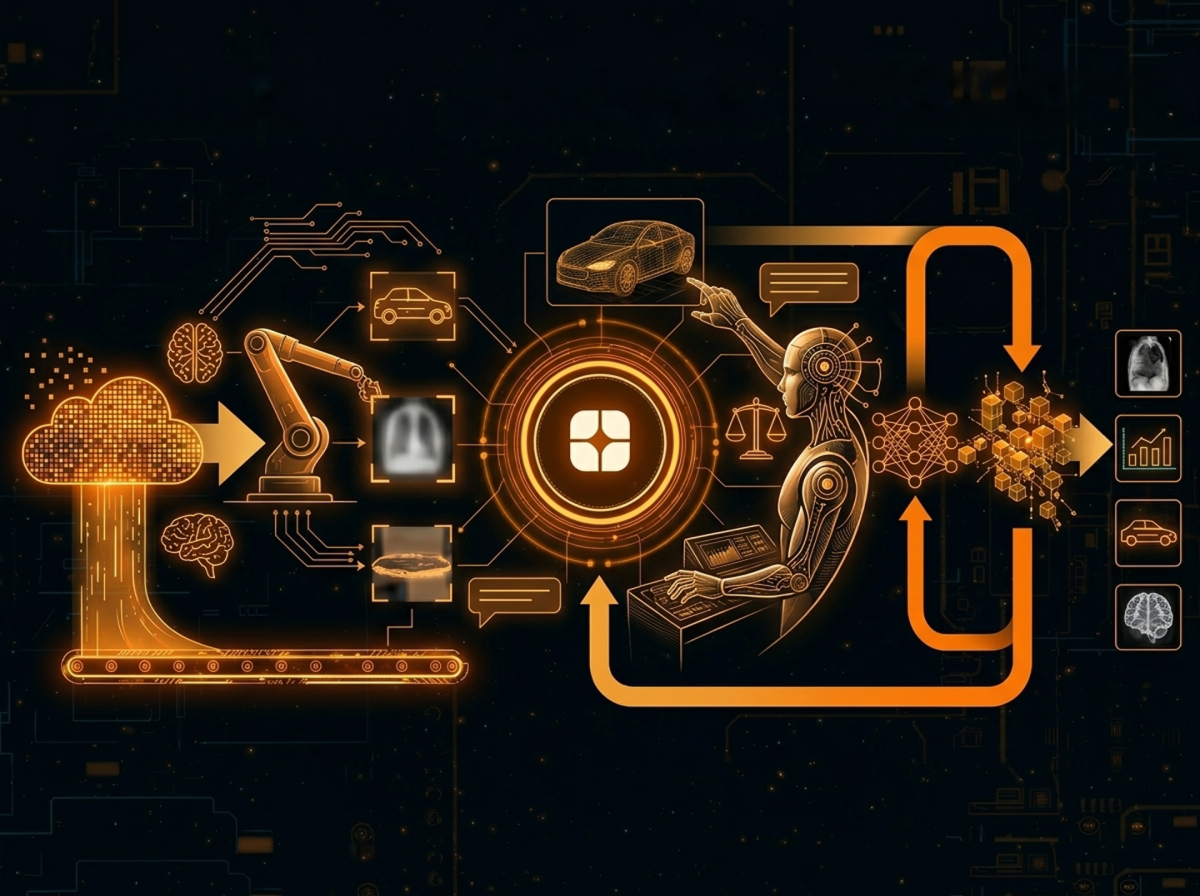
A hybrid workflow blends machine automation with human oversight in a structured process.
Here is how it typically works:
Instead of replacing humans, AI assists them. Instead of slowing down projects, humans improve machine decisions.
This combination brings three key benefits:
The result is faster project completion with higher reliability.
Several recent industry trends have accelerated this shift.
AI applications today generate massive amounts of data, including video streams, sensor data, chat logs, and medical scans. Manual-only annotation simply cannot scale to meet this demand. Hybrid workflows allow AI to handle repetitive tasks, while humans focus on complex or ambiguous cases.
Generative AI models require high-quality human feedback to refine outputs. Automated systems alone cannot judge nuance, tone, bias, or context. Human-in-the-loop systems are essential to train and evaluate these models effectively.
Industries like healthcare, finance, and automotive require strict compliance and traceability. Hybrid workflows introduce audit trails, multi-layer validation, and documented quality checks, reducing compliance risks.
Fully manual annotation is expensive and time-consuming. Fully automated annotation can lead to high error rates. Hybrid systems strike a balance, optimizing both cost and performance.
Let us explore how hybrid workflows enhance each major annotation solution.
Image annotation remains one of the most demanded services, especially in retail, manufacturing, agriculture, and surveillance.
Hybrid advantage:
Use Case:
A retail analytics company needed to track shelf stock levels across thousands of store images daily. AI handled basic object detection, while human reviewers corrected brand-level misclassifications. The hybrid model reduced turnaround time by 45 percent while improving labeling precision significantly.
Video data is far more complex due to motion tracking and frame continuity.
Hybrid workflow benefits:
In smart city projects, traffic monitoring systems rely on accurate vehicle and pedestrian tracking. Hybrid annotation ensures accurate movement patterns without missing critical safety data.
Autonomous systems require 3D bounding boxes and sensor fusion. Common challenges include dense point clouds, object occlusion, and real-world variability.
Hybrid approach:
Case Study Example:
An autonomous mobility startup needed large-scale LiDAR labeling for training object detection models. AI pre-labeled 70 percent of the dataset. Human specialists refined critical safety objects such as cyclists and pedestrians. This reduced annotation time significantly while maintaining high precision.
Healthcare AI demands extremely high accuracy.
A hybrid model ensures:
This approach reduces workload for radiologists while maintaining compliance and precision.
With the rise of chatbots and AI assistants, text and speech annotation has become central.
Hybrid workflow benefits:
Real-World Application:
A fintech company training a customer support chatbot used hybrid annotation to improve intent recognition. Human reviewers corrected subtle variations in financial queries, improving chatbot response accuracy over time.
Hybrid workflows are transforming multiple industries. Let us look at them one by one.
Autonomous driving depends on real-world data accuracy. Edge cases such as unusual traffic behavior or extreme weather conditions require human review. Hybrid systems ensure high precision in object recognition, faster dataset expansion, and safer AI model training.
Medical AI cannot tolerate high error rates. Human-in-the-loop validation ensures accurate tumor segmentation, reliable diagnostic tagging, and regulatory compliance. Hybrid workflows reduce annotation time without compromising patient safety.
Retail AI systems use annotated data for product recognition, visual search, and inventory tracking. AI handles bulk processing, while human oversight ensures brand and product-level accuracy.
Precision farming uses annotated satellite and drone imagery. Hybrid systems detect crop health patterns automatically. Human agronomy experts validate anomalies and improve yield prediction models.
Surveillance systems rely on real-time object detection and behavior analysis. Hybrid workflows ensure accurate detection in crowded environments, reduction of false positives, and continuous model refinement.
Hybrid annotation is not just about adding humans into the loop. It requires structured systems such as smart task allocation, automated pre-labeling engines, quality scoring mechanisms, feedback pipelines, and performance analytics. Modern platforms integrate annotation tools with machine learning pipelines, ensuring seamless iteration. The key difference between traditional outsourcing and hybrid systems is integration. Annotation is no longer isolated. It is connected directly to AI model improvement.
Quality is the foundation of annotation services. Hybrid systems implement:
This layered validation ensures consistency across large datasets. Instead of reactive correction, hybrid models enable proactive quality control.
AI models can inherit biases from training data. Human oversight plays a crucial role in identifying representation gaps, cultural bias, language nuances, and misclassification patterns. By introducing diverse human reviewers and structured validation processes, hybrid workflows help create more balanced datasets.
One of the biggest myths in annotation is that speed reduces quality. Hybrid workflows challenge this assumption. AI handles scale. Humans handle complexity. QA ensures consistency.
This layered system allows projects to scale rapidly while maintaining high-quality standards.
Looking ahead, hybrid workflows will become even more advanced. Emerging trends include AI-assisted quality scoring, semi-supervised labeling, active learning integration, and domain-specific expert review pools. As AI models become more industry-specific, annotation services must adapt. Hybrid workflows provide the flexibility needed to support evolving requirements.
Companies today are not just looking for vendors. They want strategic partners who understand both AI systems and human processes. Hybrid annotation partners offer faster turnaround times, lower error rates, better compliance, scalable workforce models, and continuous model improvement. For businesses investing heavily in AI, data quality is not optional. It determines success or failure.
Imagine a healthcare AI company building a diagnostic imaging model.
Step 1: AI segments potential abnormal regions.
Step 2: Medical experts verify and refine boundaries.
Step 3: QA reviewers cross-check samples.
Step 4: Corrected data retrains the AI model.
Each iteration improves model precision.
This continuous improvement loop would not be possible with either manual-only or AI-only approaches.
In today’s AI ecosystem, speed to market matters. Reliability matters even more. Hybrid workflows give companies faster dataset creation, reduced rework, improved model performance, and long-term cost efficiency. As more organizations adopt AI-driven systems, the demand for intelligent annotation frameworks will continue to rise.
The future of annotation services is not purely human and not purely automated, It is hybrid. By combining machine efficiency with human judgment, hybrid workflows are reshaping how data is labeled, validated, and improved.
Across automotive, healthcare, retail, agriculture, and security industries, this approach enables scalable, accurate, and compliant AI systems.
As AI applications continue to grow in complexity, annotation services must evolve alongside them. Hybrid human and AI workflows are not just a trend. They are becoming the foundation of modern data annotation strategies.
Businesses that embrace this model will be better positioned to build reliable AI systems, adapt to industry changes, and stay ahead in a competitive landscape.
The question is no longer whether to adopt hybrid annotation. The question is how quickly you can implement it.