Most voice AI data work is about understanding speech, transcribing it, routing it, and verifying who’s speaking. Text-to-speech (TTS) and voice cloning run in the opposite direction: they generate speech from text. That reversal changes almost everything about what the training data needs to look like, and it’s a gap that most conversations about “voice AI data” skip entirely.
A transcription model only has to get the words right. A TTS model has to get the words, the rhythm, the stress, and the emotional color right, simultaneously, or the output sounds robotic even when every word is technically correct.
This is why TTS and voice cloning depend on a different category of audio annotation than most voice AI work: the data has to capture not just what was said, but how it was said, at a level of acoustic detail transcription never needs.
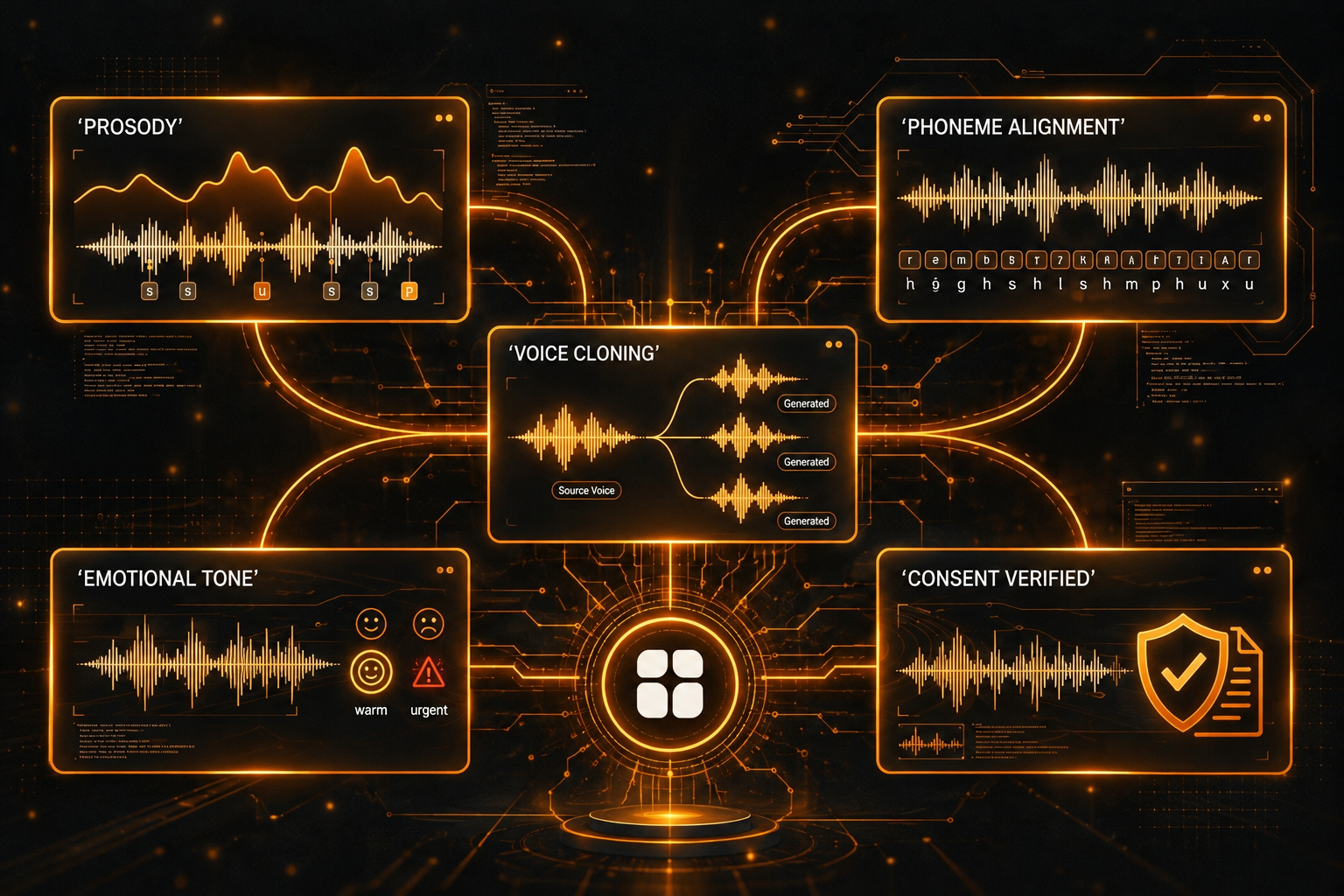
Natural-sounding TTS depends on annotation layered on top of the text-audio pairing itself:
Miss any of these layers, and the output is still technically intelligible; it just doesn’t sound like a person.
Voice cloning is TTS aimed at a single, specific voice, and that narrower target raises the bar on data quality rather than lowering it.
That consent layer is genuinely unique to voice cloning among voice AI applications, and it’s one more reason this work can’t be treated as a generic audio-labeling task.
Prosody and emotional-tone annotation is subjective in a way that plain transcription isn’t. Two annotators can transcribe the same sentence identically and still disagree on where the stress falls or how “urgent” the tone actually is. Without native-speaker fluency and consistent calibration across a labeling team, that subjectivity turns into noisy, contradictory training signal, which shows up downstream as a TTS model that sounds inconsistent from one generated sentence to the next.
A generalist, rotating annotation pool struggles here for the same reason it struggles with wake word and biometric data: continuity and domain fluency matter more than raw labeling throughput. Prosody judgments made by annotators without real linguistic grounding in the target language tend to default to flattened, generic patterns, exactly the opposite of what natural-sounding synthesis needs.
This is where Globik’s approach applies directly: native-speaker annotators working across 40+ languages, with the same multilingual data labeling services rigor extended into the specific demands of prosody, phoneme alignment, and consent-aware voice data.
Before scaling a TTS or voice cloning dataset, a few checkpoints are worth running:
TTS and voice cloning sit at the generative end of voice AI, and they expose a different set of data requirements than anything on the understanding side: prosody, phoneme alignment, emotional tone, and, for cloning specifically, a consent layer built into the data itself. Getting this right takes native-speaker fluency and consistent, specialized annotation, not generic audio labeling at volume.
TTS data needs prosody, phoneme alignment, and emotional-tone annotation on top of the text-audio pairing, since it must capture how speech sounds, not just what was said.
Prosody annotation marks pitch, rhythm, and stress patterns in speech, which is what allows generated audio to sound natural rather than flat or robotic.
Voice cloning targets one specific speaker, so errors in speaker-identity labeling or limited emotional range directly corrupt the accuracy of that individual clone.
Voice cloning replicates a real person’s identity, so consent and provenance need to be documented as part of the dataset itself, not handled separately from labeling.
Prosody judgments are subjective and require genuine language fluency; without it, annotators default to flattened patterns that produce inconsistent, unnatural-sounding speech.