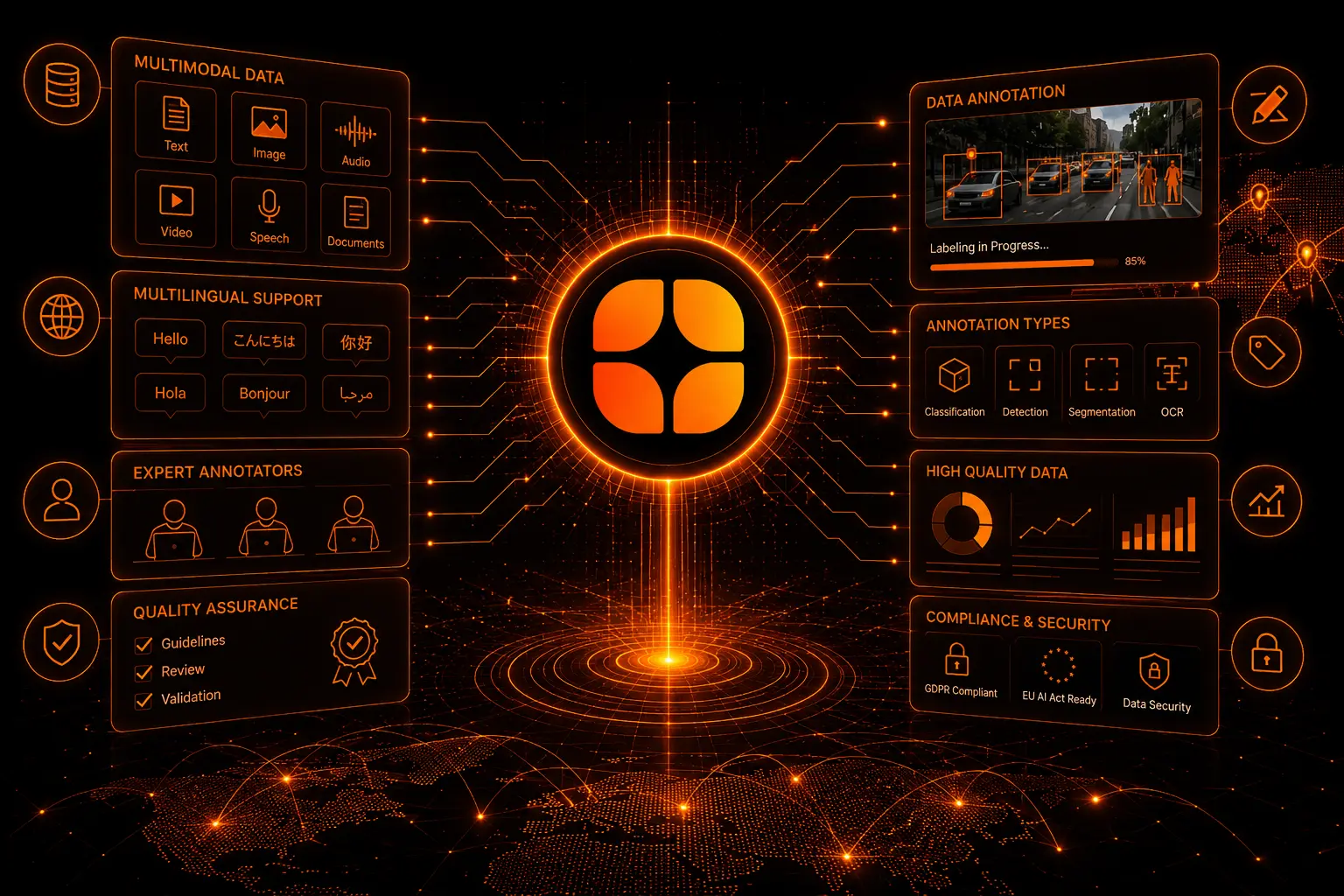
Multilingual data labeling services are annotation services that label AI training data, text, audio, images, or video, across multiple languages, using native-speaking annotators with genuine linguistic and cultural fluency in each target language, rather than a single language translated outward. They power global AI products, from customer service chatbots to voice assistants to content moderation systems, that need to actually understand and respond correctly across the languages their real users speak, not just their primary development language.
This guide answers the specific questions organizations ask when evaluating whether they need multilingual data labeling, and how to choose the right provider for it.
Text annotation across multiple languages. This includes intent classification, entity recognition, sentiment analysis, and translation quality assessment, all performed natively in each target language rather than through a single English-language guideline applied via translation.
Audio and speech annotation across languages and dialects. This covers transcription, speaker identification, and audio classification, accounting for accent variation, regional dialect, and language-specific pronunciation patterns within each language.
Multilingual conversational and dialogue annotation. For chatbots and voice assistants, this includes labeling how context, tone, and intent should be understood across different languages, including code-switching, where speakers naturally blend two languages within a single conversation.
Image and video annotation with multilingual text elements. This covers tasks like optical character recognition and content labeling for visual content that includes text, signage, or captions across multiple languages.
Cross-lingual and translation-specific annotation. This includes evaluating machine translation quality, labeling parallel text corpora, and assessing whether meaning, not just literal words, has been preserved accurately across a language pair.
Translation preserves words. Native annotation preserves meaning and context. A literal translation of an English-language labeling guideline into another language can be grammatically correct while still missing the idiom, tone, and cultural context that a genuinely native annotator would apply automatically.
Native annotation captures code-switching and mixed-language patterns. Real multilingual speakers frequently blend languages within a single sentence or conversation, particularly in informal or spoken contexts. Translation-based approaches assume a single source and target language, which breaks down entirely for this kind of naturally mixed input.
Native annotation reflects regional and dialectal variation. The same language can carry meaningfully different vocabulary, phrasing, and connotation across different regions and countries. A single, standardized translation flattens this variation, while native, regionally grounded annotators capture it accurately.
Native annotation avoids introducing translation-layer errors. Every additional translation step introduces the possibility of subtle meaning drift. Annotating natively in the target language, rather than annotating a translated version of source-language guidelines, removes this compounding error risk entirely.
Global products need to work correctly for every user, not just the primary market. An AI product built and tested primarily in one language often performs noticeably worse for users in other languages if the underlying training data wasn't built with genuine multilingual coverage from the start.
Customer expectations for non-English support are rising. Users increasingly expect AI-powered products, from customer service to voice assistants, to understand and respond naturally in their own language, not force them into a secondary, English-first experience.
Regulatory and market requirements increasingly demand local-language support. In many markets and industries, providing services and support in local languages isn't just a competitive advantage; it's an expectation tied to accessibility and, in some sectors, direct regulatory requirements.
Low-resource languages need deliberate investment to be represented at all. Many widely spoken languages remain underrepresented in existing digital text and AI training data. Without deliberate multilingual data labeling investment, AI products can end up serving only the world's highest-resource languages well, leaving a large share of potential users underserved.
Native-speaker annotators with real regional grounding, not just language fluency. The distinction between someone who speaks a language and someone who's genuinely embedded in its regional and cultural context matters enormously for the quality of the resulting labels.
Coverage across a genuinely broad range of languages, not just the largest few. True multilingual capability means meaningful coverage across the full range of languages a product actually needs to serve, not concentration on the two or three most commercially convenient options while treating the rest as an afterthought.
Explicit handling of code-switching and mixed-language input. A provider's guidelines and annotator training should treat mixed-language patterns as a core part of the task, not an edge case to be normalized away or ignored.
Consistency measurement across languages, not just within a single language. Metrics like inter-annotator agreement need to be tracked and maintained across each language independently, since consistency achieved in one language doesn't automatically transfer to another.
Domain-specific expertise combined with language expertise. For specialized applications, healthcare, legal, financial, annotators need both genuine language fluency and relevant domain knowledge, since a native speaker without subject-matter expertise can still mislabel specialized content.
Data residency and governance appropriate to the target markets. For products deployed in regions with specific data protection or sovereignty requirements, a genuinely capable multilingual provider needs to account for where data is processed and stored, not just which languages it can label.
Ask which specific languages and dialects the vendor genuinely covers with native annotators, rather than accepting a general claim of broad multilingual capability without specifics.
Ask how the vendor handles code-switching and regional dialectal variation within the languages relevant to a specific project.
Request language-specific consistency data, such as inter-annotator agreement scores broken out by language, rather than a single aggregate quality metric across all languages combined.
Ask about domain expertise availability within each relevant language, particularly for specialized, high-stakes applications where language fluency alone isn't sufficient.
Clarify data processing location and governance practices for the specific markets a product will actually serve, particularly where data residency or sovereignty requirements apply.
Global customer service and conversational AI, where chatbots and voice assistants need to understand and respond naturally across every language a company's customer base actually speaks.
E-commerce and retail, where product search, recommendations, and customer support need to function accurately across the languages of a company's international markets.
EdTech, where AI tutors and learning tools need genuine native-language support to serve students who don't primarily learn in a single global language.
Healthcare and public services, where accurate multilingual understanding can directly affect access to critical information and services for non-native speakers.
Media and content moderation, where platforms operating across many countries need multilingual annotation to accurately moderate and classify content at a genuinely global scale.
Multilingual data labeling services exist because genuine language coverage in AI can't be achieved by translating a single-language dataset outward. It requires native-speaking annotators with real regional and cultural grounding, working across a genuinely broad range of languages, with the same rigor around consistency, domain expertise, and quality measurement that any serious annotation effort requires. For organizations building AI products meant to serve genuinely global or linguistically diverse user bases, the quality of multilingual data labeling is what actually determines whether the product works well for everyone it's meant to serve, or only for users who happen to share the language the system was originally built and tested in.
They're annotation services that label AI training data across multiple languages using native-speaking annotators with genuine linguistic and cultural fluency in each language, rather than translating a single-language dataset into other languages.
Translation preserves words but often loses meaning, tone, and cultural context, and it can't handle code-switching, where speakers naturally blend two languages within a single conversation. Native annotation captures this nuance directly, without introducing an additional translation-layer error risk.
Code-switching refers to blending two or more languages within a single sentence or conversation, a common pattern in everyday multilingual speech. It matters because annotation processes built around a single source language can't accurately handle this kind of naturally mixed input.
Because an AI product trained primarily in one language often performs noticeably worse for users of other languages, and genuine multilingual data labeling is what ensures the product actually understands and responds correctly across every language its real users speak.
Native-speaker annotators with real regional grounding, genuinely broad language coverage, explicit handling of code-switching, language-specific consistency measurement, domain expertise where relevant, and appropriate data governance for the target markets.