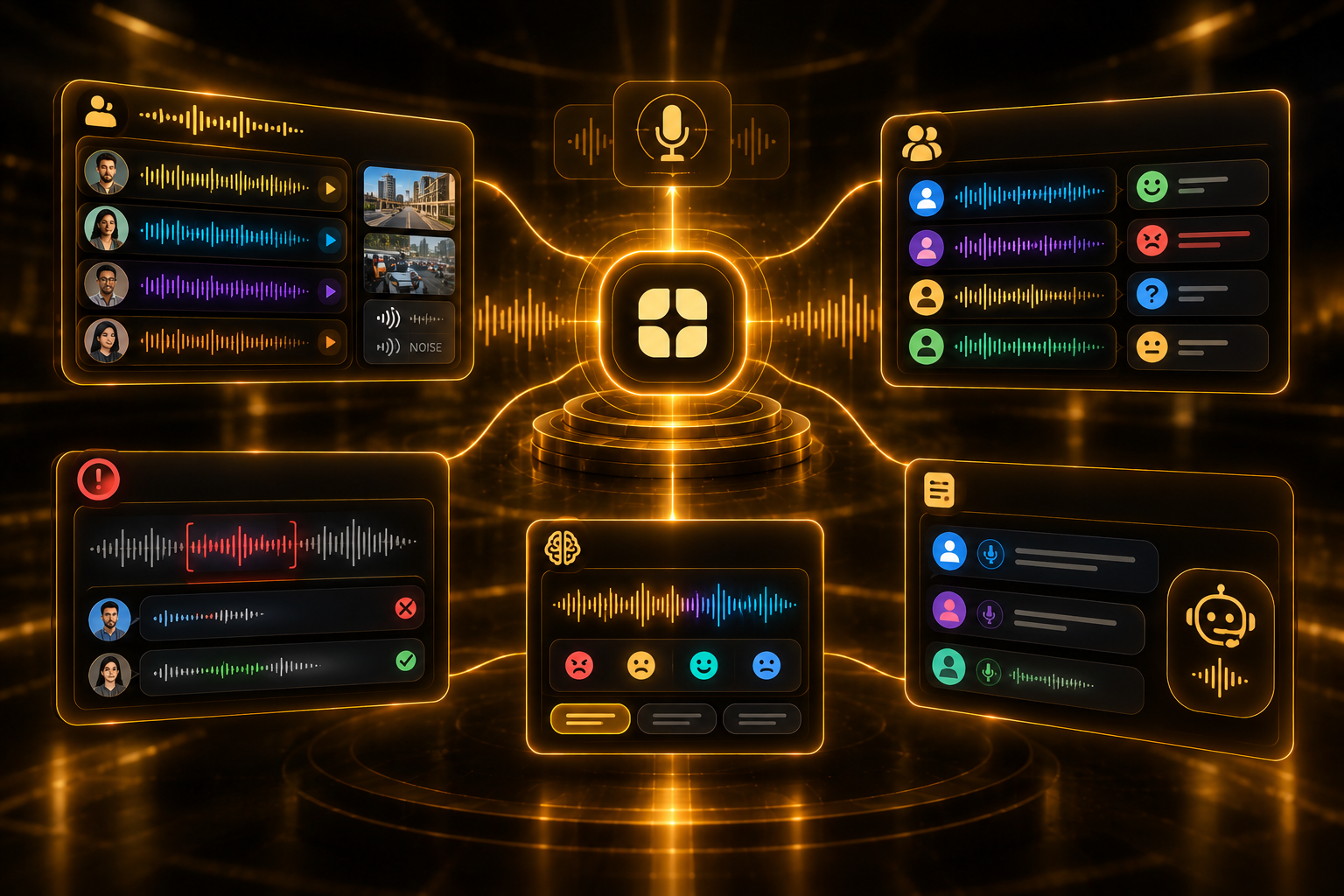
A voice AI model doesn’t announce when it was trained on bad data. It just quietly misfires: a dropped call, a misrouted complaint, an assistant that keeps asking a customer to repeat themselves. By the time anyone traces the problem back to its source, it’s usually sitting in the audio data itself: raw recordings that were never properly annotated, or annotations that looked complete without actually being correct.
This is a different problem from a model simply underperforming on a benchmark. It’s about specific, visible failures that show up in front of real users and real customers, each one traceable to a specific gap in how the underlying audio was labeled.
Before annotation even starts, the raw audio itself sets a ceiling on what’s possible. Audio collected without enough accent and dialect diversity produces a model that performs well in testing and then struggles the moment it meets a real, varied user base. Audio collected only in quiet, controlled conditions produces a model that falls apart on a real phone call with background noise, overlapping speech, or a poor connection.
No amount of careful annotation afterward can fully compensate for raw data that didn’t represent the real conditions a model will actually face. If the raw data itself is narrow, the work built on top of it inherits that same narrowness, no matter how carefully it’s labeled. This is why the quality conversation has to start before a single label is ever applied, with how representative the underlying audio collection actually is.
Even with solid raw data, weak annotation quality introduces its own specific failures, each with a direct, visible consequence once the model reaches production.
Misheard commands from inconsistent transcription: When transcription isn’t validated against real native-speaker judgment, especially for accents or regional dialects, the errors aren’t random. They’re systematic: the same words or phrases getting misheard the same way repeatedly, which means a voice assistant doesn’t just make occasional mistakes; it reliably fails specific users every single time they interact with it.
Wrong speaker attribution from weak diarization: If speaker boundaries aren’t carefully labeled, a system can merge two different speakers’ words into one garbled line, or attribute one person’s statement to someone else entirely. In a customer service call, this can mean a complaint gets logged as coming from the wrong person, or an agreement gets attributed to the wrong party, a mistake with real consequences if that record is ever relied on later.
Missed escalations from inaccurate sentiment labeling: If sentiment annotation is inconsistent, a model can fail to recognize genuine frustration or urgency in a customer’s voice, treating a tense, escalating call the same as a routine one. The practical cost here is direct: a customer who needed to be escalated to a human agent instead gets kept in an automated loop, and the frustration that should have triggered a handoff never gets acted on.
Misread intent from shallow labeling: Audio that’s transcribed accurately but only labeled at a surface level, without real attention to what the speaker actually wants, produces a system that technically “understood” the words but still responds incorrectly, because it never captured the underlying request behind them.
A single bad label is a minor error. The same systematic gap repeated across thousands of hours of training audio becomes a structural weakness in the model itself. If transcription consistently struggles with one regional accent, that’s not an occasional miss; it’s a model that reliably underperforms for an entire group of users, every time, in a way that’s invisible until someone goes looking specifically for it.
This is also why these problems are hard to catch late. A model trained on inconsistently annotated audio can still post strong aggregate accuracy numbers, because the errors concentrate in specific pockets, a particular accent, a specific type of overlapping conversation, rather than spreading evenly across the whole dataset. The aggregate score looks fine. The actual experience for a meaningful slice of real users does not, and that gap between the reported metric and the real experience is exactly where trust in a voice AI product quietly erodes.
This mirrors a pattern that shows up across every high-stakes AI application, covered in more depth in our piece on the real cost of commodity labeling: a model is only as reliable as the ground truth it was trained on, and problems concentrated in a thin, specific slice of data are often the hardest ones to catch through aggregate testing alone.
Treat raw data collection as the first quality checkpoint, not an afterthought. If the audio collected doesn’t reflect real accents, real background noise, and real multi-speaker conditions, no annotation process downstream can fully fix that gap later.
Validate transcription against real native-speaker review, not just an aggregate word-error rate. A low average error rate can still hide a model that consistently fails a specific accent or dialect, and that gap only becomes visible when you specifically test for it.
Treat diarization, sentiment, and intent labeling as distinct quality checkpoints, not an afterthought layered loosely on top of transcription. Each one has its own specific failure mode and its own specific, visible consequence when it’s done poorly.
Test for failure in the pockets that matter, not just the aggregate. A strong overall accuracy score can still mask a model that reliably fails a particular accent, speaker combination, or emotional tone, and that’s exactly the kind of gap a generic benchmark won’t surface on its own.
Ask any annotation partner how they verify consistency, not just completion. A dataset where every clip has a label isn’t the same as a dataset where every label is actually correct and consistent across annotators.
Voice AI failures in production rarely look like random noise. They look like a specific accent that’s consistently misheard, a specific kind of overlapping call that gets garbled, a specific tone of frustration that never gets flagged. Each of these traces back to a specific, identifiable gap in how the raw audio was collected or annotated. Getting the data right the first time, with real native-speaker validation and deliberate, layered annotation, is what prevents these failures from ever reaching a real customer in the first place.
It produces systematic, repeatable failures, like consistently misheard accents or missed escalations, rather than random, occasional errors.
Not fully. If the raw audio lacks real accent, noise, or multi-speaker diversity, annotation built on top of it inherits the same gaps.
Because errors concentrate in specific pockets, like one accent or one speaker pattern, not spread evenly, so aggregate accuracy scores can hide them.
Inconsistent sentiment labeling, which causes a model to miss genuine frustration or urgency in a customer’s voice.
By testing specific accent, speaker, and tone pockets directly, not relying on a single aggregate accuracy score across the whole dataset.