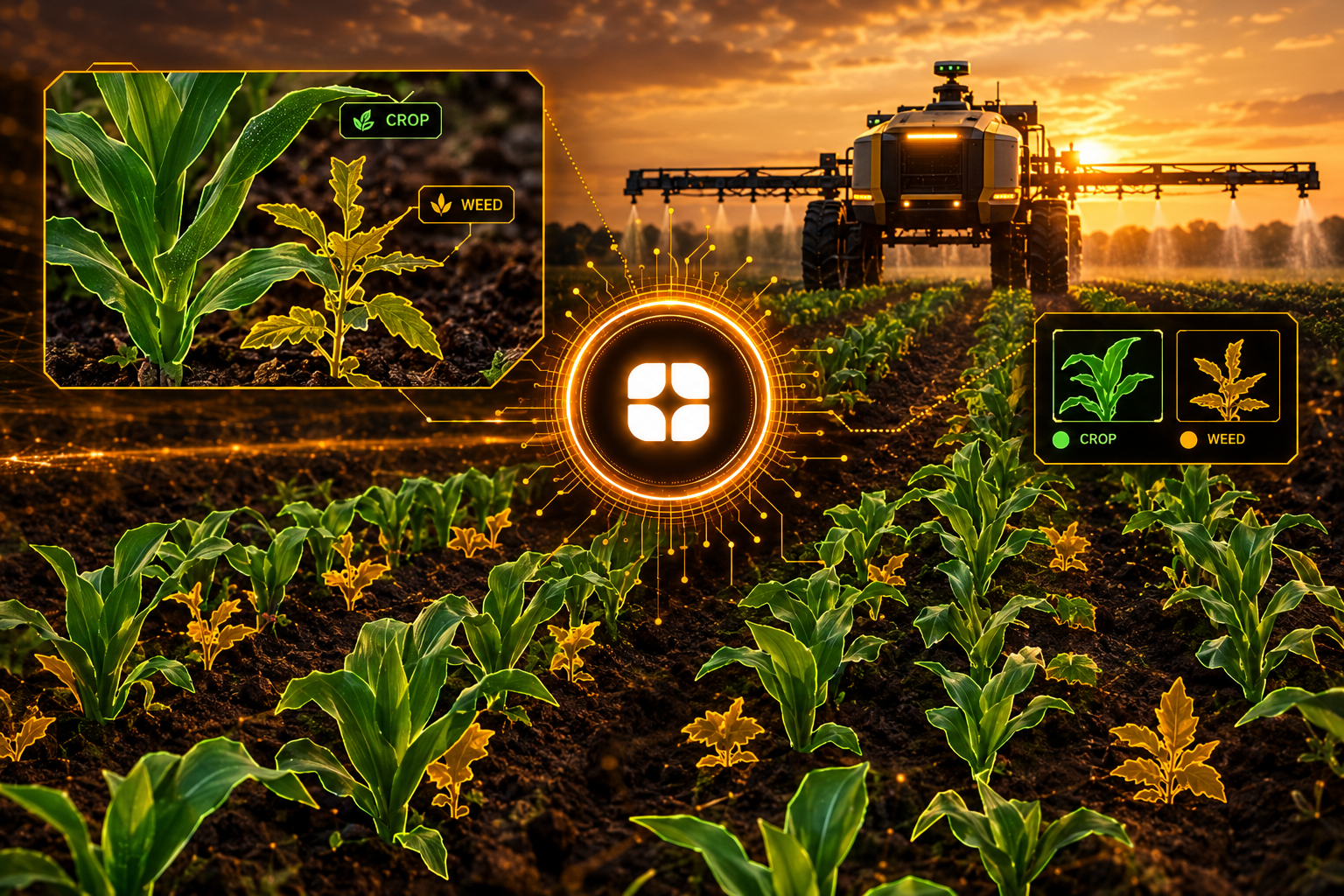
Spraying a whole field to reach a few weeds wastes product and puts chemicals where they are not needed. Precision spraying tries to fix that. Cameras on a sprayer or a field robot look at the plants below, a model decides which ones are weeds, and individual nozzles fire only where needed.
The model makes that call from what it learned in training. Weed and crop segmentation is the labeling work behind that decision. This post explains what the labels must capture, why the edge of a mask matters, and why plant knowledge makes the data better.
The model's job is not simply to say "weed present." It has to say where each weed is, how large it is, and how close it sits to the crop. A nozzle covers a defined strip of ground, so a rough location is not enough.
That is why weed detection annotation for spraying usually relies on segmentation masks, which outline each plant pixel by pixel.
A bounding box around a thin grass weed contains mostly soil. A box around a crop seedling with a weed growing against it contains both plants. In both cases, the label tells the model that soil or crop is part of the weed.
Masks fix this, but they bring their own demands:
The quality of plant segmentation masks shows up directly in the field. When the mask edge is loose, the spray zone is loose too.
The hardest cases are weeds that closely resemble the crop. A grass weed in a cereal field looks very much like the crop it grows beside. Plants left over from a previous crop, which sprout in the next one, can match the new crop almost leaf for leaf.
A generic annotator tends to label everything similar as crop, or everything unusual as weed. Either choice teaches the model something false.
People who know plants rely on small cues: leaf shape, how leaves attach, surface texture, row position, and spacing. Those cues need to be written into the guidelines, with image examples, so every annotator applies them the same way.
A project must decide how finely to name weeds. A single "weed" class is simple. It tells the model to spray anything that is not crop. But some systems treat different weed types differently, which means the labels must separate them.
Common ways to group weeds include:
More classes mean more chances for disagreement. If annotators cannot reliably tell two classes apart in the images, the classes should be merged, or a "weed, type uncertain" label should exist. A clean, coarser label set is better than a detailed one that nobody applies consistently.
Field images are messy. Soil cracks, straw, dead stalks, and stones can all look like plant parts. Shadows from the sprayer boom or from taller plants can darken part of a leaf or draw a false edge across it.
Movement adds another problem. A camera on a moving sprayer captures blur, and a blurred leaf has no clear edge to trace. Annotators need rules for what to do when the boundary cannot be seen: mark it as uncertain, label what is visible, or exclude the frame.
Not every unwanted plant is a spraying target. Some are tiny, some sit far from the crop, and some are too close to the crop to spray safely. The label guidelines should reflect the farm's decision rules, not the annotator's opinion.
Questions the guidelines should answer include:
An "unknown plant" label is useful here. It lets annotators admit uncertainty, and it lets the team decide later how the model should treat those cases.
The two errors in this field do not cost the same. A weed that goes unsprayed keeps growing and competes with the crop. A crop plant that gets sprayed by mistake can be damaged or lost.
Labels should reflect that. When a plant is ambiguous, the guidelines should say which way to lean, and reviewers should check for both kinds of errors, not just missed weeds.
People who work with crops and weeds read these images differently. They can tell a grass weed from a young cereal plant, know which volunteer plants look like the crop, and understand why a spray strip near a seedling needs a careful edge. They also write the rules that keep a large team consistent.
This matches Globik's approach of using verified domain experts for work that depends on judgment. For precision spraying AI training data, a reviewer who can identify the plants in front of them keeps the dataset free of quiet mistakes.
Before a weed and crop labeling project starts, a team can settle five things:
Precision spraying works only if the model can separate weeds from crop at the edge of a leaf. That depends on tight masks, clear look-alike rules, and labels that match how the farm decides what to spray. For another example of annotation guided by field knowledge, see our guide on livestock monitoring annotation: labeling behavior, body condition, and gait on a real farm.
It is the pixel-level labeling of images so AI can separate weeds, crop plants, and soil in a field.
Masks follow the plant's real shape, so spray zones can be precise instead of covering soil or neighboring crop.
Some weeds closely resemble the crop, so annotators need written visual cues and examples to tell them apart.
It lets annotators record uncertainty honestly, so the team can decide later how the model should treat those plants.
They can identify plants correctly and write the rules that keep masks and classes consistent across a large dataset.