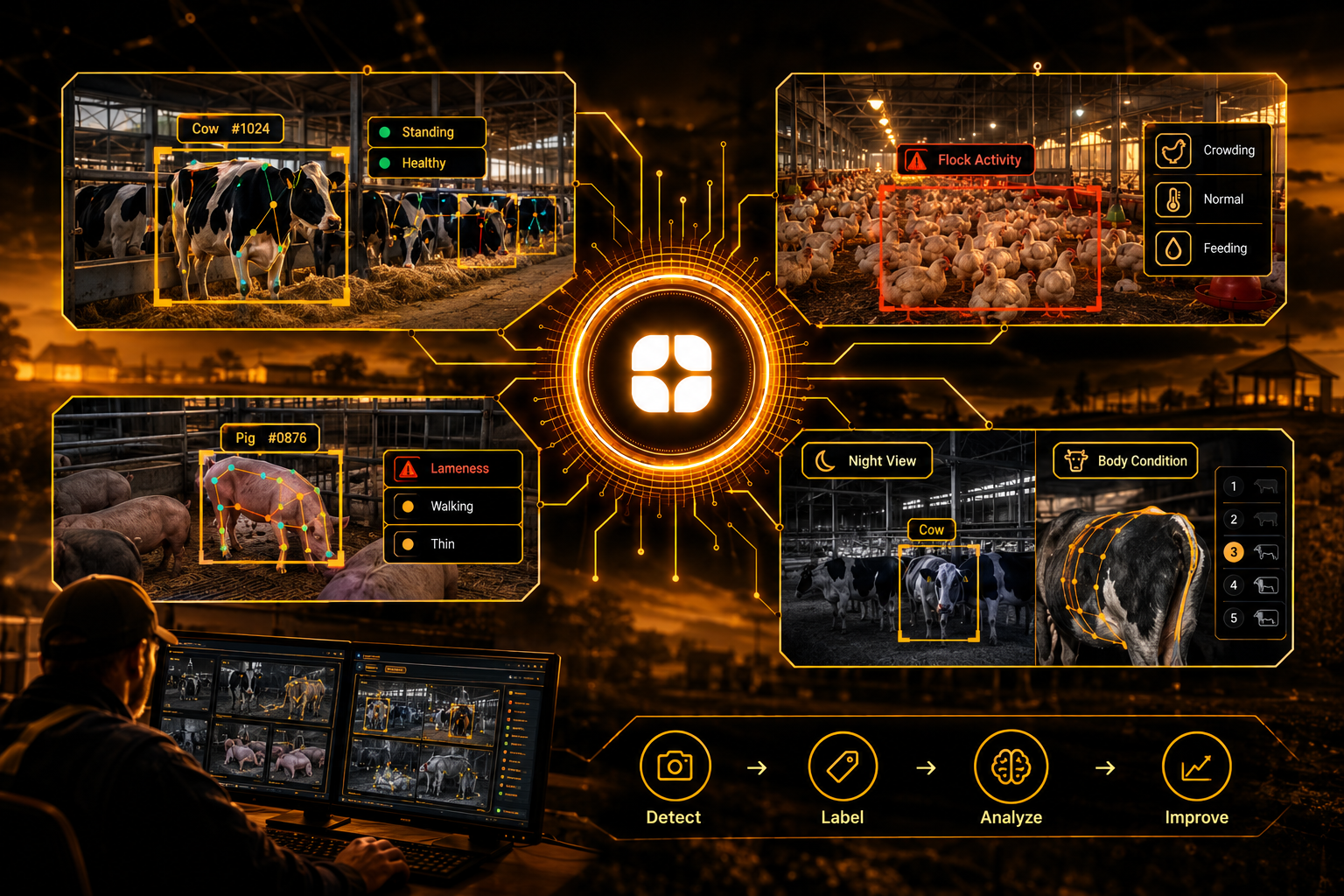
A dairy barn, a poultry house, and a pig unit all share one problem. There are far more animals than people, and the signs of trouble are small. A cow walks a little stiffly, or birds bunch up in one corner.
Cameras can watch all of this around the clock, and computer vision can flag what a person would miss. But the model only learns what the labels teach it. Livestock monitoring annotation is the work of turning farm footage into labels that capture behavior, condition, and movement correctly. This post explains what that work involves and why it needs people who know animals.
Most projects combine a few layers of labeling:
Together these power livestock computer vision data for tasks like early illness alerts, feeding checks, and herd or flock counts. Each layer has its own labeling rules, and each fails in its own way when those rules are vague.
Farm footage is hard in ways that a street scene is not. Animals stand close together, overlap each other, and lie in heaps. Many look almost identical, particularly within a single breed.
An overhead camera sees backs and heads, not faces or legs. A box drawn around two overlapping cows teaches the model to see one animal.
Annotators need rules for partly hidden animals, for animals touching, and for ones too far from the lens to judge. They also need a way to keep an individual animal's identity across frames when it walks behind another one. Without these rules, counts drift and tracking breaks.
A single frame rarely shows behavior. A cow standing still could be resting, waiting at a gate, or ill. What separates these is what happens before and after, and for how long.
For this reason, animal behavior labeling works on video segments, not isolated images. Annotators mark when a behavior starts and ends, and the guidelines set minimum durations. A few seconds at a feeder may be a visit, while a long stay is a meal. The line between them has to be written down, or two annotators will draw it in different places.
Some of the most useful labels on a farm are scores. Two common ones are body condition, which reflects how much fat cover an animal carries, and locomotion, which reflects how well it walks.
These scores are visual judgments made against a written scale. Body condition is read from the shape of the hips, back, and tail area. Lameness shows in gait: an arched back, short strides, or a nodding head. Both depend on seeing the animal from the right angle, and both are easy to misjudge without training.
Careful body condition score labeling therefore needs the following:
Scores are judgments, not facts that sit in the image. If two people score the same cow differently, the model learns to split the difference.
Birds are a different problem. A poultry house can hold thousands of nearly identical animals, and following one bird across footage is often impractical.
The labeling approach shifts from the individual to the group. Instead of tracking a bird, annotators label how the flock is distributed, whether birds are bunching or spreading out, and how active they are.
The guidelines should say which level each label applies to. A label meant for the flock should not sit on one bird, and the reverse is equally confusing.
Farms are not well-lit studios. Barns are dim at night, dusty by day, and often lit by uneven bulbs. Many systems use infrared at night, where animals look like gray shapes without color or texture.
Each condition changes how a label should be applied. A mark that is clear in daylight, such as a dirty coat or a patch of lighter skin, may disappear under infrared. Guidelines should say which labels can be applied in each lighting condition and which cannot, so the model does not learn to see things that are not there.
Annotators also need permission to mark a frame as unusable.
A model trained on one type of farm does not carry over to another without work. Dairy cattle, beef cattle, pigs, sheep, and poultry move differently, rest differently, and live in different spaces. Free-roaming animals in a paddock look different from animals in stalls or pens.
Labeling guidelines should be written for the species and the housing in front of the camera.
People who work with animals read this footage differently. They know what a healthy gait looks like, so they spot the one that is off. They know when standing still is normal and when it is a concern.
They also write better rules. Specialists define what each score means, how to treat uncertain frames, and where the line between behaviors sits. This matches Globik's approach of using verified domain experts for work that depends on judgment, where a generalist would be guessing.
Before a livestock labeling project starts, a team can settle five things:
Good livestock monitoring depends on labels that capture behavior over time, scores that people apply the same way, and rules that fit the species and the barn. For the wider case for farm-level data, see our guide on why agriculture AI needs ground-level data, not satellite averages. When the footage comes from a real barn, livestock monitoring annotation works best in the hands of people who know the animals.
It is the labeling of farm images and video so AI can recognize animals, behaviors, body condition, and signs of illness or injury.
A single frame rarely shows what an animal is doing, so annotators mark when each behavior starts and ends.
It is the visual scoring of how much fat cover an animal carries, using a written scale with image examples.
Animals overlap, look alike, and are often seen from above, so annotators need rules for hidden, touching, and distant animals.
They can read gait, condition, and behavior correctly, and they write the scoring rules that keep labels consistent.