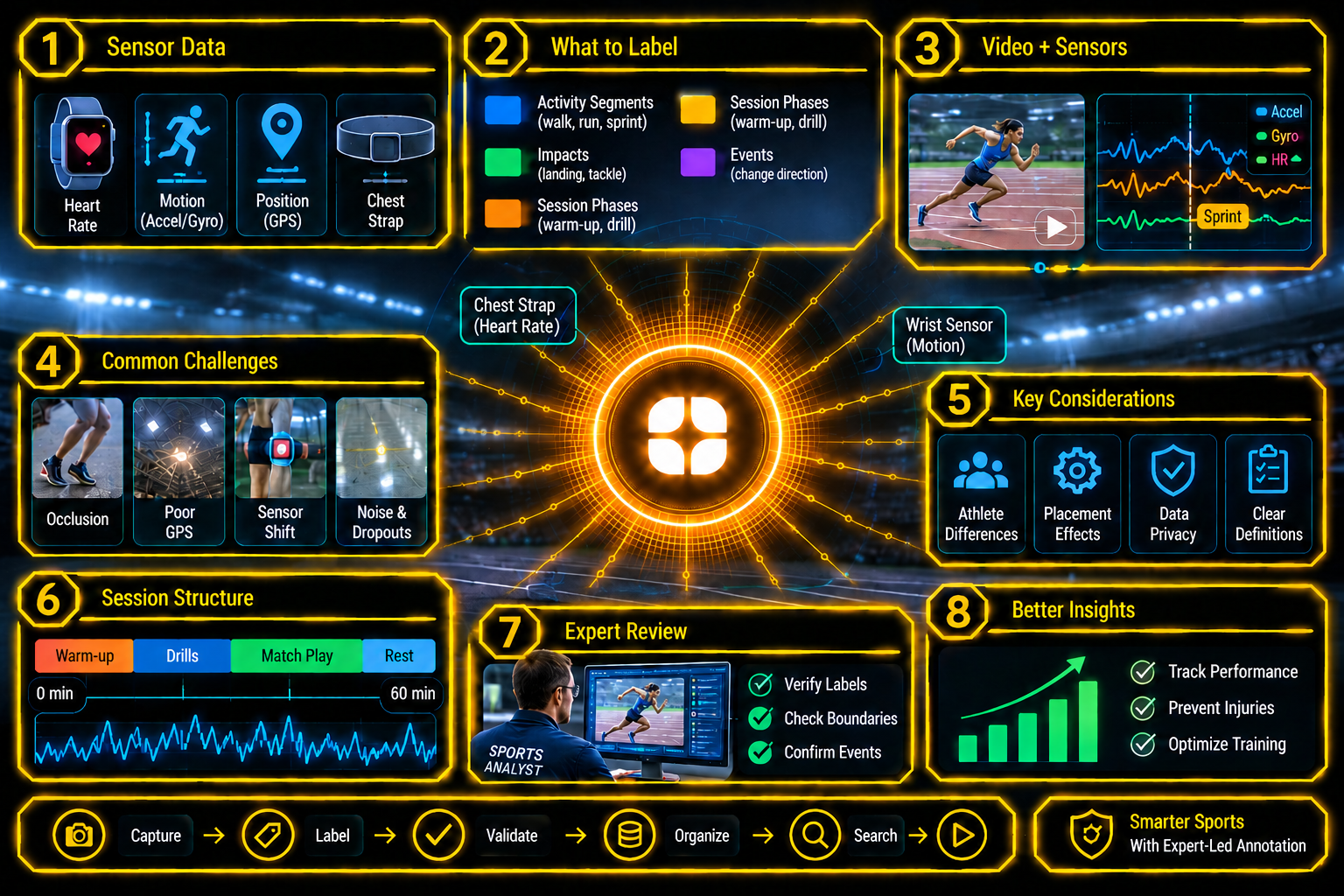
Professional teams, academies, and fitness platforms now put small sensors on athletes: in a vest, on a wrist, in a shoe, or on a chest strap. The devices record movement, position, and heart rate many times a second. A single training session can produce a huge stream of numbers.
Coaches and sports scientists do not want numbers. They want to know when the sprints happened, how hard the landings were, and how a session was structured. AI can answer those questions, but only if it learns from sensor data that people have labeled. Wearable sensor data labeling is the work of turning raw streams into meaningful segments and events. This post explains what the labels need to capture and why sport knowledge matters. The labels support staff decisions, and they make no medical judgments.
Most devices combine several sensors:
A wave on a motion trace does not announce itself as a sprint or a jump. The easiest way to know is to watch the session. For this reason, much sensor labeling uses synchronized video as a reference: the annotator watches the athlete and marks what the sensor trace was doing at that moment.
That only works if the two records line up in time. Sensor clocks and camera clocks drift apart, and a small offset places a label on the wrong part of the trace. Projects often use a sync event, such as a jump or a clap at the start of recording, that shows clearly in both. Guidelines should say how the offset is found and recorded, so that every label can be traced back to its evidence.
The most common label is the activity segment: a stretch of time with a name. Walking, jogging, striding, sprinting, resting, and sport-specific movements all count.
Boundaries are the difficulty. Movement does not switch cleanly from a jog to a sprint. It builds. A good protocol defines where a segment begins and ends, and it handles transitions: the acceleration into a run, the slowing at the end of one.
Definitions often rely on speed or intensity thresholds, and those are not the same for everyone. A pace that is a sprint for one athlete is a steady run for another. Teams should state whether thresholds are fixed or set per person, and annotators should know which.
In contact sports, teams want to find impacts. Sensors show a sharp spike, but a spike has many possible causes. Landing from a jump produces a hard jolt, and so does a tackle, a fall, or the device being dropped into a bag. An impact label should record the type of event and, where possible, the context. It should not interpret the effect on the athlete. Reviewing such events and deciding what follows belongs to the medical and coaching staff, and the labels exist to bring those events to their attention.
The same movement looks different depending on where the device sits. A sensor on the chest follows the trunk. One on the wrist swings with the arm.
Labels should record the placement for every session, and annotators should be shown examples from each. When a device clearly moved during a session, that stretch should be flagged. A label made on a displaced sensor teaches a model something that is not true of the athlete.
Real sensors fail in ordinary ways. Satellite signals weaken indoors, under stadium roofs, and between tall buildings, and positions jump or freeze. A heart rate strap loses contact when it gets sweaty or slips.
A reliable project labels these problems and does not hide them. Segments with poor data get an "unreliable" label, and gaps are marked as gaps, not filled in silently.
Bodies and styles differ. Height, weight, fitness, running form, and sport all change what a sensor trace looks like. Heart rate zones depend on a person's own range, not a universal number.
Labels therefore need context about the athlete: the role or position, the sport, and any personal settings used.
Beyond individual movements, coaches look at the shape of a session: warm-up, drills, match play, and rest. Guidelines should follow the team's own terms.
Movement and heart data describe a person's body. They are sensitive, even when no one mentions a diagnosis. Projects should settle consent, who can see raw and labeled data, how long it is kept, and whether athletes can be identified in the dataset.
Sports scientists, strength and conditioning coaches, and performance analysts read these traces differently. They know what a sprint, a landing, and a change of direction look like in the data, understand how placement affects readings, and recognize when a pattern is the athlete and when it is the device. They also write the rules that keep a team consistent: the segment definitions, the thresholds, the impact categories, and the handling of unreliable data.
This matches Globik's approach of using verified domain experts for work that depends on judgment. For sports analytics AI training data, that knowledge is what turns raw streams into labels a coaching staff can use.
Before a wearable labeling project starts, a team can settle five things:
Wearable AI works when labels line up with video, define segments and impacts clearly, record placement and athlete context, and admit when the data is poor. For the video side of the same work, see our guide on sports video annotation. Strong athlete activity recognition data depends on people who know how athletes move.
Wearable sensor data labeling is the marking of motion, position, and heart rate streams from athletes with activities and events so AI can recognize them.
Video is used because a sensor trace alone does not say what the athlete was doing, so annotators check the trace against footage.
Sprint thresholds differ because speed and effort depend on each athlete's body and fitness, so teams must decide whether limits are fixed or personal.
Sensor placement changes what a device records, so labels must note where it was worn and flag sessions where it moved.
Athlete sensor data describes a person's body, so consent, access, and retention rules must be set before labeling begins.