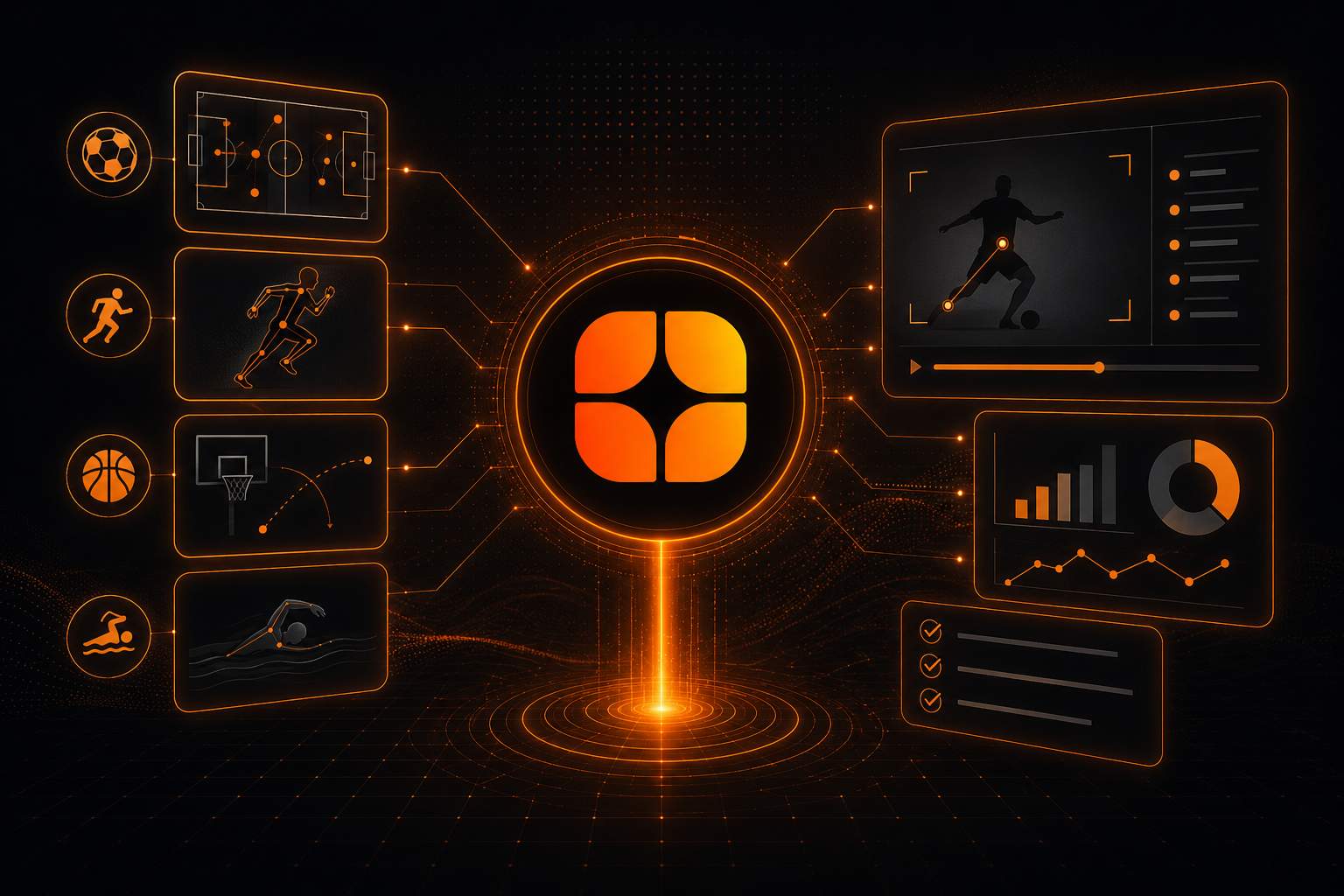
Sports video annotation is the process of labeling footage of athletic competition, players, ball or equipment position, actions, and events, so computer vision models can learn to automatically track, analyze, and interpret sports video. It's the training data layer behind automated player tracking, real-time statistics generation, broadcast enhancement graphics, and performance analytics platforms used by professional teams, leagues, and sports media companies.
This guide answers the specific questions teams and organizations actually have when evaluating what sports video annotation involves and what it takes to do well.
Sports video annotation typically combines several distinct labeling tasks applied to the same footage, since a single frame of game video usually needs to be understood across multiple dimensions simultaneously.
Player detection and tracking. Identifying and following individual players across a sequence of frames, maintaining consistent identity even as players move, overlap, or temporarily leave the frame.
Player identification. Associating a tracked player with a specific jersey number, name, or team, which requires reading jersey numbers accurately even under motion blur, unusual angles, and partial occlusion.
Ball or equipment tracking. Following the position of the ball, puck, shuttlecock, or other primary game object across frames, often the fastest-moving and most difficult element to track reliably.
Action and event recognition. Labeling specific actions and events as they occur, a shot, a pass, a tackle, a foul, a goal, tied to precise timestamps within the video.
Pose estimation. Tracking the specific body position and joint locations of players, used heavily in performance analysis, injury risk assessment, and biomechanical evaluation.
Formation and tactical annotation. Labeling team shape, positioning patterns, and tactical structures at a given moment, which supports higher-level tactical analysis beyond individual player or ball tracking.
Field, court, or rink calibration. Establishing a consistent spatial reference frame for the specific playing surface, which every other annotation layer depends on to translate pixel positions into meaningful real-world coordinates.
Fast, unpredictable motion. Players and game objects move quickly and change direction suddenly, making consistent frame-to-frame tracking considerably harder than in many other video annotation contexts involving slower, more predictable movement.
Frequent occlusion. Players regularly overlap, cluster together, and block each other from the camera's view, particularly in sports with dense player groupings, requiring annotation approaches that can maintain identity through these occlusion periods rather than losing track entirely.
Camera motion and multiple angles. Broadcast and analysis footage often involves panning, zooming cameras, and multiple simultaneous camera angles covering the same play, requiring annotation that stays consistent across shifting perspectives rather than assuming a single, fixed viewpoint.
Visually similar players. Teammates in matching uniforms can look extremely similar to a generic annotation process, requiring careful attention to jersey numbers, subtle physical differences, and positional context to maintain accurate identification.
Sport-specific rules and terminology. Correctly labeling an event as a specific foul type, a particular formation, or a rules-relevant action requires understanding the specific sport's rules and conventions, which vary significantly not just between different sports but sometimes between different leagues within the same sport.
High volume, continuous footage. A single match or game generates hours of continuous footage, and meaningful annotation, especially for granular action and event labeling, needs to cover this volume comprehensively rather than sampling only isolated highlight moments.
Automated statistics and analytics platforms. Systems that automatically generate player and team statistics, distance covered, pass completion rates, shot accuracy, depend entirely on accurately annotated tracking and event data to train the underlying models.
Broadcast enhancement graphics. Real-time overlays showing player speed, ball trajectory, or formation visualizations during live broadcasts rely on models trained to detect and track these elements accurately and quickly enough for live use.
Performance and injury risk analysis. Coaching staff and sports science teams use pose estimation and movement pattern data, trained on carefully annotated footage, to assess player workload, technique, and injury risk factors over time.
Scouting and recruitment analysis. Automated tools that help scouts and analysts evaluate player performance patterns across large volumes of footage depend on consistent, accurate action and event annotation to surface relevant, comparable data across players and matches.
Fan engagement and highlight generation. Automated systems that identify and compile highlight moments, based on recognizing specific high-value actions and events, depend on annotation trained to reliably distinguish genuinely notable moments from routine play.
Tactical analysis for coaching. Formation and tactical pattern annotation supports tools that help coaching staff analyze and visualize team shape and strategic tendencies across a season's worth of footage.
Referee and officiating support. Some sports have begun using annotated video data to train systems that assist with reviewing specific rules-relevant incidents, requiring annotation with particularly high precision given the direct impact on game outcomes.
Sport-specific domain knowledge. Annotators need to understand the specific sport's rules, common play patterns, and terminology well enough to correctly label events and actions, not just visually track motion without understanding what it actually represents.
Consistent identity tracking through occlusion. High-quality annotation maintains accurate player identity even through the frequent overlaps and occlusions common in most sports, rather than losing or confusing player tracks whenever players cluster together.
Precise temporal alignment for events. Event annotation needs to be tied to precise timestamps, not just a general indication that an event happened somewhere within a broader video segment, since downstream applications like broadcast graphics and statistics depend on this precision.
Coverage across genuinely varied game situations. Training data needs to reflect the real diversity of game conditions, different weather, lighting, camera angles, and levels of play, rather than being built primarily from a narrow set of ideal, well-lit, professional broadcast conditions.
Calibration consistency across venues. Because different venues have different field or court dimensions, camera setups, and lighting conditions, annotation and the underlying spatial calibration need to be verified and maintained consistently across the different venues a model will actually encounter.
Cross-referenced multi-layer annotation. Because player tracking, ball tracking, and event annotation all relate to each other within the same play, the strongest annotation processes connect these layers coherently, rather than labeling each independently without shared context.
Different sports create meaningfully different annotation demands. Fast-paced, continuous-play sports like soccer or hockey require sustained tracking through long periods of dense player movement and frequent occlusion. Sports with discrete, stop-start play, like American football or baseball, allow more clearly delineated play boundaries but often require more detailed formation and positional annotation at the start of each play. Individual or smaller-team sports, tennis or golf, involve less occlusion complexity but often demand more precise biomechanical and technique-focused annotation. Annotation processes need to be adapted specifically to these sport-by-sport differences rather than applying a single generic approach uniformly across every sport.
Genuine sport-specific expertise, not just general video annotation experience. Annotators need to understand the specific sport well enough to label events, formations, and actions correctly, which general video labeling experience alone doesn't guarantee.
Demonstrated ability to handle occlusion and fast motion. Given how central these challenges are to sports footage specifically, a vendor should be able to show concrete experience maintaining consistent tracking through exactly these conditions.
Precise temporal annotation capability. For any application depending on exact event timing, broadcast graphics, statistics generation, verify the vendor's annotation process supports the level of temporal precision the specific use case actually requires.
Coverage across the specific leagues, venues, or competition levels relevant to the project. A model trained primarily on one league or competition level's footage may not generalize well to another with different camera setups, player skill levels, or venue conditions.
Sports video annotation is a genuinely specialized category of video annotation, shaped by the specific challenges of fast motion, frequent occlusion, and sport-specific rules and terminology that generic video labeling approaches often aren't built to handle well. The models powering automated sports statistics, broadcast enhancements, performance analytics, and scouting tools all depend on annotation that combines genuine sport-specific domain knowledge with the technical rigor needed to track fast, cluttered, continuously moving footage accurately.
For organizations building sports AI applications, the difference between annotation that merely labels video and annotation that genuinely understands the sport being played is what determines whether the resulting model can actually be trusted for statistics, coaching decisions, or fan-facing broadcast content.
It's used to train AI systems for automated statistics generation, broadcast enhancement graphics, performance and injury risk analysis, scouting and recruitment tools, highlight generation, and tactical analysis for coaching staff.
Because sports footage involves fast, unpredictable motion, frequent player occlusion, visually similar players in matching uniforms, camera motion across multiple angles, and sport-specific rules and terminology that generic video annotation approaches aren't built to handle.
Player tracking annotation involves identifying and following individual players across a sequence of video frames, maintaining consistent identity even as players move, overlap with others, or temporarily leave the camera's view.
Pose estimation annotation tracks a player's specific body position and joint locations, which is used heavily in performance analysis, technique evaluation, and injury risk assessment by coaching and sports science teams.
Yes. Continuous-play sports like soccer or hockey require sustained tracking through dense occlusion, stop-start sports like American football involve more detailed formation annotation at play boundaries, and individual sports often demand more precise biomechanical annotation, so annotation approaches need to be adapted to each sport specifically.
Genuine sport-specific domain knowledge among annotators, consistent player identity tracking through occlusion, precise temporal alignment for events, coverage across varied real-world game conditions, and cross-referenced annotation connecting player, ball, and event layers together.