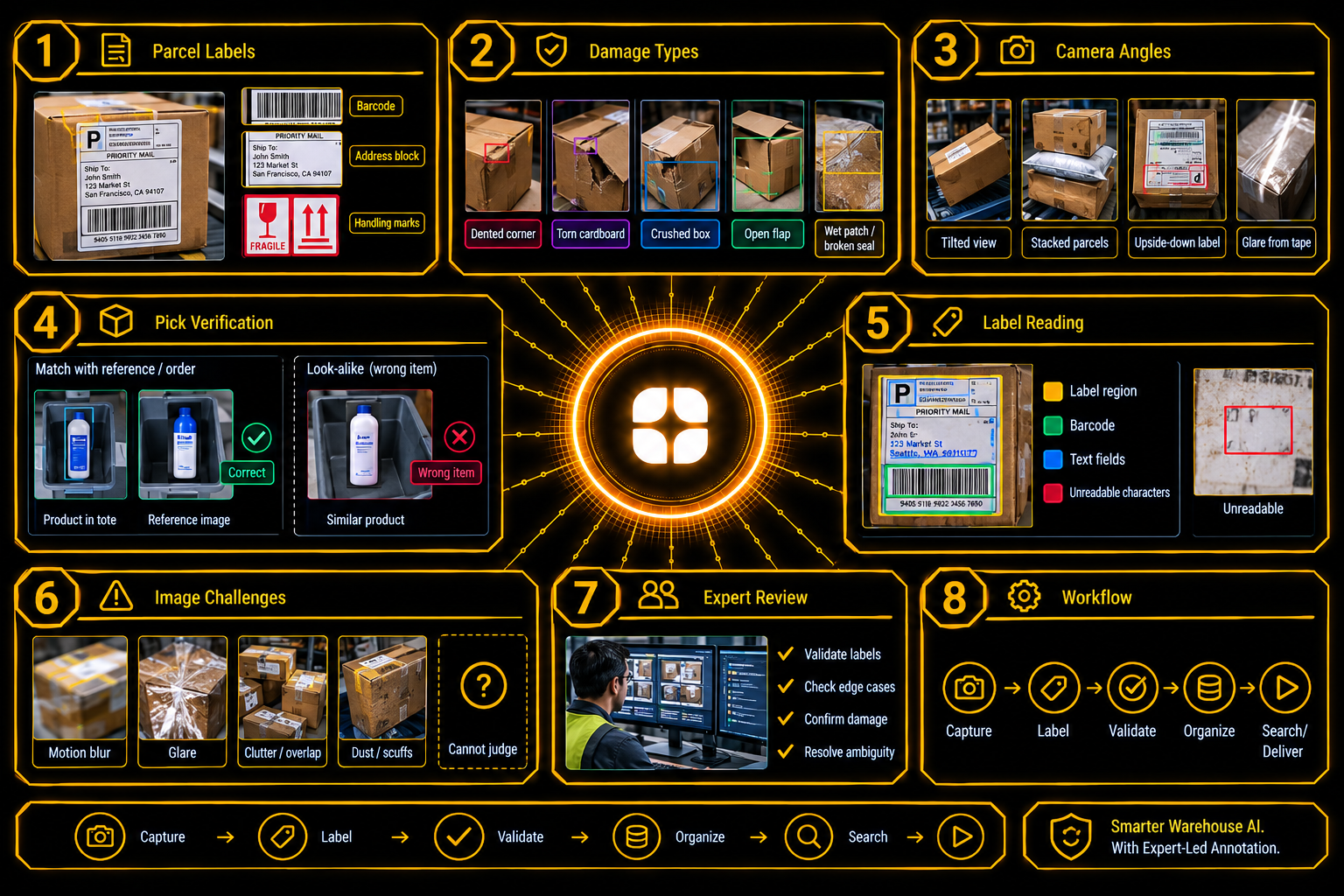
A fulfillment center moves thousands of parcels every hour. Cameras watch conveyors, packing stations, and shelves, and each image holds a question. Is the label readable? Is the box damaged? Did the worker pick the right item? People cannot check every parcel at that speed, so AI is used to help.
That AI learns from labeled images, and warehouse images are rarely clean. Good warehouse imagery annotation means labeling fast, cluttered scenes the same way every time. This post explains what the work covers, why it is hard, and what e-commerce and retail AI training data needs to get right.
Warehouse imagery is usually labeled in three areas:
Models trained on these labels support automatic sorting, damage alerts before a parcel ships, and error checks at packing stations.
A warehouse floor is busy and uneven.
Annotators need rules for images where the label or the damage cannot be judged. A “no damage” label on a hidden side of a box teaches the model a false lesson.
A shipping label holds several pieces of information in a small space. Annotators may need to mark the label itself, the barcode, the address block, and any handling marks.
Labels vary by carrier and country, and many carry several scripts. Transcription rules matter: how to record spacing, case, and unreadable characters. Because labels contain names and addresses, teams should decide early what is masked and who can view raw images. Where the task is reading text in photos, the same rules for angles, glare, and mixed scripts apply.
Damage is a judgment, and it depends on the shipper’s own standards. A small dent on a corner may be acceptable for one product and a reason to stop another.
Each damage type needs a written definition, with examples and a nearby look-alike, such as a crease versus a tear. Severity levels should follow the operator’s rules, for example pass, review, and reject. Without them, two annotators will label the same box in two ways, and the model learns the disagreement.
These two tasks look alike but fail in different ways.
In label reading, the question is “what does it say, and where?” Errors come from blur, glare, and skewed text. Reviewers check the shape of the label region and the typed content, character by character.
In damage detection, the question is “is this a defect, and how serious?” Errors come from dirt that looks like damage and from damage hidden on another side. Reviewers check class names, severity, and whether the visible view was enough to judge.
A single guide for both would blur these differences. Each needs its own examples and its own reviewers.
Pick verification asks whether the item matches the order. That sounds simple, but many products look almost the same: the same bottle in two sizes, a shirt in two colors, a cable with two plug types. Annotators need reference images and a clear note on the feature that separates look-alikes.
Hands, bags, and packaging often block the item. Annotators should have a way to mark a view as “cannot verify” instead of guessing. We cover a similar problem at checkout counters in our guide to self-checkout and fresh produce recognition annotation.
Catalogs change constantly. New packaging, seasonal items, and updated labels appear every week. A model trained on last season’s boxes may fail on this season’s.
Teams should record the date and source of each image and have a plan for adding new products. Rare items and new items need extra examples, since the model has seen few of them.
Most parcels are fine, so damaged ones are rare. Teams should count examples per damage type and collect more of the thin ones early. They should also keep hard cases in a separate group for testing, so scores are not inflated by easy images.
Frames from the same belt, shift, or camera session should stay on the same side of the train and test split, or the model will seem better than it is.
People who know warehouse operations understand what matters. They know which damage a carrier will reject, which handling marks change how a parcel is moved, and which products are commonly mixed up at packing benches. Native readers of local scripts catch label errors that a general annotator would miss.
Specialists write the damage definitions, set the severity levels, and review hard cases. This reflects Globik AI’s approach of using verified domain experts for work that depends on judgment, where a generalist would be guessing.
Before starting a warehouse imagery project, settle these points:
A warehouse moves too fast for guesswork, and the labels must be honest about what the camera could see. Strong warehouse imagery annotation uses clear damage definitions, careful label reading rules, reference images for look-alike items, and reviewers who know how fulfillment works. With that foundation, models can help catch errors before a parcel leaves the building.
It is the labeling of images from warehouses and fulfillment centers so AI can read parcel labels, spot damage, and check picks. Annotators mark each item using rules that follow the operator’s standards.
It is a labeled set of parcel images showing dents, tears, crushed corners, and other defects, each with a type and severity. Models trained on it can flag damaged parcels before they ship.
Annotators compare the item in the image with the order and mark it as correct, wrong, or cannot verify. Reference images help separate look-alike products.
Motion blur, glare, tilted boxes, clutter, and dirt hide labels and damage. Clear rules for unreadable or hidden views keep guesses out of the training data.
Specialists know which damage carriers reject, what handling marks mean, and which products are often confused. They write clear rules and review doubtful images.