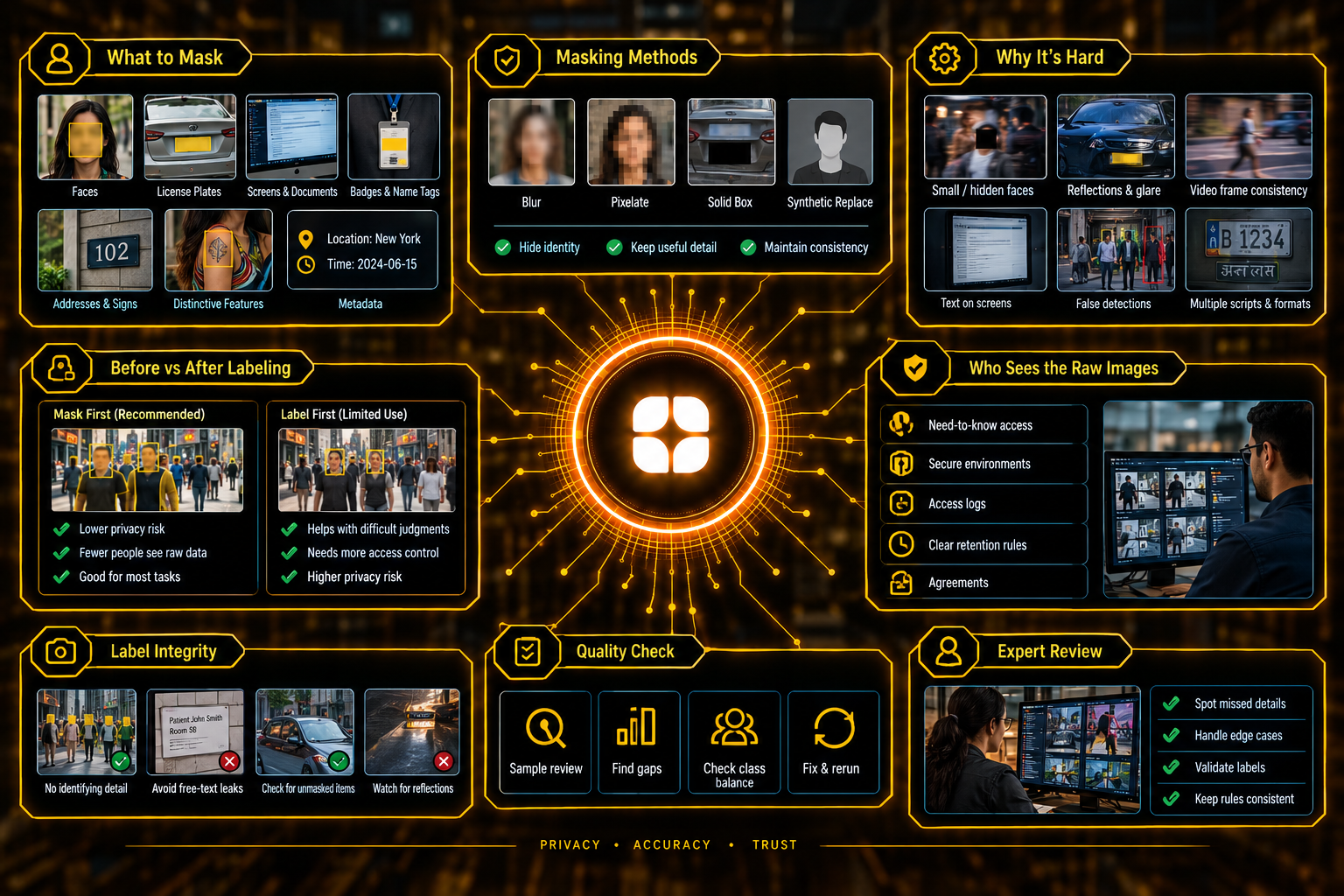
Images capture more than the task needs. A photo taken to study road traffic also shows faces on the pavement and plates on every car. A picture of a factory floor may include a worker’s badge or a monitor showing company data. Once these images enter a training set, that private detail travels with them.
This is why visual privacy in computer vision matters before labeling begins, not after. This post explains what needs masking, how to mask without ruining the data, and who should see the raw images. It also looks at what computer vision training data needs to stay both useful and responsible.
Many teams think only of faces. The list is longer.
A project should decide which of these apply to its own images. A dataset of indoor shelves has different risks from one of street scenes.
Blurring a face looks like a simple step. At scale, it is not.
Automatic masking is a good first pass, but it should not be the last one. People need to check the output, especially on difficult images.
Masking has a cost. If the model needs to detect pedestrians, a heavy blur across the whole figure can hurt the very signal you want to teach. The aim is to hide the identity and keep everything else.
Several choices affect this.
The right method depends on the model’s job. A project should test a small masked batch and check that performance holds before masking everything.
Masking before labeling means annotators never see identifying detail. Privacy risk drops sharply, and fewer people need access to raw files. The trade-off is that some labels, such as a person’s age group or a plate’s format, may become harder to judge, and mistakes in masking cannot be caught by annotators who only see the masked version.
Masking after labeling keeps full detail available to annotators, which can help with difficult judgments. The trade-off is that many more people see raw private content, and the labels may carry details, such as text notes, that identify someone.
Many projects choose a middle path: mask first for most tasks, and keep a small, restricted group with raw access for the few tasks that need it.
Privacy is not only about pixels. It is also about people and permissions. A strong setup limits raw access to those who need it and keeps a record of who viewed what.
Good practice includes:
These rules should be written before the first image is shared. Adding them later is much harder, because copies of raw files may already exist in many places.
Even a masked image can be undone by its labels. A note such as “man in red jacket near the Smith family shop” may name someone, and an annotator’s free-text comment can carry details the image no longer shows. Label schemes should favor classes such as “person” or “vehicle” over descriptions of individuals. Free-text fields need review as well.
A final check matters. Sample the masked set and look for gaps: unmasked faces in the background, plates in reflections, text on a screen at the edge of the frame. Count how often these appear. If the rate is high, fix the process and rerun it, not just the sampled images.
This step also helps with class balance. Masking can change how images look, and a class with many masked examples may behave differently from one with few. Our guide to fine-grained image classification labeling explains why small visual cues matter so much, which is exactly what careless masking can erase.
People who know the setting understand what counts as private there. A reviewer familiar with hospitals knows that a wristband or a whiteboard may reveal a patient. A reviewer who knows traffic work understands which plate formats appear in the region. This kind of knowledge helps teams write masking rules that fit the images in front of them, not a generic list.
Specialists also review the hard cases that automatic tools miss. This reflects Globik AI’s approach of using verified domain experts for work that depends on judgment, where a generalist would be guessing.
Before starting a visual privacy project, settle these points:
Privacy in image data is a design decision made at the start, not a patch added at the end. Strong visual privacy in computer vision means knowing what to mask, choosing a method that keeps the useful signal, and controlling who sees the raw files. With those steps in place, teams can build models on real-world images without exposing the people in them.
It is the practice of protecting people’s identity in images and video used for AI. This includes masking faces, plates, screens, and badges, and controlling who can view raw files, before the data is used for training.
Faces, license plates, screens, documents, badges, house numbers, and identifying features such as tattoos. Image metadata such as location tags should also be removed. The exact list depends on what the images show and what the model needs to learn.
No. Automatic tools miss small, turned, or hidden faces and may blur harmless areas. Human review should check the output, especially on difficult images and video, so that unprotected people do not slip through into the training set.
It can, if the mask removes detail the model needs. A heavy blur over a whole person may weaken detection. Teams should test a masked sample first, choose a method that hides identity only, and avoid masking features the task depends on.
Only the people whose work needs them, inside secure systems with access logs. Most annotators can work on masked versions. A small, restricted group may hold raw access for tasks that cannot be done any other way.