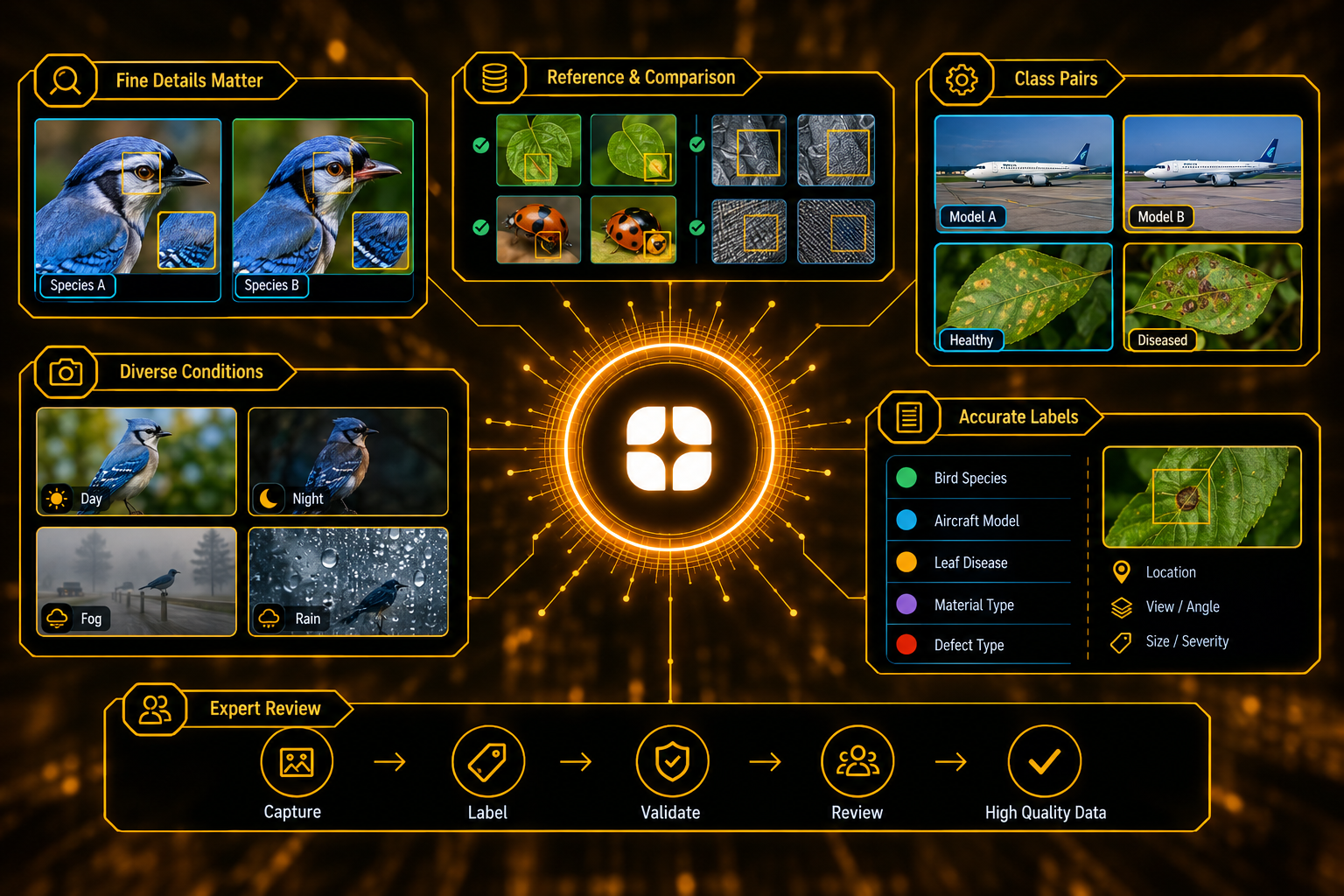
Telling a cat from a car is easy. Telling one bird species from a close relative, one fabric weave from another, or one early-stage skin change from a harmless mark is not. In many real projects, the classes a model must separate look almost the same, even to a trained eye.
This is the problem of fine-grained image classification labeling. The model can only learn the difference if the labels draw a clear, correct line between near-identical classes. This post explains why these labels go wrong and what computer vision training data needs to get right.
In ordinary classification, classes differ in obvious ways. In fine-grained work, they share the same overall shape, color, and setting. The difference sits in a small detail: a marking, a texture, a proportion, or a part that is only visible from some angles.
Typical examples include plant varieties, product models from one brand, material grades, and defect types that differ only in depth or edge shape. In each case, the useful signal is small, and the noise around it is large.
Several things push labelers toward mistakes:
The result is a dataset where the boundary between classes is blurry, and the model learns that blur. Accuracy looks fine on easy images and fails on the cases that matter.
The same issue appears in inspection work, where a hairline crack and a surface scratch can look alike. We cover this kind of work on our computer vision AI page.
The strongest fix happens before labeling starts. Each class needs a written definition that says what separates it from its closest neighbor, not just what it is.
A useful definition includes:
The key step is agreement. Have two or three experts label the same sample on their own, then compare. Where they disagree, the definition is not clear enough yet. Revise it until independent experts reach the same answer. If experts cannot agree, annotators will not either.
Forcing a choice on every image creates false confidence. Some images simply do not contain enough information. The view is wrong, the image is blurry, or the deciding feature is hidden.
A good workflow gives annotators a way out. They can mark an image as uncertain, or as “cannot be judged,” and send it for expert review. These images then have three possible fates: an expert resolves them, they are removed, or they are kept in a separate group so the team can see how often this happens.
This route improves the data in two ways. It keeps guesses out of the training set, and it shows where the class definitions or image collection need work. A high uncertain rate for one class pair is a useful signal, not a failure.
Labeling quality starts with what gets photographed. If one class is shot mostly in bright light and its neighbor mostly indoors, the model may learn the lighting instead of the class. Teams should check that each class appears across similar angles, backgrounds, and conditions.
Rare classes need attention too. A class with only a handful of examples gives experts little to compare against, and the model little to learn from. It is better to find these gaps early, while more images can still be collected, than after thousands of labels are done.
In coarse labeling, most images are clear, and annotators work quickly. Disagreement is low, and general guidelines are enough. Review is mostly spot-checking for slips.
In fine-grained labeling, many images are ambiguous, so work is slower and more careful. Disagreement is common, and it carries information. Guidelines must be detailed, with paired examples of the most confused classes. Review focuses on the boundary cases, since easy images rarely cause trouble.
Treating a fine-grained project like a coarse one is a common reason for poor results.
You cannot fix what you do not measure. Track how often annotators agree, and break it down by class pair, not just overall. A project can report high overall agreement while two specific classes are being swapped constantly.
Useful habits include:
Experts see the cue that a general labeler misses. A specialist in the subject, whether plants, materials, products, or defects, knows which detail decides the class and which details only look important. They also know how items vary naturally, so they do not mistake normal variation for a different class.
Specialists write the definitions, choose the reference images, and settle disputes. This reflects Globik AI’s approach of using verified domain experts for work that depends on judgment, where a generalist would be guessing.
Before starting a fine-grained labeling project, settle these points:
When classes look almost identical, the label is the whole lesson. Strong fine-grained image classification labeling depends on definitions experts agree on, a safe route for uncertain images, and agreement checks that look at the hardest class pairs. With that foundation, a model learns where one class ends and the next begins.
It is the labeling of images whose classes look almost the same, such as close species or defect types. Annotators must spot small deciding details, so precise definitions and expert review are needed.
The difference between classes is often a tiny detail that angle, light, or blur can hide. Without clear definitions, annotators guess, and the model learns a blurry boundary.
It is a workflow option that lets annotators mark an image as uncertain instead of forcing a class. Those images go to an expert or are tracked separately, keeping guesses out of training data.
Have several annotators label the same sample, then measure agreement for each class pair, not only overall. Expert-labeled gold images help check accuracy over time.
Specialists know which details decide a class and how items vary naturally. They write clear definitions and settle disagreements, which makes borderline labels more reliable.