Streaming services, studios, and video platforms handle more footage than any team can watch. New uploads arrive constantly, and large back catalogs still need a rating. Every title has to be checked against platform rules and matched to an audience before it reaches a viewer.
AI can help by sorting content, flagging what needs a closer look, and suggesting a rating. But the model only learns what its labels teach it. Video content moderation labeling and age-rating labeling are the work of turning policy into training data. This post explains what that work involves and why careful, knowledgeable reviewers matter.
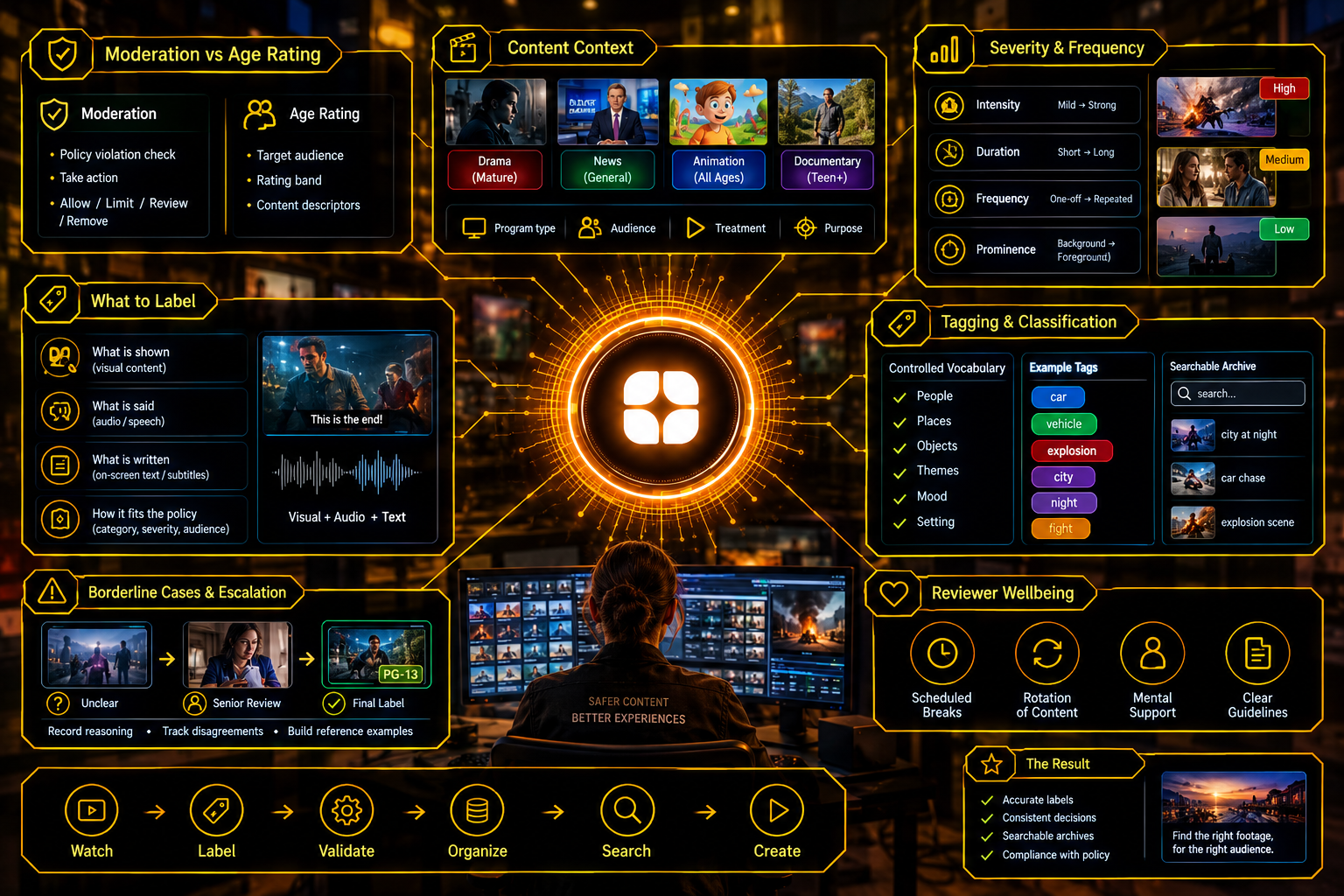
Moderation and age rating are often discussed together, but they answer different questions.
Moderation asks whether a piece of content breaks platform rules and what should happen next: allow it, limit it, send it for review, or remove it. Age rating asks who the content suits and assigns it to an audience band, often with descriptors that explain why.
A project that mixes the two into one label set confuses both. Moderation decisions are about action. Rating decisions are about degree. Each needs its own labels, its own rules, and its own examples. A clip may be fine to keep on a platform and still carry a high age rating, which is why the two cannot share one label.
Annotators do not decide what is acceptable. They apply a written policy. That policy should define each category, give examples, and set out the edge cases in plain words.
Policies differ. Platforms have their own rules, countries have their own rating bodies, and a title may be labeled differently for different markets. A label that was correct under one policy can be wrong under another.
For this reason, every labeled batch should record which policy version it followed. When a rule changes, the team can see exactly which data was labeled under the old one and decide what to relabel.
The same footage can mean very different things in different settings. A violent scene in a news report, in a fictional drama, and in a children's cartoon are three separate cases. A brief word in a documentary interview is not the same as strong language in a comedy.
A label that records only what is visible misses this. Good content classification data captures context fields alongside the content itself:
Without these fields, a model learns to react to surface features and flags the wrong things. With them, its flags can be explained in terms a reviewer recognizes.
Ratings depend on how much, not just whether. A single mild moment and a constant stream of the same moments can land in different bands.
Useful labels capture several dimensions:
Because these vary through a video, labels should apply to segments, not to the whole file. A two-hour film may have only a few moments that drive its rating, and annotators need to mark where they sit.
A scene can look harmless and sound otherwise. Strong language may come in the audio while the picture shows a quiet room. Subtitles and on-screen text can add their own content.
Annotators therefore need to label across signals: what is shown, what is said, and what is written. Rules should say how these combine. Does strong language over a calm scene count toward the same descriptor as strong language during action? Is a subtitle treated like spoken words? These choices should be written down, not left to each reviewer.
Some content sits on the line between categories. That is normal, and a good process expects it.
An "unsure" label is useful, along with a route to a senior reviewer who makes the final call. The reviewer's reasoning should be recorded, so that similar cases are handled the same way later. Over time, those decisions become a bank of reference examples that new reviewers can learn from.
Tracking where reviewers disagree also helps. Repeated disagreement on one type of content usually means the policy is unclear, not that the reviewers are careless.
Moderation work can involve difficult material. People who review it deserve care, and the quality of their work depends on it.
Sensible projects set limits on exposure, rotate reviewers between kinds of content, provide breaks and access to support, and give clear guidance on when to step away. Tired or distressed reviewers drift in their judgments, which shows up as inconsistent labels.
Good project design treats reviewer wellbeing as part of data quality, not as a separate concern.
People with experience in content standards, classification, or trust and safety work read footage differently. They know how rating descriptors are used, understand why context changes the answer, and can spot where a policy is vague. They also write the rules that keep a large team consistent: category definitions, severity levels, and the handling of borderline cases.
This matches Globik's approach of using verified domain experts for work that depends on judgment. For trust and safety AI training data, that experience helps keep labels consistent, so the model's decisions can be explained and defended.
Before a moderation or rating project starts, a team can settle five things:
Moderation and rating AI works when labels follow a clear policy, capture context, and measure how much and how often, not just whether. For a look at how video is structured before it is rated, see our guide on scene, shot, and tag labeling for media archives: making video libraries searchable. In both cases, strong video content moderation labeling depends on people who understand the material.
It is the labeling of video against written policy so AI can flag content that needs review or action.
Moderation decides what action to take, while age rating assigns the content to an audience band.
The same footage can mean different things in news, fiction, and children's programs, so labels must record the setting.
A few moments often drive a rating, so reviewers need to mark where they occur and how intense they are.
Tired or distressed reviewers drift in their judgments, which makes labels inconsistent.