A broadcaster, studio, or production house may hold decades of footage: news reports, documentaries, drama, interviews, and raw camera material. Somewhere in that library is the shot an editor needs today. It might be a wide view of a harbor at dusk, or a close-up of hands at work.
AI can search video by what it shows, but only if the footage has been labeled well. Media archive video tagging turns hours of footage into material that editors, producers, and researchers can actually search. This post explains what that labeling involves and why it needs people who understand how video is made and reused.
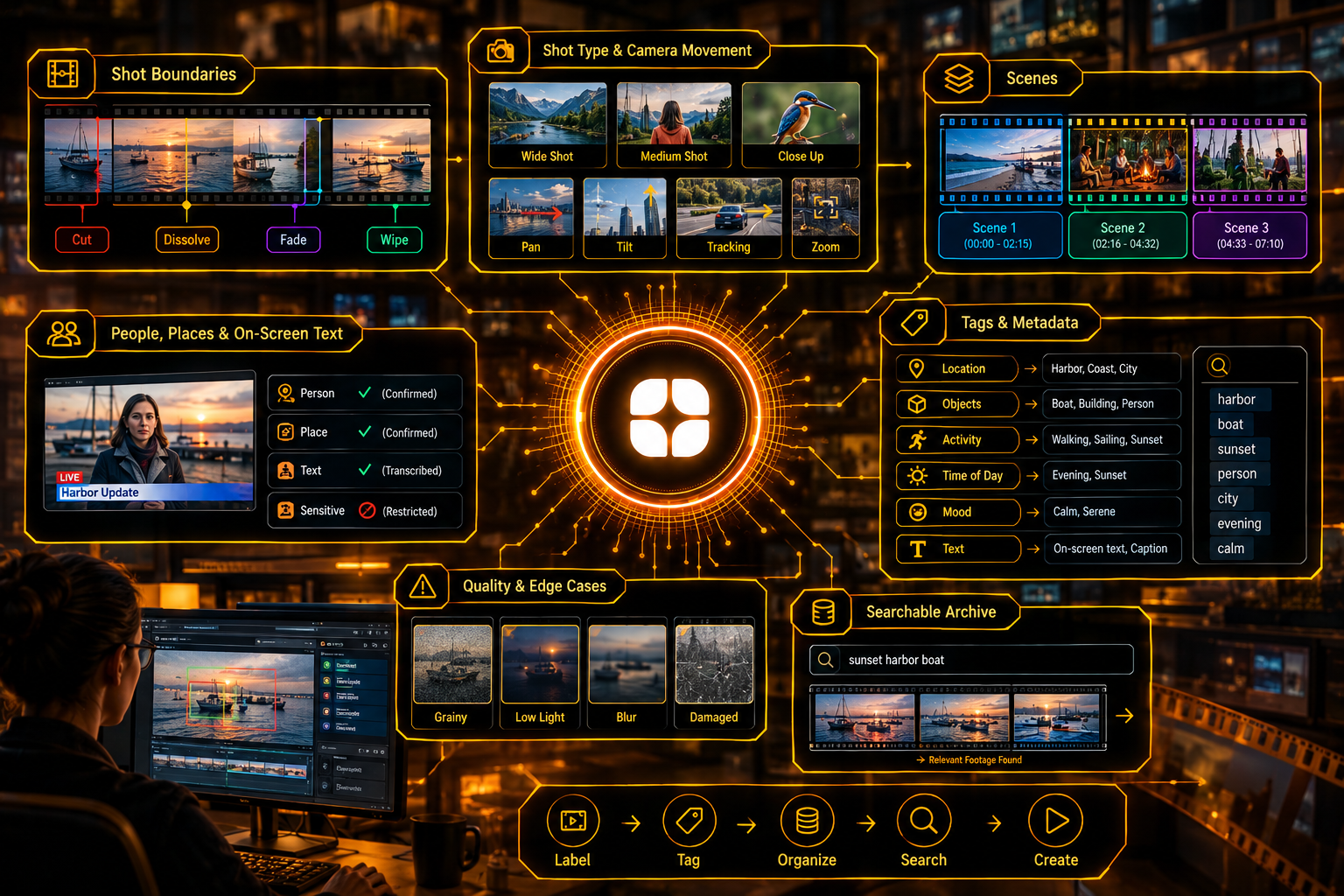
Most archive projects combine several kinds of labels:
A library that skips a layer cannot answer searches that depend on it.
Shot boundary annotation sounds simple: mark the cut. In practice, cuts come in several forms. A hard cut is easy to see. A dissolve blends two shots over several frames, so the exact boundary is a judgment call. A fade to black ends a shot, and a wipe slides one over another.
Other things look like cuts but are not. A camera flash, a fast whip pan, or a sudden lighting change can all mimic a boundary.
Annotators need written rules for each of these cases. Where does a dissolve start and end? Does a flash count as a cut? Frame-accurate timecode matters too, because an editor who lands a few frames off will see the wrong picture.
Editors search by framing. They ask for wide, medium, or close shots, for overhead views, or for a particular camera move. Labels for shot type should use a fixed list, with an example image for each.
The boundaries between types are soft. A shot between medium and close-up could go either way, and two annotators may disagree. The guide should say how to decide, for example by what part of a person is in frame.
Camera movement adds another set of terms: static, pan, tilt, zoom, tracking, and handheld.
A shot has a clear start and end. A scene does not. It is a group of shots that share a place, a moment, or a line of action, and where one scene stops and the next begins depends on the material.
In a drama, a scene may cut between two characters in one room. In raw camera material, there may be no scene structure at all.
Scene segmentation labeling needs rules that fit the type of footage. Without them, annotators draw scene boundaries in different places, and the same footage ends up grouped in different ways.
Tags are what most people think of when they imagine a searchable archive: location, setting, time of day, objects, activities, and mood.
The danger is inconsistency. One annotator writes "car," another writes "automobile," and a third writes "vehicle." A search for one will miss the others. For this reason, video metadata tagging should use a controlled vocabulary, a defined list of allowed terms with their synonyms, so that the same thing always gets the same tag.
Several choices need to be made early:
Archives often need to log who and where. The rules should be conservative. A person should be named only when the footage or its records confirm it, not on a guess from a face. A location tag should reflect what is shown, not what the annotator assumes.
Text on screen, such as signs, captions, lower-third graphics, and titles, can also be logged. Projects should decide in advance whether it is transcribed exactly or tagged by type.
Some fields may be sensitive, and labeling rules should say who can see them.
Archive material is not clean. Older footage may be grainy, scratched, faded, or black and white. Some of it comes from legacy tape formats with unusual aspect ratios or interlaced pictures that look jagged when paused.
These conditions affect labeling. A dim, noisy frame makes tags harder to judge, and damage can look like a cut. Guidelines should say what to do when footage is too poor to label with confidence. A "cannot judge" option is better than a guess that spreads through the library.
A large archive means thousands of hours. Small differences in how annotators work add up, and a library tagged inconsistently becomes harder to search over time, not easier.
A practical check is the search test. Take real queries an editor might type, run them against the labeled library, and see whether the right footage comes back. If it does not, the labels or the vocabulary need work.
People who have worked with archives, editing, or production read footage differently. They know how editors search, what a useful tag looks like, and where a shot really ends.
They also help write the rules that keep a large team consistent: the tag vocabulary, the boundary rules, and the handling of poor-quality footage. This matches Globik's approach of using verified domain experts for work that depends on judgment. For media archives, that experience is what makes a library easy to search.
Before an archive labeling project starts, a team can settle five things:
A video library is only as useful as its labels. Clear shot boundaries, consistent tags, and rules built for real footage turn an archive into something editors can search. For a sport-specific look at labeling video, see our complete guide to sports video annotation. In both cases, strong media archive video tagging depends on people who understand the footage.
It is the labeling of shots, scenes, and content in video libraries so AI and people can search footage quickly.
It is marking where each shot starts and ends, including hard cuts, dissolves, and fades.
They make sure the same thing always gets the same tag, so searches do not miss footage labeled with a synonym.
Scenes depend on place, time, and action, and the right boundaries vary by footage type, so rules are needed.
They know how editors search and can tell cuts, flashes, and camera moves apart.