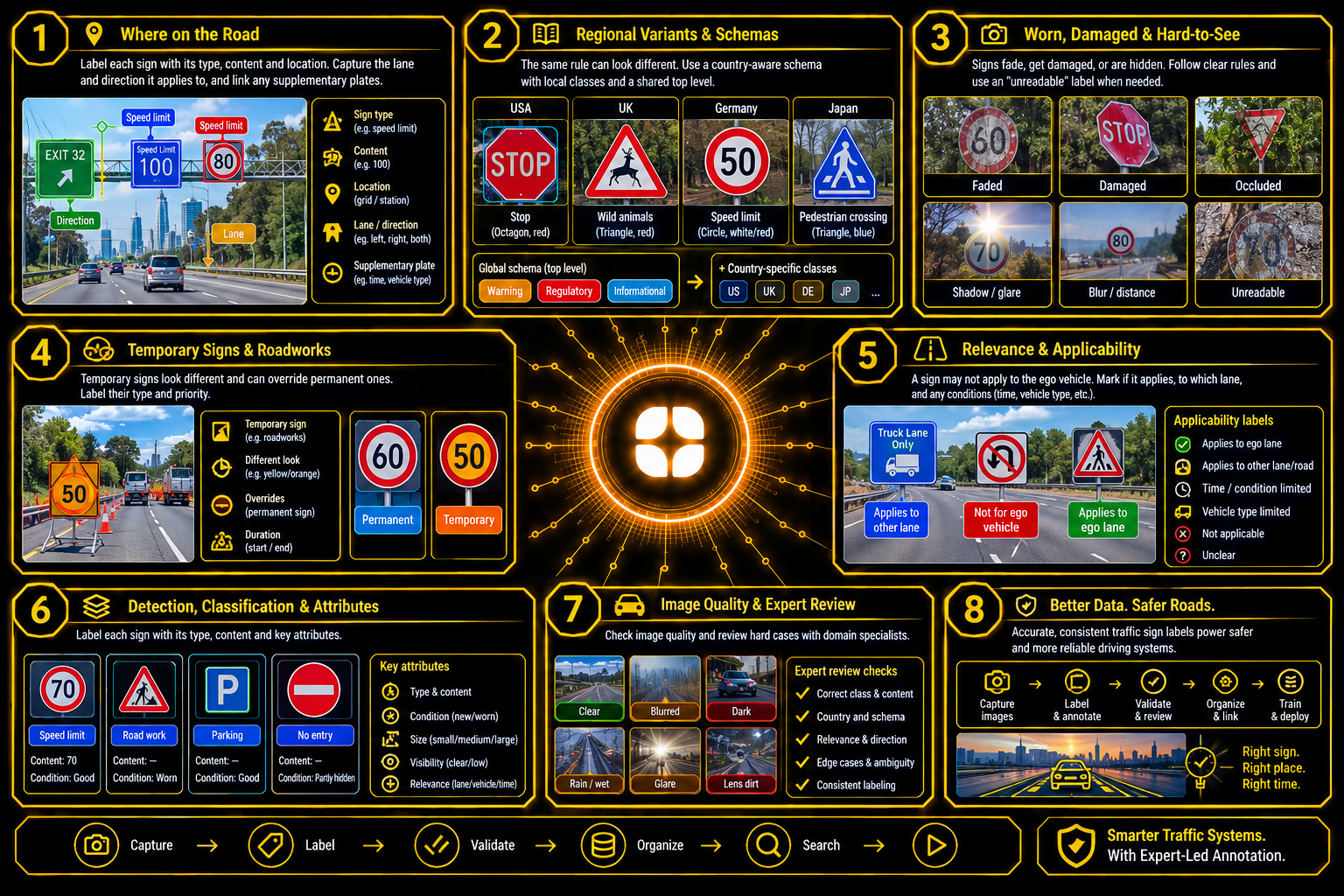
A speed limit sign looks like a simple object. It is round, it has a number, and it sits at the roadside. But a model trained on signs from one country can fail when it crosses a border. The shape, color, symbol, and even the meaning of a sign can change from place to place.
Driver assistance and self-driving systems must read signs correctly in every country and every kind of weather. That makes traffic sign annotation a careful job. This post explains how regional variants, worn signs, and temporary signs change the work, and what autonomous driving training data needs to get right.
Sign annotation usually has four parts:
Models trained on these labels support speed alerts and map updates. This is the base of traffic sign recognition data.
Countries follow different sign conventions. Many follow shared international agreements, yet details still vary.
Annotators need to know which country’s rules an image follows. A single global class list will merge signs that should stay apart. These regional traffic sign variants need a clear schema, with a country tag on every image and a mapping to shared categories.
A single global schema is simple to manage, since annotators learn one list. But it hides real differences, and “warning sign” may be too vague for a model that must know which hazard is ahead.
Country-specific schemas capture local meaning exactly, with a class and definition for each sign. But they mean more guides, more examples, and more reviewers who know each country.
Most projects use a mix: detailed local classes under a shared top level, so the model learns both the specific sign and the general type.
Real signs are rarely clean. They fade in sun, get bent, collect stickers, and hide behind trees.
Annotators need rules for how much of a sign must be visible to label it, and a flag such as “present, content unreadable.” Guessing the value of an unreadable sign teaches the model to invent numbers it cannot see. Faded paint and unusual camera views cause similar problems in low-speed driving, which we cover in our guide to parking space and low-speed maneuvering annotation.
Temporary signs appear at roadworks, events, and incidents, and they may override the permanent signs around them.
Labels should say whether a sign is permanent or temporary, and a rule should state which one wins in a conflict. Without it, a model may follow an old limit inside a roadworks zone.
A sign in the image does not always apply to the vehicle that took it. Some face a side road, an exit ramp, or the opposite direction. Others apply only to certain lanes, vehicle types, or times. A plate under the sign may limit it to trucks or school hours.
Annotators need a relevance rule, with labels such as “applies to ego lane,” “applies to another road,” and “unclear.” Supplementary plates should be linked to the sign they modify, not treated as separate objects.
Some signs are common, and others are very rare. Teams should count examples per class and per country, and collect more of the thin ones early.
Testing needs care too. Test on countries, roads, and weather the model did not see in training, and keep frames from the same drive on the same side of the split, or scores will look better than real performance.
People who know road rules and local signage read images differently. They know how a country signals priority, which signs apply to which lanes, and how temporary signs override permanent ones. Native readers of local scripts catch text errors a general annotator would miss.
Specialists write the class lists, set relevance rules, and review hard cases. This reflects Globik AI’s approach of using verified domain experts for work that depends on judgment, where a generalist would be guessing.
Before starting a traffic sign project, settle these points:
A sign is a rule shown in pictures, and the rule depends on the country, the condition of the sign, and whether it is permanent. Strong traffic sign annotation uses clear regional schemas, honest handling of worn signs, firm rules for temporary signs, and reviewers who know local conventions. With that foundation, a driving model can read the road wherever it travels.
It is the labeling of road signs in images and video so AI can find them, name their type, and read their content. These labels train driver assistance and self-driving systems.
Shapes, colors, symbols, units, and legal meanings differ by country. A single global list can merge signs that should stay apart, so images need a country tag and a clear class schema.
Mark them as present but unreadable instead of guessing the value. Clear rules on how much of a sign must be visible keep the model from inventing content.
They may override permanent signs, use different colors, and appear only briefly. Labels should mark them as temporary and state which sign takes priority in a conflict.
Specialists know local road rules, lane relevance, and how temporary signs override permanent ones. They write clear class schemas and review doubtful cases, making sign data more reliable.