Parking is where most drivers feel the least confident. The spaces are tight, the lines are worn, and a mistake costs a scraped wall or a dented door. Parking assistance and automated parking systems exist to help, and they rely on cameras mounted around the car.
Those systems learn from labeled images, and the images are unusual. Parking slot annotation and the labeling of the space around a slow-moving car are very different from labeling a road scene at speed. This post explains what the labels need to capture, why the camera views are tricky, and why precision matters when the margins are measured in centimeters.
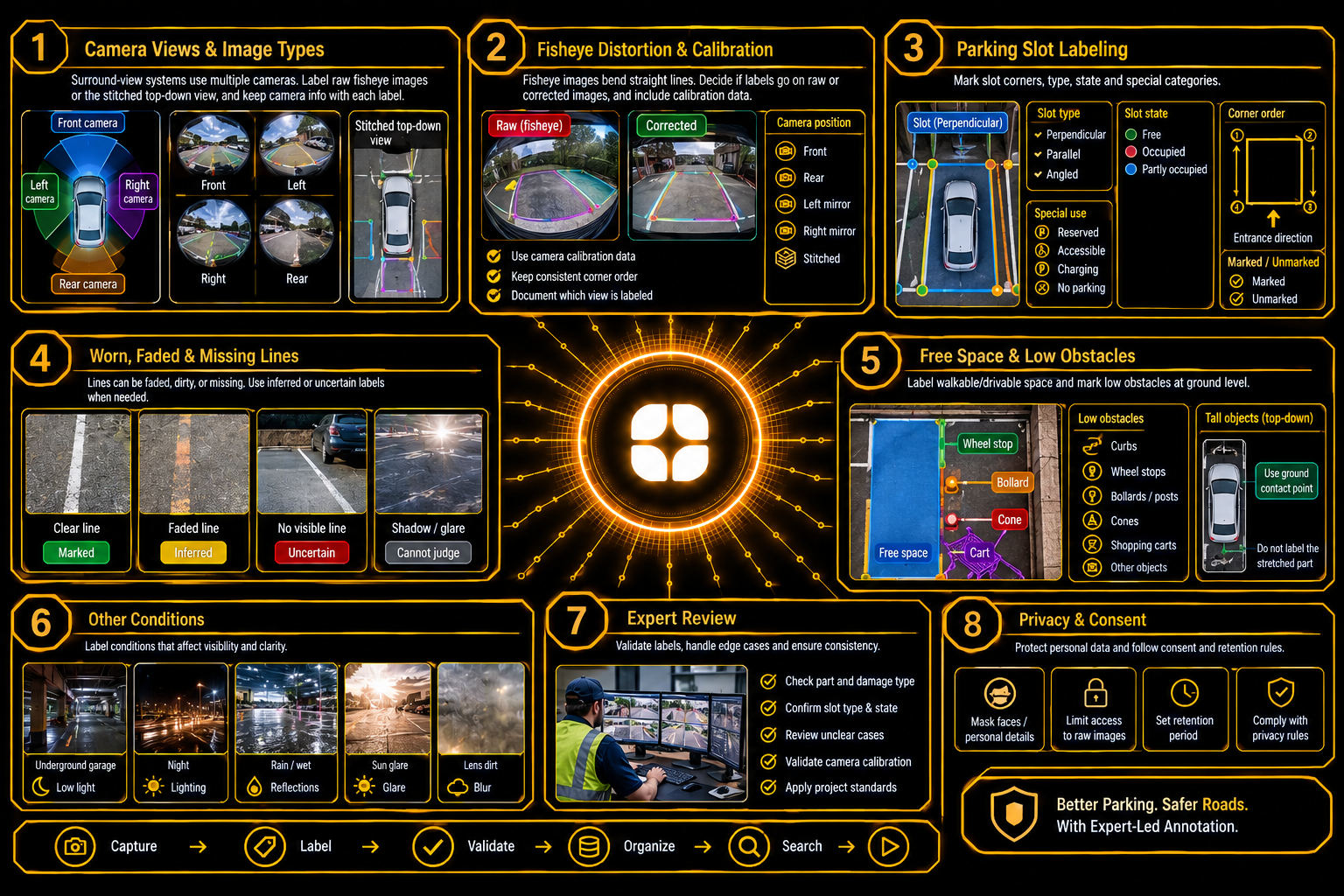
A typical surround-view system uses four wide-angle cameras, one at the front, one at the rear, and one under each side mirror. Each produces a fisheye image, a very wide view that bends the scene.
The system can also stitch the four views into a single top-down picture, as if a camera hovered above the car. Drivers see this on their dashboard screen.
Annotators may label either the raw fisheye images or the stitched top-down view. A project has to choose, and the choice shapes everything that follows. Surround-view camera annotation needs a clear statement of which view is being labeled, and the data should record which camera or stitched image each label comes from.
In a fisheye image, straight lines curve, especially near the edges. A rectangular parking slot appears bent, and objects at the edge of the frame look stretched.
Annotators need to understand this. If labels are placed on the raw image, the same slot looks different depending on where it sits in the frame, and consistent corner placement takes practice. If the image has been corrected first, the straight lines return, but the edges can still be soft or stretched.
Projects should say whether labels go on corrected or raw images, and whether camera calibration data travels with each image.
Slots are usually labeled by their corner points and entry line. A consistent order of corners matters, because the model needs to learn which side is the entrance and which way the slot faces.
Several details need rules:
Region matters too. Slot sizes, angles, and markings differ from one country to the next. Guidelines should be written for the places the data comes from.
Real car parks are not freshly painted. Lines fade, get covered by dirt, and disappear in shadow. Wet surfaces reflect lights and hide markings. Old lines overlap with new ones. Columns and walls in garages break the pattern.
Annotators need a rule for slots whose lines cannot be seen. If the slot is clearly implied by neighboring cars or other cues, it can carry an "inferred" label. If it cannot be determined, it should be left out or marked uncertain. A model taught to find lines that do not exist will suggest slots that are not there.
Parking is also about space, not only slots. The system must know where the car can safely go. That means labeling free space, usually as an area on the ground, along with its edges.
The edges are small things: curbs, wheel stops, bollards, cones, posts, and walls. Some are low enough to hide in the blind spot of a camera. Others, like a shopping cart or a child's toy, are easy to miss. Free space segmentation labeling has to mark these objects at their base, where they meet the ground, since that is where the car will touch them.
Margins are tiny. A boundary placed ten centimeters off can mean a collision, so precision rules and review matter more here than in most vehicle tasks.
The stitched top-down image assumes everything lies flat on the ground. That works for paint and pavement. It does not work for anything tall.
A pole, a parked car, or a person gets stretched and smeared away from the camera in the top-down picture. Annotators must label the point where the object meets the ground, not the smear above it, and the guidelines should show examples of both.
The seams between camera views create their own problems. An object near a seam may appear twice, appear cut in half, or vanish. Annotators need to know how to treat these and when to flag a frame as affected by the stitching.
Conditions vary a great deal. Underground garages are dim, lit by uneven lights, and full of reflections on wet floors. Outdoors, low sun creates glare at exits, and rain beads on lenses. Dirt on a camera blurs part of the view.
People who work on driver assistance and parking systems read these images differently. They know how the cameras are mounted, understand what fisheye and stitching do to a scene, and recognize which obstacles matter most. They can tell when a faded line is still a slot and when it is not.
They also write the rules that keep a large team consistent: the view being labeled, the corner order, the free-space boundaries, and the handling of stitched seams. This matches Globik's approach of using verified domain experts for work that depends on judgment. For automated parking AI training data, that knowledge makes labels precise enough to trust at close range.
Before a parking labeling project starts, a team can settle five things:
Parking AI works when labels respect how the cameras see, mark slots and free space precisely, and admit when a line or an edge cannot be judged. For another example of labeling photos around a car, see our guide on vehicle damage assessment imagery: labeling panels, scratches, and what is new. Strong parking slot annotation depends on people who understand how the car sees.
It is the labeling of parking spaces in camera images so AI can find free spots and guide a car into them.
Straight lines curve and edges stretch, so annotators need clear rules and calibration data.
Top-down views stretch tall objects, so the ground contact point shows where the car would touch.
It marks a slot whose lines are faded or missing but is clearly implied by neighboring cars or other cues.
Margins are measured in centimeters, so small boundary errors can mean a collision.