When a rental car comes back, someone has to decide whether it has new damage. When a driver files a claim, someone has to see what happened to the car. When a used car goes on sale, buyers want to know its condition. In every case, the evidence is a set of photos, often taken on a phone, and there are far too many of them to review by hand.
AI can read those photos and point to dents, scratches, and cracks. It learns from labeled images, and car damage is harder to label than it looks. Vehicle damage annotation is the work of marking what is wrong, on which part of the car, and whether it is new. This post explains what those labels need to capture and why people who know vehicles label them best.
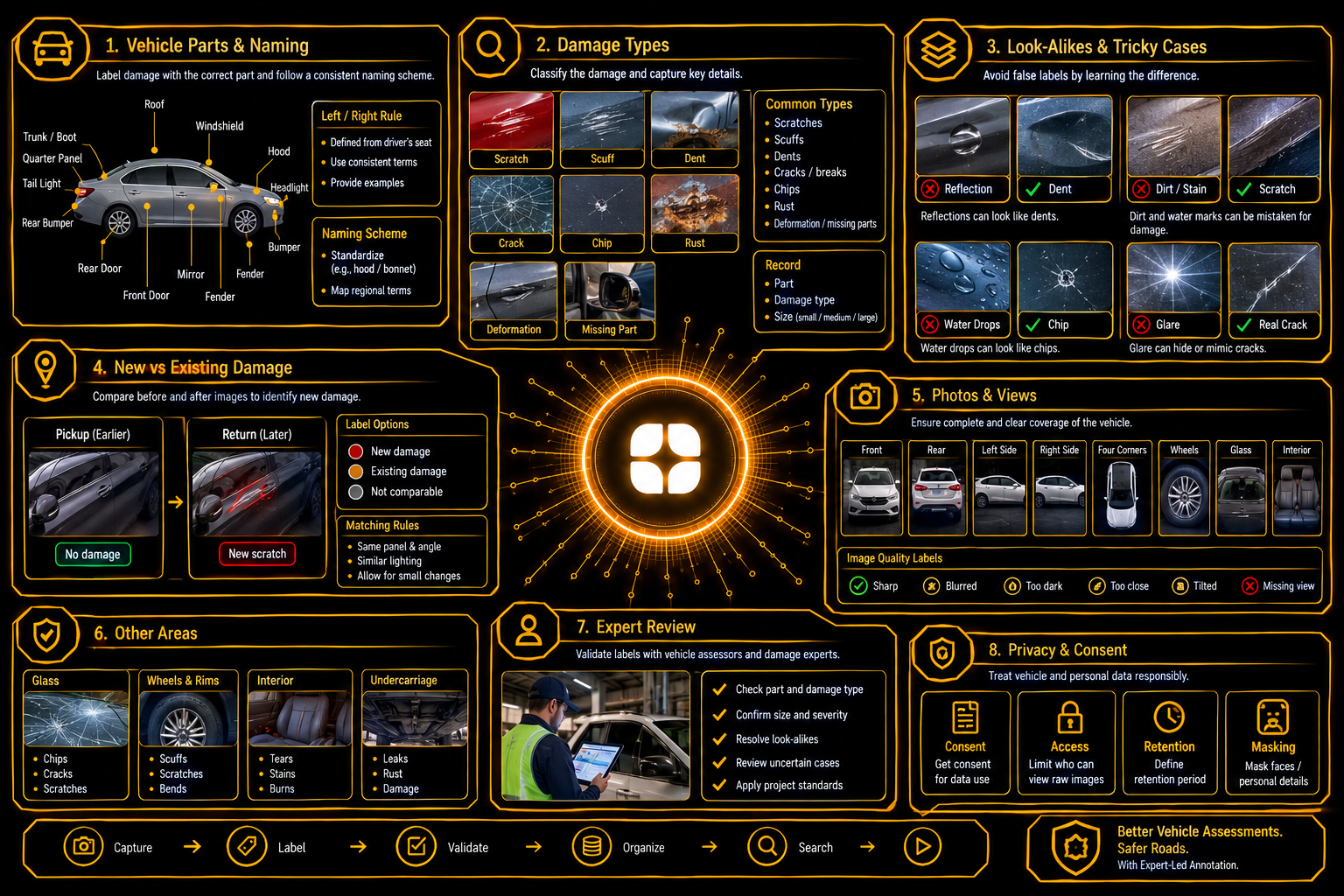
Damage is only useful if it is tied to a part. Cars have a standard set of body parts: bumpers, fenders, doors, quarter panels, the hood, the trunk lid, the roof, pillars, mirrors, lights, glass, and wheels.
The vocabulary shifts between regions. What one market calls the hood, another calls the bonnet. A trunk is a boot, and a fender is a wing. A project should pick one naming scheme and map the others to it.
Left and right cause constant confusion. On a car, left and right are defined from the driver's seat, which is not the same as the left and right of a photo. Annotators need a clear rule and examples, or a front-left door will be recorded as front-right.
The damage vocabulary usually includes:
The differences are practical. A scuff can often be polished away, and a scratch through to the metal cannot. A label that only says "damage" does not help the person who has to decide what happens next.
Cars are glossy, and gloss misleads. Reflections of buildings, trees, and the photographer bend across curved panels and can look like dents. Water drops, dirt streaks, dried salt, and stickers look like marks. A dent can hide under a reflection.
Car damage detection data has to teach these differences. The telling feature of a dent is how the reflection bends around it, which is why photos from more than one angle help. Annotators should be shown pairs of images, one with a real dent and one with only a reflection, so they learn what separates them.
A "cannot judge" label is important here. Where glare or dirt makes the answer unclear, it is better to say so than to guess.
For rentals and fleet returns, the real question is not whether the car has damage, but whether it has damage that was not there before. That means comparing photos from pickup and return.
Labels in this setting go beyond "dent." They record whether a mark is new, already present, or impossible to compare. Annotators need pairs of images and rules for matching them, such as the same panel from a similar angle in similar light.
Lighting, angle, and distance change between the two sets, and a mark that is visible in one view may hide in the other. A fair label set includes an "unable to compare" option, so annotators do not blame a car for damage that the first photo simply did not show.
Older repairs and general wear add another layer. Faded paint, small chips, and repaired panels are not new damage, and the guidelines should give examples.
Professional inspection stations capture photos in a fixed pattern. Customers and staff do not. Phone photos are blurry, tilted, and dark. They crop out the corner of the car, and they cover only part of it.
Good projects define a standard set of views: front, rear, both sides, the four corners, wheels, glass, and any interior areas that matter. Annotators check whether each required view is present and flag missing ones. They also label image quality, such as sharp, blurred, too dark, or too close.
Without those labels, a model cannot tell the difference between a car that has no damage and a car that was never fully photographed.
Beyond the type, labels often record how big the damage is and where it sits on the panel. Size can be recorded in simple classes, such as small, medium, and large, defined in plain terms and shown with examples.
Annotators should not guess at repair cost. Estimates belong to assessors who inspect the car.
Some damage sits outside the body panels. Windshield chips and cracks are small and hard to see. Wheel rims show scuffs from curbs. Seats and trim show tears and stains.
People who work as vehicle assessors, body shop estimators, or rental fleet inspectors read these photos differently. They know the part names, see the difference between a reflection and a dent, and understand how damage on a body line differs from damage on a flat panel. They also write the rules that keep a large team consistent: the naming scheme, the damage list, the size classes, and the pairing rules.
This matches Globik's approach of using verified domain experts for work that depends on judgment. For automotive damage assessment AI training data, that experience is what makes labels dependable enough to settle disputes.
Before a vehicle damage project starts, a team can settle five things:
Vehicle damage AI works when labels tie each mark to a part, separate real damage from reflections and dirt, and compare before and after fairly. For another example of labeling inside the car, see our guide on in-cabin driver and occupant monitoring annotation: labeling attention, seatbelts, and who is in the car. Strong vehicle damage annotation depends on people who know cars.
It is the labeling of car photos with damage types and locations so AI can detect and describe damage.
Glossy paint bends reflections across panels, so they can look like dents.
The question is usually whether damage is new, which needs matched images and an "unable to compare" option.
It shows whether a car was fully photographed, so missing views are not read as no damage.
They know part names and damage types, and can tell real damage from reflections and dirt.