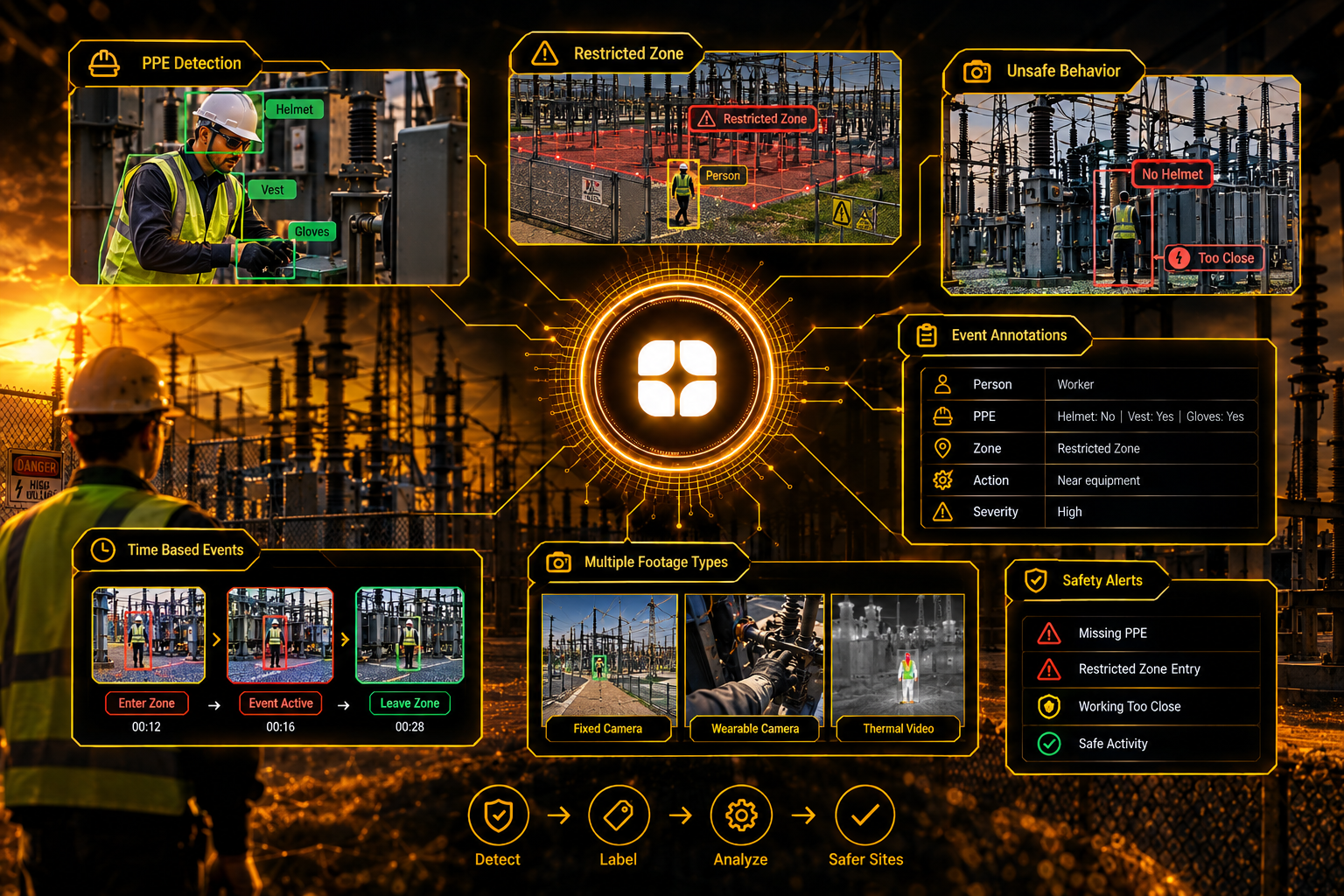
A substation is one of the most dangerous places a person can work. Live equipment, high voltage, and moving machinery sit close to people doing routine tasks. Utilities already use cameras to watch these sites, but no one can watch every screen all day. AI can help by flagging a missing helmet, a person in the wrong zone, or a crew working too close to live equipment.
That only works if the model learned from correctly labeled video. Good substation safety video labeling is about teaching a model what safe and unsafe look like on a real site. This post explains what makes this footage hard to label and what energy and utilities AI needs from its training data.
Safety video for utilities is usually labeled in four areas:
Models trained on these labels can raise an alert in real time, count violations over a week, or help safety teams find where problems cluster.
Substation footage is not as clean as a factory floor.
Annotators need rules for objects that are too small, too blocked, or too blurred to judge. A label that says “no helmet” when the helmet is simply hidden teaches the model a false lesson.
The hardest part of safety labeling is deciding what counts as a violation. That depends on the task and the site, not just on what is visible.
Take a few examples:
If these rules stay unwritten, two annotators label the same clip differently, and the model learns noise. The result is either constant false alarms or missed real risks. Each rule should be written down with examples, including borderline ones.
Zones are where utility safety differs most from ordinary video labeling. In a substation, danger is often about distance and state, not just location.
Some areas are always off limits. Others are safe until equipment is energized, or until a work permit changes their status. Annotators therefore need to know how a site marks its zones: painted lines, fences, cones, tape, or signs. They also need a rule for what counts as “entering.” Does a foot over the line count, or must the whole body cross? How long must a person stay before it is an event?
Safe approach distances add another layer. The distance a person must keep from live parts depends on voltage, and a camera cannot measure it directly. Teams need a clear method, such as marked ground references, and a rule for what to do when the distance cannot be judged from the footage.
Different footage needs different labeling rules, even on the same site.
A fixed site camera watches a wide area for long periods, so labeling focuses on zone entry, people counts, and gear on small, distant figures. A wearable or helmet camera shows the work from the technician’s point of view. Labeling there focuses on hands, tools, and the equipment being touched, and the footage moves and shakes. Thermal video is used to spot heat, and it shows shapes more than colors, so gear rules built for normal video do not apply.
A single guide for all three would blur these differences. Each footage type needs its own examples and its own reviewers.
Safety events unfold over time. A person may remove a helmet for a few seconds, step briefly into a zone, or be hidden behind a structure and reappear. Labelers should mark when an event starts and ends, not just whether something appears in a single frame.
Short, accidental moments also need rules. A one-second glimpse of a person crossing a boundary is different from a person standing inside it for a minute. Written time thresholds keep labels consistent and help the model avoid alerts on every passing shadow.
Safety video captures workers who go about their jobs. Handling this well matters for both ethics and adoption. A model built to protect workers should not feel like a tool for spying on them.
Projects should decide early what is labeled: a “person without a helmet,” not a named individual. They should set whether faces are masked, who can see raw footage, and how access is recorded. Clear rules also help when safety teams later review how a dataset was built.
Video becomes more useful when it connects to what happened next. An unsafe act caught on camera may match a near-miss note or a repair order written later by a crew. Linking the two depends on consistent text labels, which we cover in our guide to maintenance work order annotation. When video labels and text labels use the same asset and event terms, teams can see patterns across both.
People who have worked on live sites read this footage differently. They know why a person near a particular piece of equipment is a concern, recognize the difference between a switching task and a routine walk, and can tell proper protective gear from lookalikes. They also know which zones change with permits and outages.
Specialists write the rules that keep a large team consistent, covering PPE standards, zone definitions, and time thresholds. This reflects Globik AI’s approach of using verified domain experts for work that depends on judgment, where a generalist labeler would be guessing.
Before starting a safety video project, settle these points:
Safety AI is only as good as the rules behind its labels. Strong substation safety video labeling starts with written safety rules, clear zone definitions, and careful handling of distance, time, and privacy, and it relies on reviewers who know how live sites work. With that foundation, a model can tell the difference between a real risk and an ordinary day on site. To discuss a project, visit globik.ai/contact or explore our services.
It is the labeling of video from substations and field sites so AI can recognize people, protective equipment, restricted zones, and unsafe activities. The labels teach a model what safe and unsafe conditions look like, so it can flag risks to safety teams in real time.
It is the labeling of protective equipment such as helmets, vests, gloves, and glasses in images or video. Annotators mark whether each item is present, worn correctly, or cannot be judged. Clear written rules matter, because requirements differ by task and area of the site.
Danger often depends on state and distance, not only location. An area may be safe until equipment is energized or a permit changes. Annotators need to know how the site marks zones and what counts as entering, or labels will be inconsistent.
Outdoor lighting, weather, long distances, steel structures, and unusual worker poses all affect how people and gear appear. Annotators need rules for small, blocked, or blurred objects so the model does not learn false lessons from footage that cannot be judged.
Specialists who have worked on live sites understand equipment, zones, and tasks. They can tell proper gear from lookalikes, write clear safety rules, and apply them consistently across large video sets, which makes alerts more reliable and reduces false alarms.