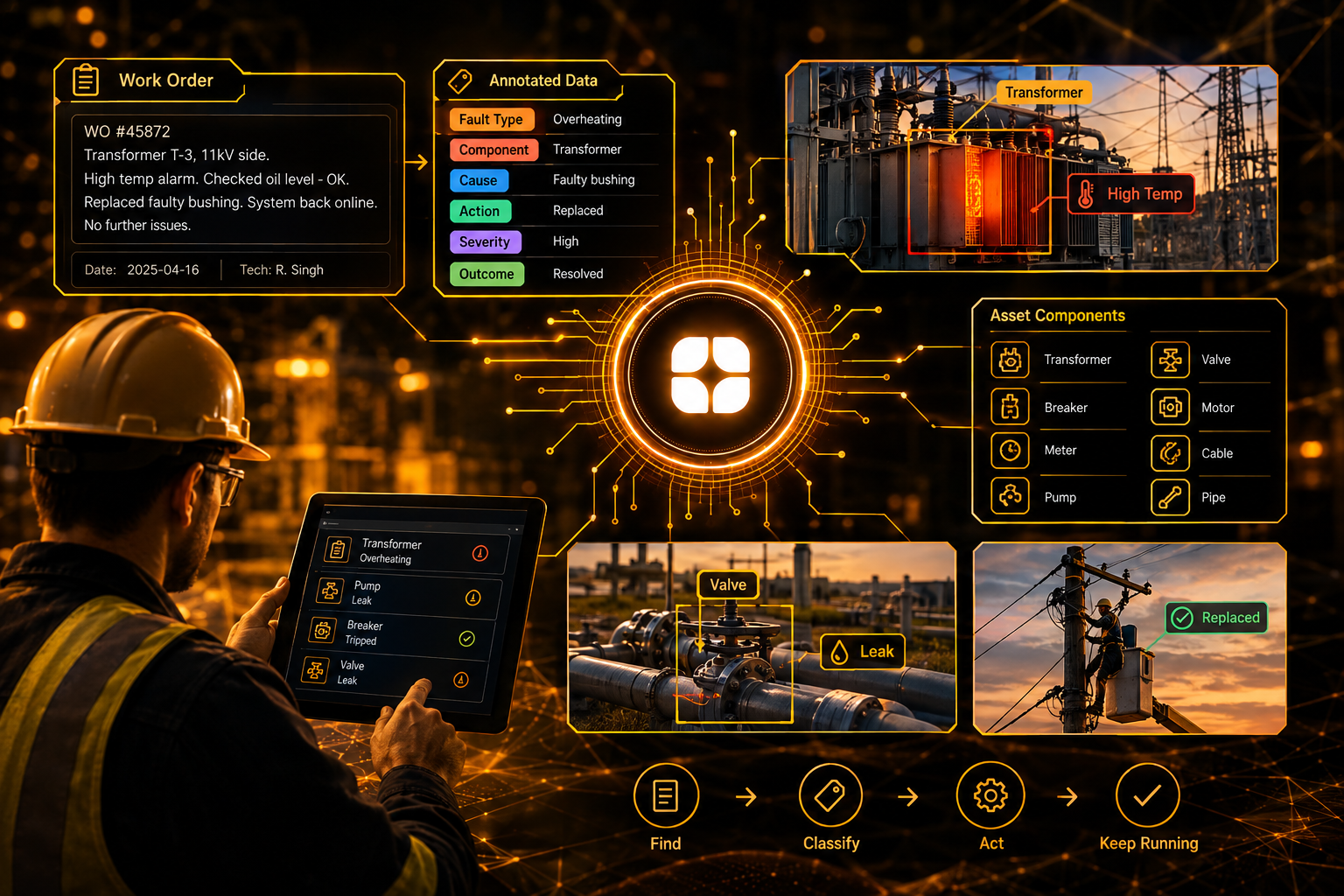
Every time a technician repairs a transformer, replaces a meter, or fixes a pipeline valve, someone writes it down. Over the years those notes become millions of work orders and field reports. They record what failed, why, and what was done. But most of it is free text, so software cannot easily use it.
AI can turn that text into structured data, but only if it learns from examples labeled by people who know the work. Good maintenance work order annotation means assigning faults, causes, and actions the same way every time. This post explains what makes field text hard to label and what energy and utilities AI needs from its training data.
Annotation for maintenance text usually has four parts:
Models trained on these labels can group similar failures, spot repeat faults at one site, and help planners decide where to send crews. This is the foundation of fault classification data.
Field reports are written fast, often on a phone and often outdoors. They rarely read like clean sentences.
The key decision is the fault taxonomy. A list that is too short hides useful differences, and one that is too long leaves annotators choosing between near-identical options.
A strong taxonomy has levels: a fault family, a specific fault, and a likely cause. It should follow the utility’s own asset and failure codes where they exist, so labels can later be joined to maintenance systems. Each class needs a written definition and examples, including boundary cases, such as when a loose connection counts as electrical and when it counts as mechanical.
Many work orders include a drop-down code as well as a written note. The two do not always match. Technicians under time pressure may pick the first code on the list to close a ticket, while the note describes something different.
Annotation rules should say which source wins, how to flag a mismatch, and how to treat duplicates, reopened jobs, and tickets closed without a note. Without these rules, the model learns the shortcuts people took, not the faults that occurred.
A work order is planned and structured, with a job number, an asset, and a closing note. Labeling focuses on matching the planned task to what was actually done. A field technician report is informal and written after the fact. Labeling focuses on pulling the fault, cause, and action out of loose text. An inspection note sits between them. It records condition rather than a repair, so it needs its own labels for severity and follow-up.
One guide for all three would blur these differences. Each type needs its own examples and its own reviewers.
A fault note is most useful when it points to a real asset. Linking a note to the right breaker or inverter often depends on the drawings behind it, a topic we cover in our guide to engineering drawing annotation for utilities.
Reports can contain technician names, customer addresses, and meter numbers. Decide early what is masked, who may see raw text, and how access is recorded. Safety incidents, such as injuries or near-misses, may also need their own flag and careful handling.
People with field experience read these notes differently. They know that a tripped breaker is a symptom, understand local shorthand, and can tell a routine reset from a repeat fault. They also write the taxonomy and decision rules that keep a large team consistent. This reflects Globik AI’s approach of using verified domain experts for work that depends on judgment, where a generalist would be guessing.
Before starting a maintenance text project, settle these points:
Maintenance text holds years of practical knowledge, but only if faults, causes, and actions are labeled the same way every time. Strong maintenance work order annotation uses a clear taxonomy, handles shorthand and mismatched codes, and relies on reviewers who know the field. To discuss a project, visit globik.ai/contact or explore our services.
It is the labeling of maintenance records and technician notes so AI can identify the fault, component, cause, and action in each one. The labels turn free text into structured data that models can group, count, and learn from, helping utilities plan repairs and spot repeat failures.
Reports are written quickly in shorthand, often mix languages, and may combine several jobs in one note. They also skip details such as asset IDs or causes. Annotators need clear rules and a glossary, or the same note will be labeled differently by different people.
It is a labeled dataset that assigns each maintenance event to a fault family, a specific fault, and often a likely cause. Models trained on it can group similar failures and highlight repeat problems. Its quality depends on clear class definitions and consistent labeling across reviewers.
The project needs a rule for which source wins and how to flag the mismatch. Technicians sometimes pick a quick code to close a ticket while the note says something else. Without a rule, the model learns the shortcut instead of the real fault.
Specialists understand field shorthand, equipment, and the difference between a symptom and a cause. They can write a workable fault taxonomy and apply it consistently, which a generalist reading unfamiliar abbreviations would struggle to do. This makes the training data more reliable.