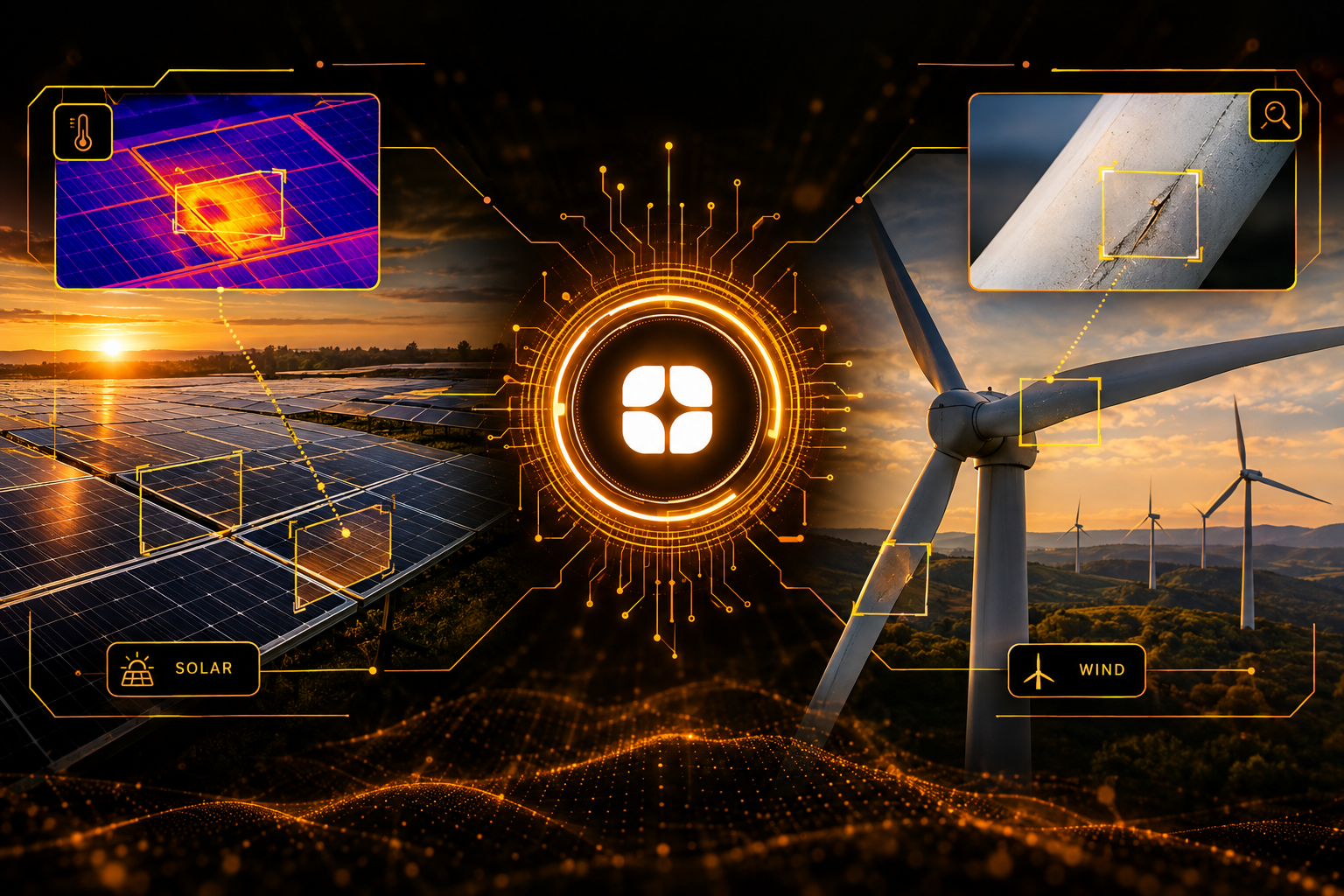
A solar farm can hold tens of thousands of panels. A wind farm can hold hundreds of turbines, each with three long blades. Nobody inspects every surface by hand, so operators turn to cameras and, increasingly, to computer vision.
That vision model is only as good as its labels. Solar panel defect imagery annotation and wind turbine blade inspection labeling both look simple from a distance. Up close, they depend on reading heat patterns, ignoring glare, and recognizing slow wear. This post explains what that work involves and why it needs people who know the equipment.
Solar arrays produce two image types: ordinary visible photos and thermal images. The visible photo shows cracks, discoloration, soiling, and broken glass. The thermal image shows how heat is spread across each panel.
Wind turbines are mostly visible-light work. The images are close-ups of blade surfaces, taken from different positions along each blade. The subject is a smooth, pale surface, and small marks on it can matter a great deal.
A bright patch on a thermal image is not automatically a defect. Panels warm up in sun, and the color scale can differ from one image to the next. An annotator who sees a warm area without knowing the scale settings, the weather, or the viewing angle can mislabel it.
The more useful label is the pattern. A single hot cell, a hot strip across part of a panel, and a panel that is warm all over are different findings. They often point to different problems, and a model needs to learn that difference. So the guidelines should name each pattern and show examples of it.
Thermal images also contain look-alikes that are not defects:
People who have worked with photovoltaic equipment know which of these are normal. A generic labeler tends to mark them all.
A heat pattern means more when you can see the panel itself. A warm patch under a bird dropping is a different case from a warm patch on clean glass.
For this reason, thermal and visible images of the same panel should be labeled together, not as unrelated files. Annotators need to match them, even when the two cameras differ in resolution or are slightly offset. When the pair cannot be matched with confidence, the guidelines should say how to record that, instead of leaving annotators to guess.
Blade damage has its own set of terms, and the differences are subtle in a photo:
Oil streaks, insect residue, and dirt trails can resemble cracks at a glance. Someone who has inspected blades knows to compare against the surrounding surface.
A defect that cannot be found again cannot be fixed.
For solar, a useful label ties each finding to a location in the array: the row, the table, the string, and the panel. For wind, it ties the finding to the turbine, the blade number, the blade surface, and roughly how far along the blade it sits.
Without those fields, a model can say "defect found" and a crew still has to hunt for it. With them, the annotation becomes something a maintenance team can act on. Annotators need clear rules for reading position, because a photo of one panel in a long row is easy to attribute to the wrong panel.
Both asset types are shiny. Solar glass reflects clouds and sun. Blade surfaces catch hard light that can wash out a real mark or create a false one. Shadows from the tower or another blade can look like a dark streak across the surface.
Guidelines should say whether each case is a defect, a reflection, or an unusable image.
When an array holds thousands of similar panels, small differences in how annotators treat borderline cases add up. One reviewer may call a faint hot cell a finding, and another may let it pass. Across a large dataset, that becomes a quiet bias in what the model learns.
A reference set of agreed examples helps. So does regular sampling of finished work, with reviewers checking the borderline cases first, since those are the ones most likely to drift.
People with experience in solar installations or wind turbine inspection read these images differently. They know what a healthy panel looks like under thermal view. They know which blade marks are cosmetic and which are not, and they know why position information matters to a repair crew.
Globik uses verified domain experts for work like this, with layered review to settle disagreements. For renewable energy AI training data, that combination keeps labels consistent across large, repetitive datasets, where small errors are easy to miss.
Before a solar or wind labeling project starts, a team can check five things:
Solar and wind inspection images carry a lot of information, but only if the labels capture patterns, positions, and look-alikes correctly. For the same kind of work on lines, structures, and substations, see our guide on power line and grid asset inspection imagery annotation: name the part before you judge the defect. In both cases, thermal image annotation and visible-light labeling need people who can tell real wear from noise.
It is the labeling of visible and thermal images of solar panels so computer vision can recognize cracks, soiling, and abnormal heat patterns.
A warm area can come from sun, glare, shadow, or wiring, so annotators must read patterns and conditions instead of marking every bright spot.
Common findings include leading edge erosion, cracks, peeling coating, lightning marks, and trailing edge splits, all of which need close visual judgment.
They tie each finding to a specific panel or blade location, so a maintenance crew can find and repair it without searching.
People with solar or turbine inspection experience, with layered review, because they can separate real wear from glare, shadows, and look-alikes.