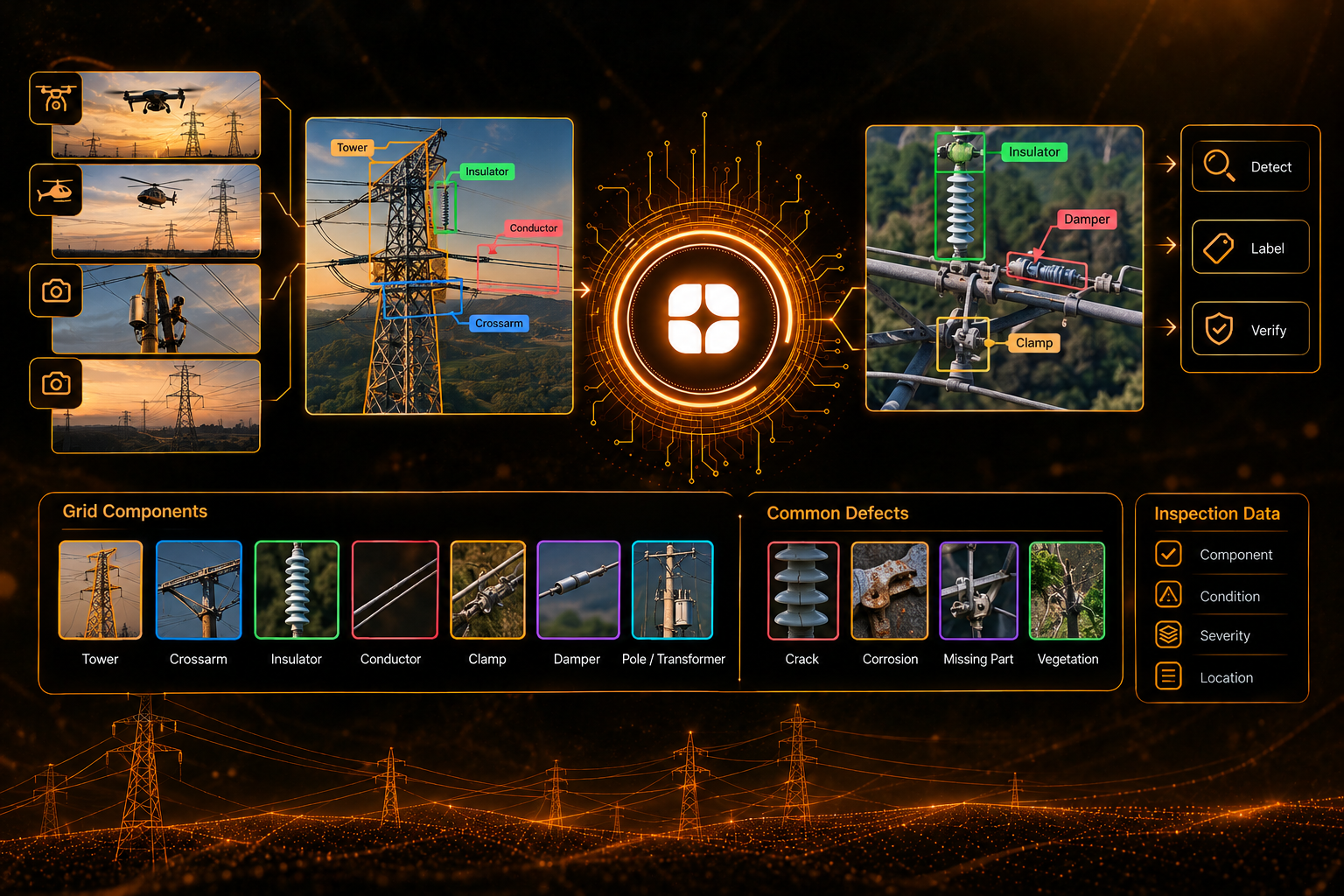
Utilities inspect transmission and distribution networks with drones, helicopters, climbing crews, and fixed cameras. The images pile up faster than any team can review by eye. Computer vision can help, but only if the images were labeled by people who know what they are looking at.
Power line inspection imagery annotation is not general object labeling. A tower, a crossarm, and an insulator string each have parts, and each part wears out in its own way. This post explains how grid asset inspection images should be labeled, and why the work belongs with people who understand electrical equipment.
A single photo of a transmission tower can hold dozens of labelable parts: the structure itself, crossarms, insulators, conductors, and hardware such as clamps, dampers, spacers, bolts, and pins. Distribution images add poles, transformers, fuses, and service lines.
Images arrive at different distances and angles. The parts that matter most are often small, sometimes only a few dozen pixels wide, and often partly hidden.
For this reason, good labeling works in two steps. First, name the component. Second, record its condition. Mixing the two into one label makes the data harder to use and harder to check.
A defect label means nothing if the part was identified wrongly. A generic labeler may tag every ceramic-looking object as "insulator" and move on. In practice, suspension, pin, and post insulators sit differently, and porcelain, glass, and polymer units look different and fail in different ways.
A cracked glass shell does not look like a contaminated porcelain disc. A damper on a conductor is not a spacer, even though both are small objects clamped to a line. Transmission structures and distribution poles also carry different sets of parts.
When the component is named wrongly, the condition label attaches to the wrong class. The model then learns a pattern that does not exist on real equipment. This is why utility inspection image annotation starts with a clear, illustrated list of components before anyone labels a defect.
The condition labels for grid assets usually fall into a few groups:
The hard part is telling a real defect from something that only looks alarming. Rust-colored staining on a bracket may be cosmetic, while a small crack in an insulator shell may be serious. Dirt, glare, and shadows can all pass for damage. An annotator without equipment knowledge cannot reliably sort these out.
Many inspection programs grade defects by urgency, for example monitor, schedule repair, or act now. Those tiers should come from the utility's own inspection manual or maintenance criteria, not from an annotator's judgment.
Each tier needs written definitions and image examples. Without them, one annotator's "minor" is another annotator's "urgent," and the model learns an average that matches nobody's maintenance plan.
Small parts such as pins, bolts, and clamps are usually marked with tight boxes. Conductors are different. They are long, thin, and often diagonal, so a box around one contains mostly sky. Polylines or masks fit these better.
For insulator strings, guidelines should say whether each unit gets its own label or the whole string is judged as one item.
Occlusion also needs a rule. When a tower leg hides half a fitting, annotators should label what is visible and mark the part as partly hidden. Guessing at the hidden half teaches the model to guess too.
Vegetation near lines needs special care. Clearance is judged in three dimensions, but a photo is flat. Annotators should mark trees and lines separately, record the viewing angle where it matters, and use clearance categories defined by the utility instead of their own estimate.
The same defect looks different from a drone, a helicopter, and a ground camera. Scale, angle, and lighting change from one source to the next, and a model trained on mixed images needs labels that stay consistent across all of them.
Guidelines should settle the smaller questions before work begins:
A reference set of agreed examples gives everyone the same starting point and settles disagreements without guessing.
People who have worked with line equipment can tell one fitting from another at a glance. They know which missing pin is urgent. They know what a healthy insulator string looks like, so they can spot the one that is not.
Globik uses verified domain experts for work like this, with layered review to resolve disagreements. For energy and utilities AI training data, that combination matters because the cost of a wrong label shows up later, in missed defects or in crews sent out to inspect parts that were fine.
Before an inspection labeling project starts, a team can check five things:
Reviewers should also look for false defects, not only missed ones. A model trained on staining and shadows labeled as damage will flag healthy equipment.
Inspection images show what an asset looks like today. Equipment sensors show how it behaves over time, and that side of the work is covered in our guide on why predictive maintenance AI depends on annotated sensor data. For the image side, insulator and hardware defect labeling is only as good as the people who can tell a healthy part from a failing one.
It is the labeling of photos and video of towers, poles, insulators, conductors, and hardware so computer vision can recognize parts and spot defects.
A defect label only makes sense on the right part, and wrongly named components teach the model patterns that do not exist on real equipment.
They often cannot tell similar parts apart or separate real damage from staining, glare, and shadows, which leads to unreliable labels.
The utility should, using its own inspection manual or maintenance criteria, with written definitions and image examples for each tier.
Polylines or masks fit conductors better than boxes, because a box around a diagonal wire contains mostly sky and adds noise.