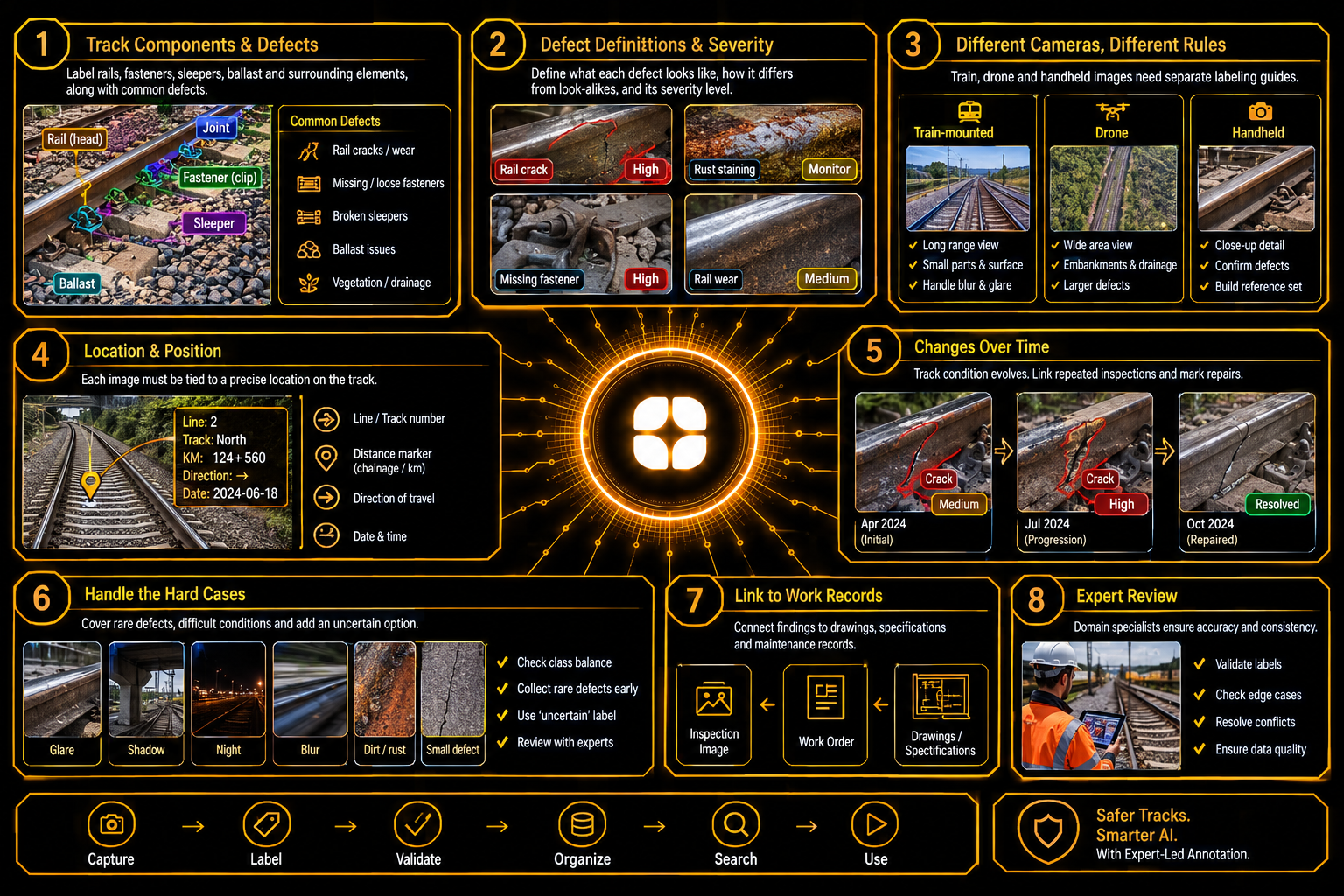
A railway track looks simple from a distance: two rails, a row of sleepers, and a bed of stones. Up close, it is a system of many small parts, and each one can fail. A missing fastener, a cracked sleeper, or a worn rail head can become a safety risk if no one catches it in time.
Railways now collect huge volumes of inspection images from cameras on trains, drones, and handheld devices. No team can review all of it by eye. AI can help, but only if it learns from carefully labeled examples. This post explains how railway track inspection imagery annotation works, why it is hard, and what railway AI training data needs to get right.
Track inspection images are usually labeled in four areas:
Switches and crossings, where tracks split or cross, are often labeled as their own group because they have more moving parts and wear faster. Labeling each of these parts is the base of track component labeling.
Railway footage looks repetitive, but the conditions change constantly.
Annotators need rules for images that are too blurred, too dark, or too dirty to judge. A “no defect” label on an unreadable image teaches the model a false lesson.
The hardest decision is what counts as a defect, and how serious it is. A mark that is harmless on one rail may need action on another, depending on the railway’s own standards.
Teams should write down, for each defect type, what it looks like, how it differs from its closest look-alike, and what size or position makes it serious. A missing clip, for example, may need a different label from a loose one. Severity levels, such as monitor, repair soon, and repair now, should follow the railway operator’s own maintenance rules, so the labels fit how crews actually work.
Without written definitions, two annotators will label the same crack in two ways, and the model learns the confusion.
Different cameras need different labeling rules, even on the same line.
Images from a train-mounted camera are taken at speed from above or beside the track. They cover long distances in a fixed view, so labeling focuses on small, repeated parts such as fasteners and rail surface, and on handling blur. Drone images give a wider view and can show embankments and drainage, but they see less fine detail on the rail itself, so labeling focuses on larger problems such as washouts or vegetation. Handheld or trolley images are taken close up by inspectors. They show the most detail, so they suit confirming defects and building reference examples.
A single guide for all three would blur these differences. Each type needs its own examples and its own reviewers.
A defect label is only useful if crews can find the spot again. Railways locate things by distance along the line, often using kilometer markers or chainage, along with the track number. Each labeled image should carry its position, direction of travel, and date.
Annotators need a rule for how that position is recorded, and reviewers should check that it matches the image. A perfect label on the wrong stretch of track sends a crew to the wrong place.
Track condition is not fixed. A small crack today may grow over the coming months, so railways inspect the same stretch again and again. Annotation can help by marking the same defect across repeat visits, so the model can learn how problems develop.
This needs careful rules. Annotators must decide how to match a defect across two dates when the lighting, angle, and position differ slightly. They also need a way to mark a defect as repaired, so the model does not keep learning from a fault that is gone.
Because serious defects are rare, a dataset can be full of healthy track and still teach the model little. Teams should check how many examples exist for each defect type and collect more of the rare ones early. They should also keep difficult cases in separate groups for testing, so the model is judged on the hard examples and not only the easy ones.
Safety makes an “uncertain” route essential. If an annotator cannot tell whether a mark is a crack or a stain, it should go to an expert, not be guessed. A missed defect and a false alarm have very different costs, and the rules should say how each is treated.
An inspection finding is most useful when it connects to the repair that follows. That link depends on drawings, specifications, and records that describe what the track should look like and what work was ordered. Our guide to construction document annotation explains how references like these are labeled so they can be matched with what is found in the field.
People who have worked on railway maintenance read these images differently. They know which wear is normal for a given rail, how a weld differs from a crack, and why a missing fastener near a joint matters more than one in the middle of a straight section. They also understand how severity is judged in practice.
Specialists write the defect definitions, set the severity levels, and review the hard cases. This reflects Globik AI’s approach of using verified domain experts for work that depends on judgment, where a generalist would be guessing.
Before starting a railway inspection project, settle these points:
Railway safety depends on catching small defects before they grow, and AI can only help if it learns from labels that are correct and consistent. Strong railway track inspection imagery annotation uses clear defect definitions, rules for each camera type, exact position records, and reviewers who know how track fails. With that foundation, inspection teams can spend their time on the places that need attention.
It is the labeling of images of rails, fasteners, sleepers, and ballast so AI can find defects. Annotators mark each part and any faults, using rules that follow the railway’s own maintenance standards.
Common labels include rail cracks and wear, missing or loose fasteners, broken sleepers, and ballast problems. Each defect needs a written definition and severity level so annotators label it the same way every time.
Glare, dirt, blur, and tiny defects make faults hard to see, and welds and joints can look like cracks. Serious defects are also rare, so datasets need extra effort to include enough examples.
Crews must find the defect again. Each image should carry its line, track, distance marker, and date. A correct label on the wrong stretch of track sends maintenance to the wrong place.
Specialists know normal wear, how welds differ from cracks, and how severity is judged in practice. They write clear defect rules and review doubtful cases, which makes the training data more reliable for safety work.