An online marketplace can hold millions of listings from thousands of sellers. The same product often appears many times, each with a different title, a different photo, and a slightly different price. Shoppers see clutter. Retailers cannot compare prices, merge reviews, or clean up their catalog.
AI can find these matches, but it learns from labeled examples, and the question it answers is harder than it sounds. Product matching annotation is the work of deciding, for pairs and groups of listings, whether they describe the same product. This post explains what those labels need to capture and why retail knowledge matters.
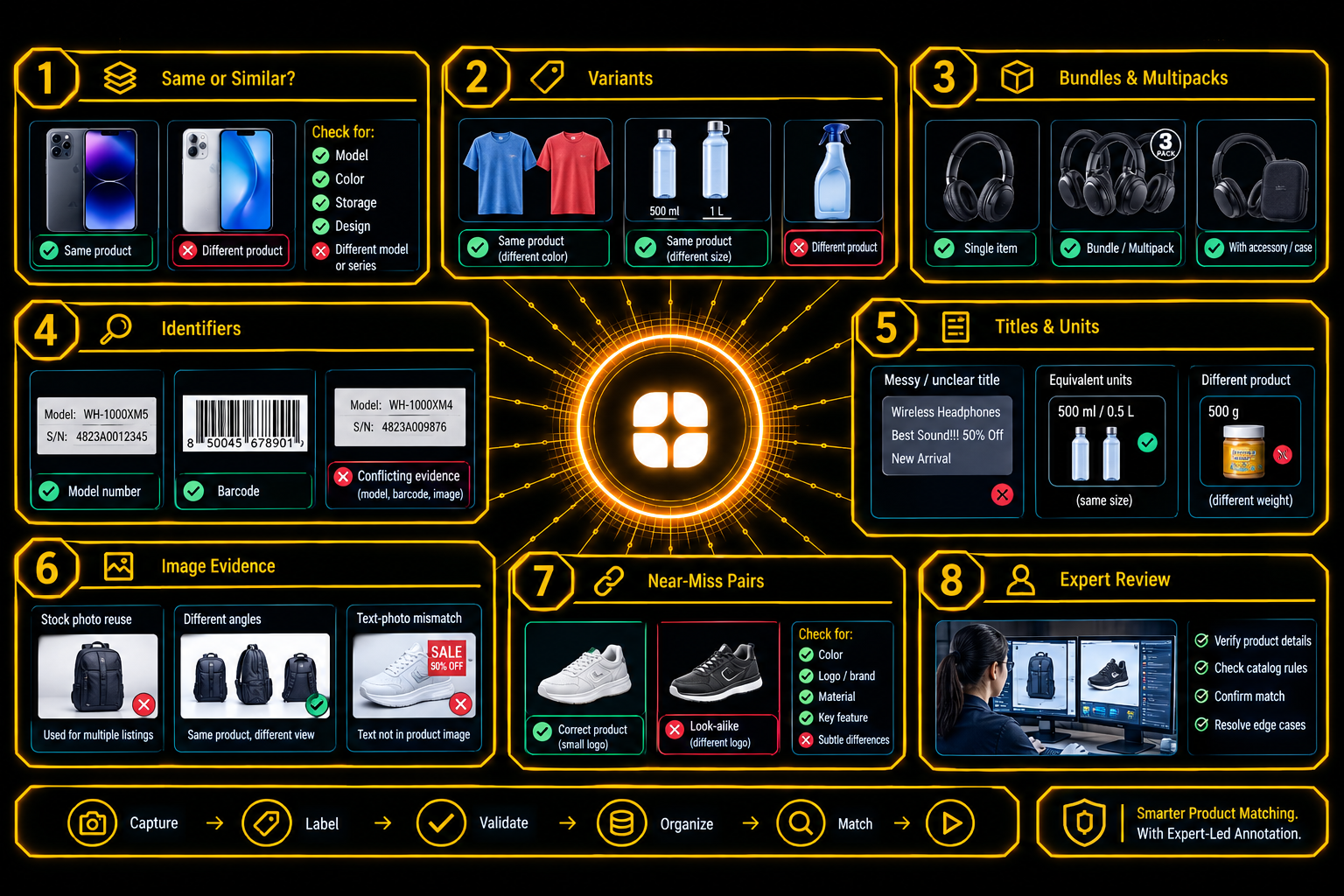
The raw material is pairs of listings, and sometimes whole groups. For each pair, annotators choose a relationship, such as:
The list is more important than it looks. A simple yes-or-no label throws away distinctions that retailers care about.
Matching is about identity, not similarity. Two listings can look alike, share most of their words, and still be different products. A phone and a case made for it will share a name. Two phone cases for the same phone, in different colors, are related but not identical.
An annotator who works from the look of the listing will group too much. One who requires an exact match on every word will group too little. The labeling guide has to define what "same" means, and show examples at the boundary.
Variants are the largest source of disagreement. A shirt in blue and the same shirt in red are the same design and different items. A 500 ml bottle and a 1 liter bottle are the same product line and different sizes.
Whether they match depends on what the data is for. If the goal is price comparison, only identical items should match. If the goal is grouping listings under one product page, variants belong together. Product variant labeling therefore has to follow the business purpose, and the guidelines should state it plainly.
The cleanest approach is to label two things: whether the products belong to the same family, and whether they are the exact same item. Both labels can then serve different uses.
Listings often sell the same item in different quantities. A single item and a pack of three are different offers. A bundle may contain the item along with extras. Used, refurbished, and open-box items are not the same as new, even when the photos match.
Accessories complicate things further. A listing for a replacement part, a case, or a refill describes something that works with the product without being it. Annotators need rules for compatible items, and for listings that mention the product only to say they fit it.
Many listings carry identifiers such as model numbers and barcodes. These are strong evidence. They are not proof.
Sellers copy identifiers from other listings, sometimes by mistake and sometimes to borrow another product's visibility. The same identifier can appear on two different items, and the same item can carry different identifiers on different listings. A model number in the title may disagree with the barcode in the data.
Annotators should treat identifiers as evidence and record when they conflict with other signals. A label made only on an identifier will carry that identifier's errors straight into the training data.
Listing titles are written for search, not for accuracy. Sellers stuff in keywords, use abbreviations, and mix languages. Units vary: "500 ml" and "0.5 L" mean the same thing, while "500 g" does not.
Duplicate listing labeling needs rules for these cases. Annotators should know common unit conversions, how to read abbreviations in the category, and what to do with titles that contain extra words that describe something else, such as the products it works with.
Photos help, but they can mislead. Sellers reuse stock images for different products. Photos taken from different angles can make the same item look different. Lighting changes color. Some listings show the product alongside accessories that are not included.
Annotators need to know how to weigh image evidence against text evidence, and what to do when they disagree. A listing whose photo shows one item and whose text names another should carry a flag, not a guess.
Matching data raises a question that other labeling does not: which pairs should be labeled? The number of possible pairs in a large catalog is enormous.
Random pairs are almost always obvious non-matches, such as a toaster and a pair of shoes. Models learn little from them. The pairs that teach the most are near-misses: products that look alike and differ in a detail. A good dataset includes many of them, and the project should decide how they are chosen.
People who work in merchandising or catalog management read listings differently. They know how products are grouped in their category, which details separate one model from another, and how sellers tend to write titles. They also know which differences matter to shoppers and which do not.
They write the rules that keep a team consistent: the relationship list, the variant policy, the unit conversions, and the handling of conflicting evidence. This matches Globik's approach of using verified domain experts for work that depends on judgment. For e-commerce AI training data, that knowledge is what makes the labels reflect how products really relate.
Before a product matching project starts, a team can settle five things:
Product matching AI works when labels define what "same" means, separate variants, bundles, and accessories, and treat identifiers, titles, and images as evidence that can conflict. For the wider case for deeper retail annotation, read our guide on why retail AI needs more than product tagging. Strong product matching annotation depends on people who know how products are sold.
It is the labeling of listing pairs or groups to show whether they describe the same product.
Variants, bundles, and accessories are related to a product without being identical to it.
It depends on the purpose, so label both product family and exact match.
Sellers copy identifiers, so the same one can appear on different products.
Random pairs are obvious, while look-alike products teach a model where the boundary lies.