Every online store runs on labels. A search bar, a "similar items" row, and a visual search tool all depend on someone having labeled the products correctly. When those labels are weak, shoppers see the wrong results and leave.
Many teams start with basic product tagging: a category, a color, a size. It is a good start, but it is not enough. Modern retail AI data has to capture how products look, how they relate to each other, and how customers talk about them. This post explains why, and what better e-commerce annotation looks like.
Retail AI covers a lot of ground. It helps shoppers find products, helps stores manage inventory, powers visual search, and drives personalized recommendations. Each of these depends on training data, and each needs a different kind of labeling.
The common thread is that retail data is full of detail. A single product can have dozens of attributes. Shoppers describe the same item in many different ways. A model can only learn this if the data reflects it.
Basic tagging answers one question: what category is this item? Retail AI needs more than that. Here is where simple tagging runs out.
At retail scale, generic annotation tends to prioritize speed over attribute precision. The data looks complete, but the model learns from shallow labels.
Retail AI also needs to understand customers, not just products. One of the clearest places to see this is in customer reviews. Reviews show what shoppers like, what disappoints them, and the words they use.
Labeling that customer behavior data takes care. A review can sound positive and still contain a complaint. A short comment can carry a strong opinion. Annotators need to understand product categories and everyday customer language to label sentiment correctly. A model trained on poorly labeled reviews will misread what shoppers actually think.
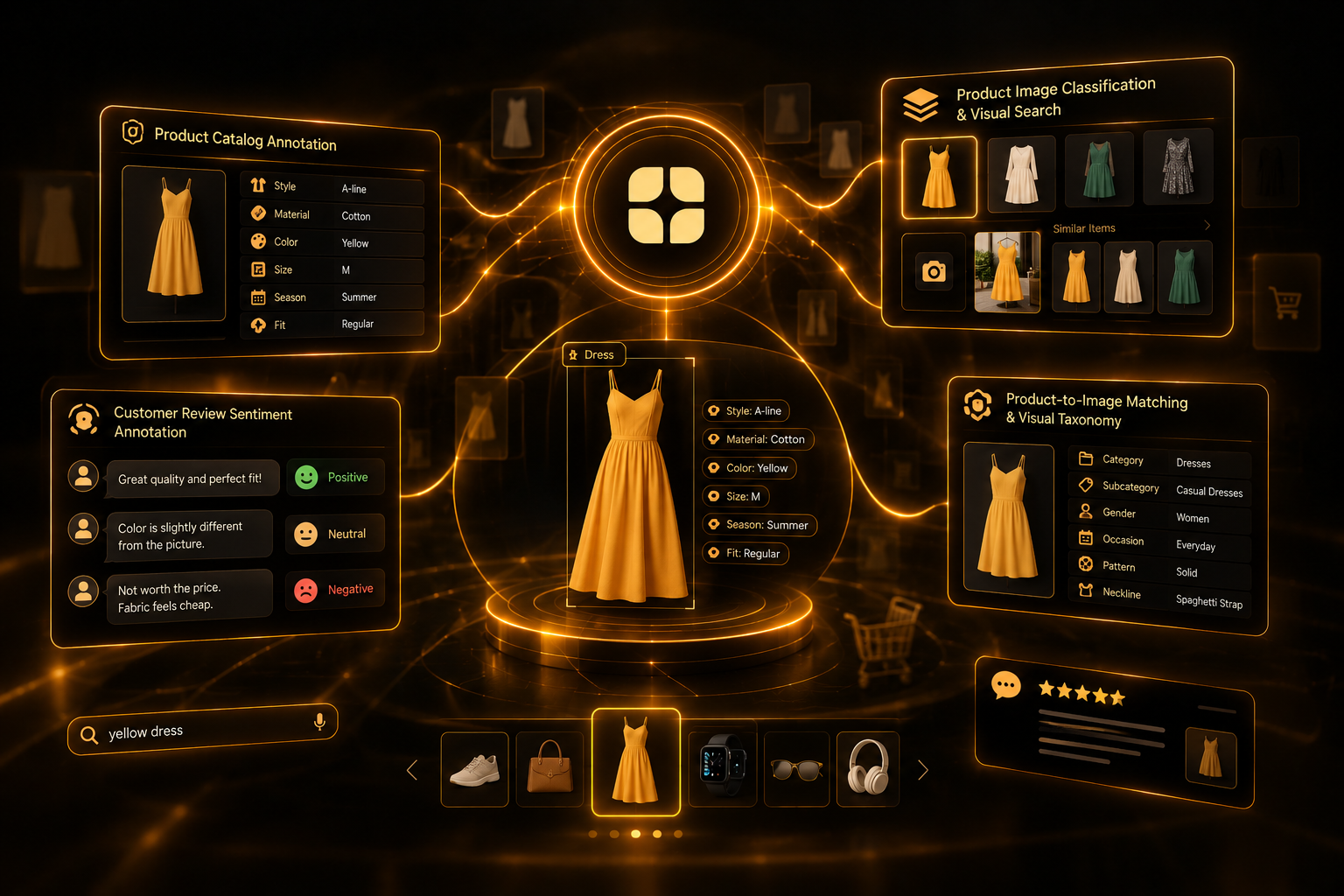
Strong e-commerce annotation goes beyond one tag per product. Globik AI supports retail AI with work such as:
Together, these cover how retail AI sees products, how it organizes them, and how it understands the people buying them. If you work with shelf or in-store imagery, our post on computer vision annotation for retail AI covers what those models need.
Product annotation is not guesswork. It takes an understanding of product categories, attribute hierarchies, and customer language. A person who knows how products are grouped and described will label faster and more accurately than someone seeing the category for the first time.
This is the core of how Globik AI works. We are not a crowd platform. We deliver domain-specific training data through a verified network of subject matter experts. You can read more about our retail work in the Retail AI section of our Industries page.
Trust matters when your product data feeds search and recommendations. Every expert in the Globik AI network goes through:
Every expert is auditable, so you know who worked on your data.
When you compare partners, look past price and speed. Ask who will label your product data and how they're verified, whether they understand product categories and attribute hierarchies or only general image labeling, whether they can handle both product data and customer review data, how quality is checked before delivery, and whether you can test the work on a small batch first.
A. Customer behavior data describes how shoppers think and speak about products. A clear example is customer reviews, which show opinions, complaints, and the words people use. Labeling reviews for sentiment helps retail AI understand what customers actually want and which product details matter most to them.
A. Globik AI offers four retail annotation services: product catalog annotation and attribute extraction, product image classification and visual search labeling, customer review sentiment annotation, and product-to-image matching and visual taxonomy labeling. Each is done by verified subject matter experts, not generalist crowds.
Ask for a scoped phase before committing. At Globik AI, a small, real slice of your data runs end to end in one to two weeks, covering the rubric, annotation, QA, and delivery. You can judge the quality of the work before you scale, and no long-term contract is required.
A. Customer behavior data describes how shoppers think and speak about products. A clear example is customer reviews, which show opinions, complaints, and the words people use. Labeling reviews for sentiment helps retail AI understand what customers actually want.
Globik AI offers product catalog annotation and attribute extraction, product image classification and visual search labeling, customer review sentiment annotation, and product-to-image matching and visual taxonomy labeling.
A. Ask for a scoped phase. At Globik AI, a small, real slice of your data runs end to end in one to two weeks, so you can judge the quality before you scale.