A streaming service may hold tens of millions of tracks. A production music library may hold thousands of cues that editors search for by feel: something tense, something warm, something with acoustic guitar. Nobody listens to every track to find them, so AI helps search, recommend, and organize the catalog.
That only works if the tags behind it are reliable. Music tagging annotation is the work of listening to audio and recording what it contains in a structured, consistent way. This post explains what is tagged, why each kind of tag is harder than it looks, and why trained listeners matter.
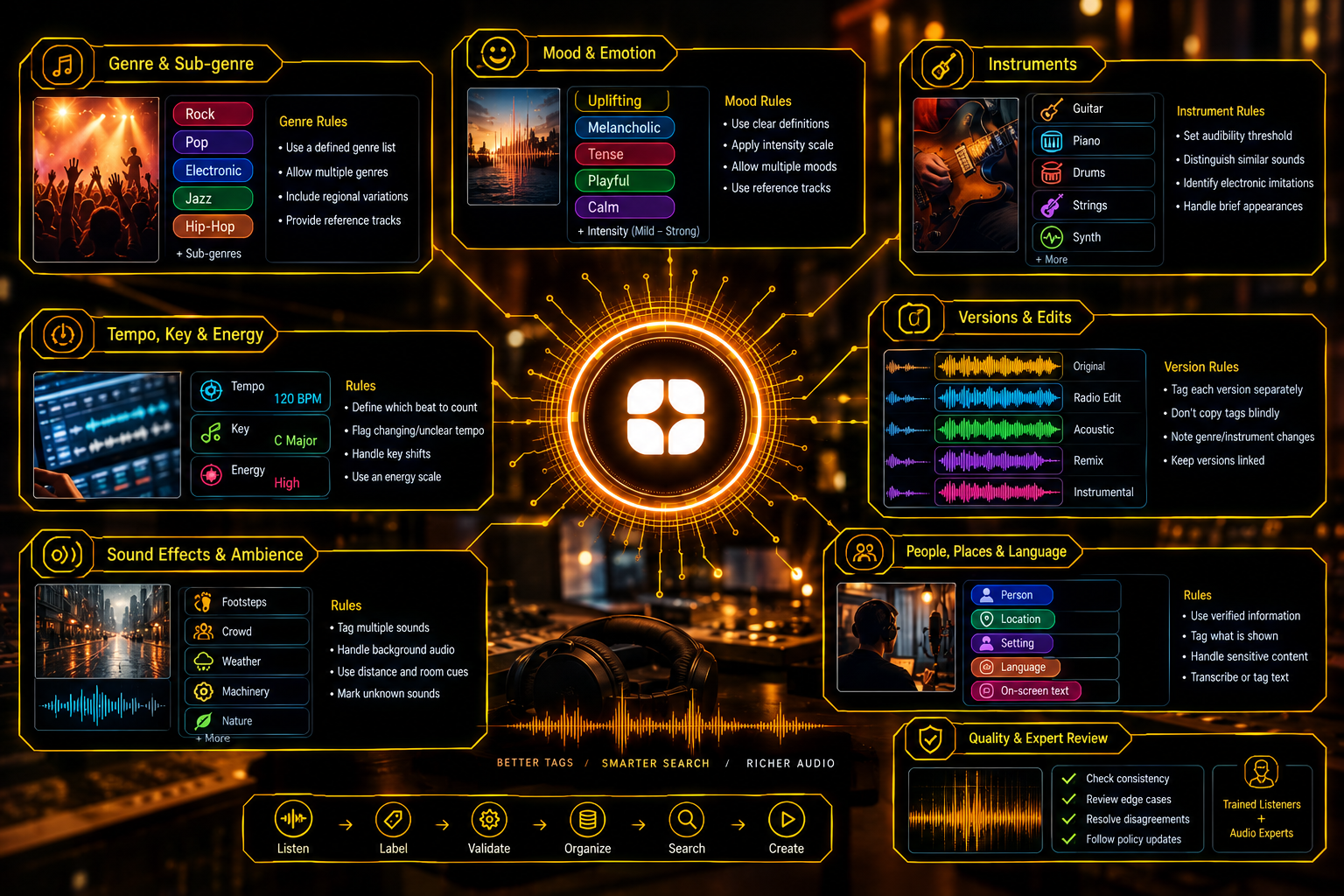
A tagged track usually carries several kinds of information:
Each of these needs its own rules. A single "tags" field with free text would give a model a pile of inconsistent labels.
Genre sounds like a simple label until you try to apply it. Many tracks blend styles. Sub-genres multiply, and listeners disagree about where one ends and another begins. Genre names also change from one country or community to another, and a name that is common in one region may mean something different in another.
Good projects handle this in a few ways. They use a written genre list that fits the catalog, with definitions and reference tracks. They allow more than one genre per track, and sometimes a primary and secondary label. They also avoid treating a Western-style genre list as universal when the catalog includes music from many traditions.
Mood tags are the most useful for search and the hardest to keep consistent. "Uplifting," "melancholic," "tense," and "playful" depend on the listener, the culture, and the context.
Music mood labeling works better when each mood has a written definition and a set of reference tracks. Many projects also add an intensity scale, so "tense" can be mild or strong, and allow several moods per track.
Time matters as well. A track may start calm and build to something dramatic. Labeling the whole track with one mood hides that. Where the use case needs it, moods should be marked by section, not only for the whole piece.
Because mood varies by listener, projects often have several people tag the same track. The spread in their answers is useful information. A track that listeners tag as "joyful" and "bittersweet" is telling you something real.
Naming instruments sounds easy until the music is dense. In a full mix, instruments overlap, share frequencies, and hide each other. Effects and processing change how things sound. Many sounds are electronic, and some imitate real instruments closely.
Instrument recognition data needs annotators with trained ears. They need to tell an electric guitar from a synthesizer playing a guitar-like line, a string section from a synthesized pad, and a drum machine from a live kit. They also need rules for how much of an instrument must be audible before it is tagged, and for whether to tag an instrument that appears for only a few seconds.
Tempo seems like a number, but it is often ambiguous. A track at one pace can feel twice as fast or half as fast, depending on how the beat is felt. Some tracks change tempo, and some have no steady beat at all.
Annotators need a rule for which beat to count, and a way to flag tracks with changing or unclear tempo. Key raises similar questions when music shifts between tonal centers or sits between two.
Energy is a more subjective measure of how intense a track feels. Like mood, it needs a defined scale and example tracks so that "high energy" means the same thing to every annotator.
One song often exists in many versions: the original, a radio edit, a live recording, an acoustic take, a remix, and an instrumental. These share a name and may share tags, but they do not always share a mood, an instrument list, or a tempo.
Labeling should treat each version as its own item. Copying tags from the original to every version saves time and introduces errors. A remix may change the genre, and an acoustic version changes the instruments entirely.
Audio tagging is not limited to music. Sound libraries hold effects and ambient recordings that need labels too: footsteps, doors, weather, crowds, machinery.
These recordings bring their own difficulties. Several sounds can overlap, and a quiet sound may sit under a louder one. Distance and room acoustics change how a sound is heard. The guidelines should say what to tag when several sources play at once, and what to do when a sound cannot be identified with confidence.
People who work in music, audio production, or music cataloging listen differently. They know how genres relate, can pick instruments out of a dense mix, and understand how editors and music supervisors search. They also write the rules that keep a large team consistent: the genre list, the mood definitions, and the handling of versions.
This matches Globik's approach of using verified domain experts for work that depends on judgment. For audio tagging for AI, that listening experience is what turns a pile of tags into a catalog people can search with confidence.
Before a music tagging project starts, a team can settle five things:
Music and audio catalogs become searchable when tags are defined, consistent, and applied by people who can hear the difference. For another example of labels that depend on context, see our guide on video content moderation and age-rating labeling: context decides the category. In both cases, strong music tagging annotation begins with clear definitions and knowledgeable reviewers.
It is the labeling of audio with genre, mood, instruments, tempo, and other tags so AI can search and recommend music.
Mood depends on the listener and context, so each mood needs a written definition, an intensity scale, and reference tracks.
Instruments overlap and electronic sounds imitate real ones, so annotators need trained ears and clear audibility rules.
Remixes, live takes, and acoustic versions can differ in genre, instruments, and tempo from the original.
They know genres, can hear instruments inside dense mixes, and write rules that keep large teams consistent.