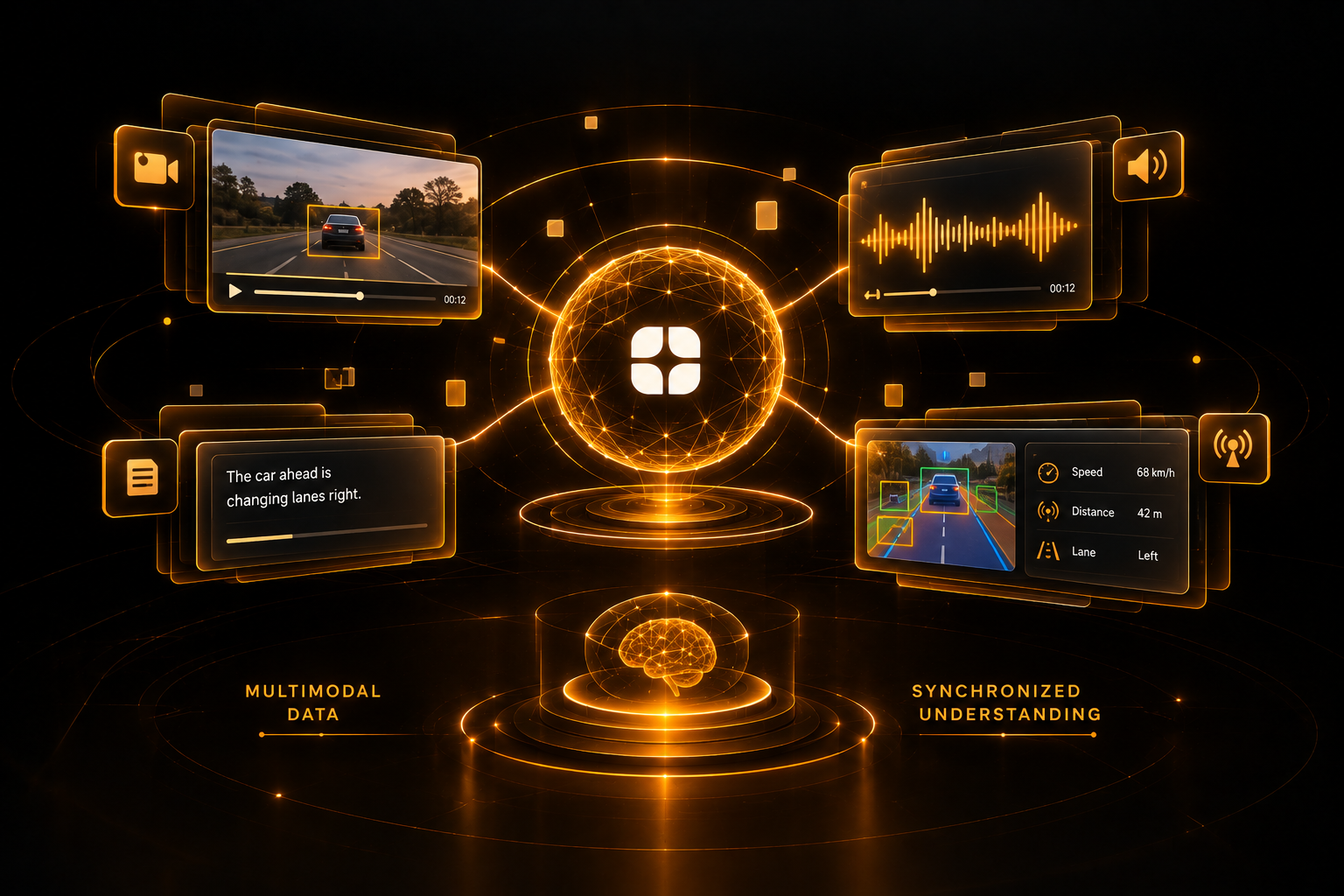
A multimodal model doesn't just process images, text, audio, and video separately. It has to understand how they relate to each other in time and context: a spoken word matched to a lip movement, a sensor reading matched to a visual frame, a caption matched to the right moment in a video. The model's entire value depends on these connections being accurate.
Most annotation work isn't set up to protect those connections. It's set up to label each type of data well on its own. That gap, between labeling each modality correctly and labeling them correctly together, is where a lot of multimodal projects quietly lose quality. This post looks at why multimodal annotation so often breaks down at exactly this point.
Most annotation pipelines were originally built for single-modality work: an image team, a separate text team, a separate audio team, each with its own tools, its own reviewers, and its own quality process. This structure makes sense historically, since most early AI projects only needed one modality at a time.
The problem shows up when the same pipeline gets reused for multimodal projects without real changes to how the teams work together. An image gets labeled by one team. The audio from the same clip gets transcribed by a completely different team, on a different tool, often without seeing the video at all. The two outputs might both be individually accurate. But nothing in the process confirms that they line up correctly with each other, frame to frame, moment to moment.
This is what "labeling in silos" really means. It's not that any single piece of data is wrong. It's that the relationship between pieces was never actually verified.
Synchronized data labeling means every modality is labeled with full awareness of the others, not labeled separately and merged afterward. That sounds like a small distinction, but it changes the entire workflow.
A transcript labeled without seeing the video might miss that a speaker pauses mid-sentence because they're reacting to something visual happening on screen. A sensor reading labeled without the matching camera footage might miss context that explains why a reading briefly spiked. An audio clip transcribed in isolation might miss sarcasm or tone that only becomes clear once you see the speaker's expression.
None of these are labeling mistakes in the traditional sense. The label itself, in isolation, can be perfectly correct. The mistake is structural: the person labeling one modality never had access to the information in the other modality that would have changed their judgment.
When data isn't labeled with real synchronization in mind, the damage usually isn't visible right away. It shows up later, in the model's behavior.
A unified annotation environment addresses this by design, not as an afterthought. Instead of separate tools and separate teams producing separate outputs later stitched together, annotators work with all relevant modalities visible at the same time, within the same task.
This means someone labeling audio can see the corresponding video frame-by-frame while they work, instead of working from an isolated audio file. It means text, image, and sensor data tied to the same moment in time are reviewed together, not merged after the fact by someone who wasn't involved in either original labeling pass. It also means guidelines and edge-case rules are written with cross-modal awareness built in from the start, rather than each modality team inventing its own interpretation independently.
Quality review works differently too. Instead of checking each modality's accuracy separately, review needs to specifically test whether the modalities agree with each other, whether a transcript matches lip movement, whether a label accounts for what's visible elsewhere in the same frame.
Multimodal models are increasingly used in applications where misalignment has real consequences: autonomous systems relying on synchronized sensor and camera data, conversational AI interpreting tone alongside words, video understanding systems tracking events across audio and visual streams at once.
As these use cases move from research into production, the cost of silo-labeled data stops being a minor quality gap and becomes a real reliability problem. A model that mishandles timing in a research demo is an inconvenience. The same failure in an autonomous system or a real-time monitoring tool is a different category of risk entirely.
For teams evaluating how their data gets labeled, a few questions reveal whether a vendor is actually set up for multimodal work or just applying single-modality processes across more file types:
Multimodal models depend on relationships between data types, not just the accuracy of each type on its own. Multimodal annotation that treats each modality as a separate labeling job, stitched together afterward, misses exactly the thing that makes multimodal data valuable in the first place. A genuinely unified annotation environment, where modalities are labeled together, reviewed together, and governed by shared guidelines, is what actually protects the synchronization these models depend on to work the way they're meant to.
A: Labeling in silos means different modalities, such as audio, video, and text, are labeled by separate teams using separate tools without shared visibility into the other modalities, which can result in accurate individual labels that don't actually align with each other.
A: Synchronized data labeling is important because multimodal models depend on accurate relationships between data types, such as matching audio to lip movement or sensor readings to camera footage, and labeling each modality in isolation can break those relationships even when each label looks correct on its own.
A: Problems include misaligned timing between audio and visual elements, weakened cross-modal reasoning, inconsistent judgment calls across teams, and quality issues that are difficult to detect because each modality appears correct when reviewed separately.
A: A unified annotation environment is a labeling setup where annotators have access to all relevant modalities for a given task at the same time, allowing labels to reflect the full context rather than being created in isolation and merged afterward.
A: A company can evaluate this by asking whether annotators see all relevant modalities while labeling, whether guidelines address cross-modal consistency, and whether quality review checks alignment between modalities rather than just the accuracy of each one individually.