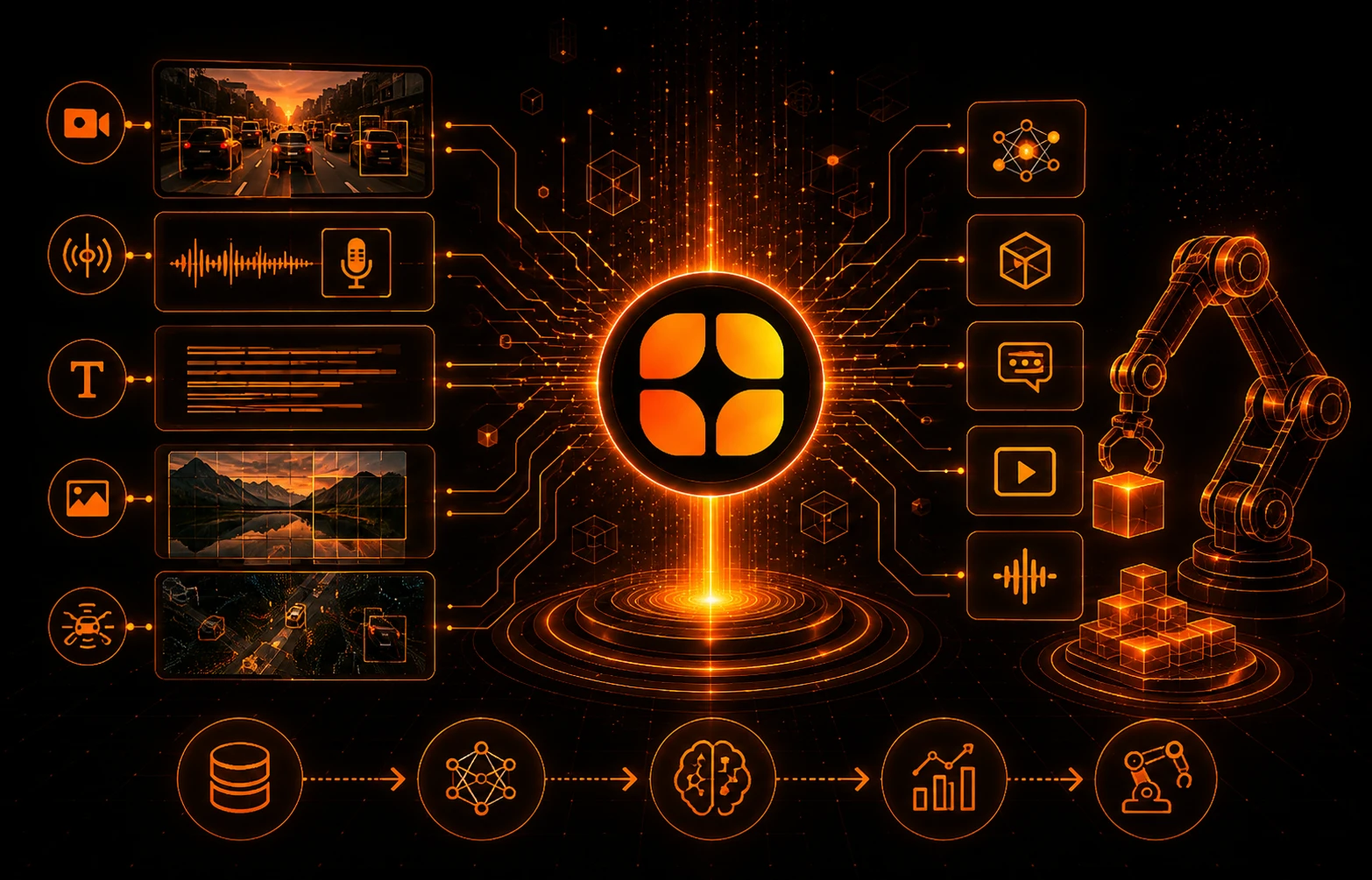
For most of AI's recent history, models specialized in a single type of data. Language models processed text. Computer vision models processed images. Speech models processed audio. Each excelled within its own domain and struggled the moment a task required understanding across more than one type of input at once. Multimodal AI represents a genuine departure from this pattern: systems built to understand and reason across multiple data types together, text, images, audio, video, and increasingly sensor data, combining them the way humans naturally do when we read a document with an accompanying photo, watch a video with dialogue, or listen to someone describe what they're pointing at.
This shift isn't a minor technical refinement. It's changed what AI systems can actually be asked to do, from answering questions about an uploaded image, to understanding a video's content well enough to summarize it, to powering agents that can see a screen, read associated text, and take an appropriate action based on both together. This guide covers what multimodal AI actually is, the training data it depends on, how multimodal models are typically built, and where the technology is genuinely being used today.
Multimodal AI refers to systems capable of processing, understanding, and often generating content across more than one data modality, commonly text, images, audio, and video, within a single model. Rather than requiring separate, disconnected systems for each data type, a multimodal model learns joint representations that connect information across modalities, allowing it to answer a question about an image, describe what's happening in a video clip, or generate an image based on a text description, all within the same underlying system.
The key distinction from earlier, single-modality AI isn't just that a multimodal data system can accept multiple input types. It's that the system genuinely learns relationships between those modalities, understanding, for instance, that a specific region of an image corresponds to a specific phrase in an accompanying caption, or that a particular tone of voice in an audio clip corresponds to a specific emotional context in a video's visual content.
It matches how information actually exists in the real world. Most real-world information isn't confined to a single modality. A product listing includes both images and text. A video includes visual content, spoken dialogue, and often on-screen text simultaneously. A medical record might include clinical notes alongside imaging. Systems that can only process one modality at a time miss the connections between these different information types that often carry the most meaningful signal.
It enables genuinely new categories of applications. Tasks like visual question answering, generating accurate image captions, video summarization, and AI agents that can see and interact with a screen simply aren't possible with single-modality systems, regardless of how sophisticated a text-only or vision-only model becomes on its own.
It improves accuracy even within familiar tasks. Even for applications that could technically be handled by a single modality, adding complementary information from another modality frequently improves accuracy. A content moderation system that considers both an image and its accompanying caption can catch violations that either modality alone might miss.
Paired and aligned multimodal data. The most fundamental requirement is data where different modalities are genuinely connected and aligned with each other, images paired with accurate, descriptive captions, video paired with accurate transcripts and timestamps, audio paired with corresponding text. This alignment is what allows a model to learn genuine cross-modal relationships rather than treating each modality as an entirely separate input stream.
Fine-grained, region-level annotation for vision-language tasks. Beyond simple image-caption pairs, more sophisticated multimodal capabilities depend on annotation connecting specific regions or objects within an image to specific words or phrases in accompanying text, enabling a model to learn precisely which part of an image a given description actually refers to, rather than only a general, whole-image association.
Temporally aligned video and audio annotation. For video-based multimodal tasks, training data needs annotation that's precisely aligned in time, labeling which specific moments in a video correspond to which spoken words, on-screen text, or described actions, since video's temporal dimension adds a layer of complexity that static image-text pairing doesn't require.
Cross-modal reasoning examples. Beyond simple description and captioning tasks, more advanced multimodal capabilities depend on training data that requires genuine reasoning across modalities, answering a question about an image that requires combining visual information with external knowledge, or interpreting a chart that requires connecting visual data representation with the specific numerical claims it supports.
Diverse, representative coverage across modalities. Just as with single-modality training data, multimodal datasets need genuine diversity, covering different visual styles, audio conditions, languages, and cultural contexts, to avoid producing models that perform well on a narrow slice of well-represented content while struggling with genuinely varied, real-world inputs.
Safety and bias-aware annotation across modalities. Multimodal systems introduce their own distinct safety considerations, since harmful or biased content can emerge from the combination of modalities even when each modality alone appears acceptable, requiring annotation processes specifically designed to catch these cross-modal issues.
Modality-specific encoders. Most multimodal architectures use separate encoding components initially specialized for each input type, a vision encoder processing images, a text encoder processing language, before combining their outputs into a shared representation space.
Cross-modal fusion. After initial encoding, multimodal architectures need a mechanism for combining information across modalities, allowing the model to learn relationships between, for example, specific visual features and specific textual concepts, rather than processing each modality's information in complete isolation.
Joint pretraining on paired data. Multimodal models are typically pretrained on large volumes of paired data, image-text pairs, video-transcript pairs, learning general associations between modalities before being fine-tuned on more specific, task-oriented multimodal data.
Task-specific fine-tuning. Following broad multimodal pretraining, models are often fine-tuned on data specific to a target application, visual question answering, video summarization, or document understanding, using annotation built specifically for that narrower task.
Increasing move toward unified architectures. While early multimodal systems often stitched together separately trained single-modality components, more recent approaches increasingly favor architectures designed from the outset to handle multiple modalities within a more unified framework, reflecting a broader industry shift toward treating multimodality as a core design principle rather than an add-on capability layered onto an existing single-modality system.
Visual question answering and image understanding. Systems that can answer natural language questions about the content of an image, identifying objects, describing scenes, or interpreting charts and diagrams, depend directly on well-aligned image-text training data.
Document understanding. Many real-world documents combine text, layout, tables, and images together, invoices, forms, scanned records, and multimodal AI has become central to accurately extracting and interpreting this combined information, rather than treating document text and layout as separate, disconnected inputs.
Video content understanding and summarization. Applications ranging from content moderation to automated video summarization depend on models that can jointly process visual content, spoken dialogue, and on-screen text to understand what's actually happening in a video, not just what it superficially looks like from isolated frames.
Retail and e-commerce product understanding. Multimodal AI increasingly powers product search and recommendation systems that combine product images with descriptive text, enabling more accurate matching between what a customer is looking for and what a product listing actually shows and describes.
Healthcare diagnostic support. Combining medical imaging with clinical notes and patient history allows multimodal systems to support diagnostic reasoning that draws on multiple information sources together, closer to how a clinician actually integrates different types of information during an evaluation.
Autonomous systems and robotics. As covered extensively in physical AI more broadly, robots and autonomous vehicles depend on genuinely multimodal understanding, combining vision, depth, audio, and increasingly tactile and force data, to perceive and act reliably in the physical world.
Accessibility tools. Multimodal AI powers tools that describe visual content for visually impaired users, transcribe and interpret audio for hearing-impaired users, and bridge between modalities in ways that meaningfully expand access to digital content and physical environments.
Conversational AI agents that see and act. Increasingly, AI agents combine conversational language understanding with the ability to interpret a screen, an image, or a video feed, and take appropriate action based on that combined understanding, extending the agentic AI capabilities discussed elsewhere into genuinely multimodal territory.
Genuine alignment accuracy, not loose association. Poorly aligned data, captions that only loosely describe an image, transcripts with significant timing drift from their video, teaches a model weak or incorrect cross-modal associations, undermining exactly the capability multimodal training is meant to build.
Sufficient granularity for the target task. Simple, whole-image captioning data is insufficient for tasks requiring fine-grained, region-level understanding, and annotation needs to be built at the level of detail the actual target application requires, not a generic, loosely aligned baseline.
Domain-appropriate annotation for specialized applications. Just as with single-modality annotation, specialized multimodal applications, medical imaging paired with clinical notes, technical diagrams paired with engineering documentation, benefit enormously from annotators with genuine domain expertise, not just general multimodal labeling experience.
Coverage of genuinely challenging cross-modal cases. The most valuable multimodal training data often includes examples where modalities provide complementary rather than redundant information, situations where understanding requires genuinely combining information across modalities rather than relying on any single one alone, since these are the cases that actually test and build real cross-modal reasoning capability.
Invest specifically in alignment quality, not just data volume. Loosely paired or misaligned multimodal data undermines the core capability multimodal training is meant to build, regardless of how much volume is collected.
Match annotation granularity to your actual application. Simple caption-level data may be sufficient for basic description tasks, but applications requiring precise, region-level or moment-level understanding need annotation built at that level of detail from the start.
Bring in domain expertise for specialized multimodal applications. Medical, legal, technical, and other specialized multimodal use cases require the same domain-expert annotation rigor that specialized single-modality applications depend on.
Deliberately collect challenging, complementary cross-modal examples. Datasets dominated by simple, redundant modality pairings won't build genuine cross-modal reasoning capability as effectively as datasets that include cases requiring real integration across modalities.
Multimodal AI reflects a genuine shift in what AI systems can understand and do, moving from single-modality specialists toward systems that reason across text, images, audio, and video the way information actually exists in the real world. But this capability depends entirely on training data built specifically for genuine cross-modal alignment, sufficient granularity, and real domain expertise where specialized applications demand it.
For organizations building or evaluating multimodal AI, understanding what the underlying training data actually requires, not just which modalities a model claims to support, is what separates systems that genuinely reason across modalities from systems that merely accept multiple input types without truly connecting the information between them.
Multimodal AI refers to AI systems capable of processing, understanding, and often generating content across more than one data modality, such as text, images, audio, and video, within a single model, learning genuine relationships between these different types of information.
A genuinely multimodal system learns joint representations connecting information across modalities, understanding relationships between, for example, specific image regions and specific text, rather than simply running separate models on each modality and combining their outputs afterward without any learned connection between them.
Multimodal AI needs genuinely aligned, paired data across modalities, such as accurately captioned images, precisely timed video transcripts, and fine-grained region-level annotation, along with diverse, representative coverage and safety-aware labeling that accounts for cross-modal issues.
Common applications include visual question answering, document understanding, video content summarization, product search and recommendation, healthcare diagnostic support, autonomous systems and robotics, accessibility tools, and conversational AI agents that can see and act on visual information.
Because poorly aligned data, such as captions that only loosely describe an image or transcripts with significant timing drift, teaches a model weak or inaccurate associations between modalities, undermining the core cross-modal understanding multimodal training is meant to build.