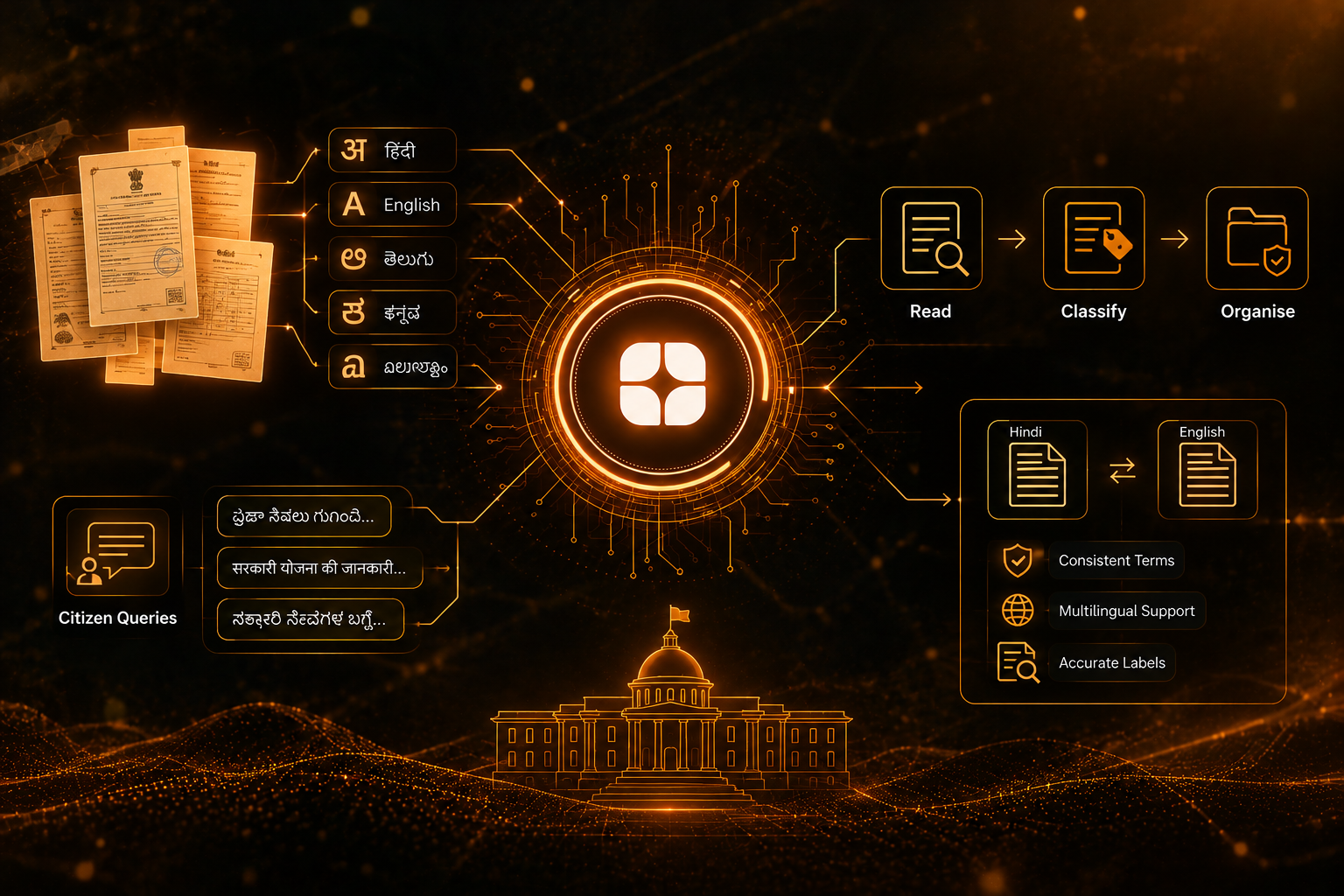
Government work rarely happens in one language. Notices, forms, announcements, and citizen queries move between national and regional languages, often within the same office on the same day. AI built for these settings has to read, sort, and respond across all of them.
That makes multilingual public sector data annotation different from labeling a chatbot dataset in several languages. The text is official, the vocabulary is fixed, and a mistake can change what a notice appears to promise. This post looks at what makes official language hard to annotate across national and regional languages, and what government AI training data needs to get right.
Public sector language data comes in many forms: circulars, public notices, application forms, service announcements, helpline logs, and written queries from citizens. Annotation tasks include sorting queries by topic or department, tagging names, places, and offices, and checking whether a translated notice says what the original said.
Each of these tasks has to work in every language the administration uses. A label applied differently in two languages leaves the model with two incompatible views of the same service.
For paper archives, see our guide on government document digitisation and administrative record classification.
Official documents use a style of their own. Sentences run long, the voice is often passive, and fixed phrases appear again and again. A reader who speaks the language fluently but has never worked with government paperwork can still find it hard to follow.
Citizen queries sit at the other end. People write in plain, informal words. A single public sector project often needs both: formal text to read and classify, and everyday text to understand.
The two registers need different labeling rules. Guidelines written for one will mislead annotators working on the other, so each needs its own examples and its own reviewers.
Government language is full of fixed names. Schemes, departments, designations, forms, and procedures all have approved terms, and those terms are meant to be used the same way each time.
Problems start when annotators pick their own translations. If a scheme name is rendered three different ways across three languages, the model may treat them as three different things. Even within one language, informal shortcuts can drift away from the official name.
The fix is a shared glossary: one approved term per concept in every language, owned by someone who can settle disputes. Annotators check the glossary before labeling, and reviewers check that labels match it. Without this, consistency across languages depends on individual memory.
Governments often publish the same notice in several languages. In theory the versions say the same thing. In practice, wording can differ, and one version may be updated before the others.
Annotators working on this material need rules for several questions:
A model trained on versions that quietly disagree learns to treat disagreement as normal. Labeling that marks real differences helps it learn the opposite.
Names and places create a quieter problem. The same person or town can be written in more than one script, and the same script can produce several spellings of one name. Titles and honorifics add more variation.
Entity labeling has to link these variants to a single entity, rather than treating each spelling as someone new. Address formats also differ across regions, with different orders, landmarks, and local terms. Annotators need rules for which parts of an address count as which parts, and they need reviewers who recognize local naming patterns.
Small details carry real weight in official text. Dates may be written day first or month first, and numerals may appear in different scripts. Reference numbers mix letters, digits, and separators in ways that identify an office or a year.
Annotation rules should say how each of these is read and recorded, so a date means the same thing no matter which language it appears in. A model that confuses day and month, or misreads a reference code, can send a document to the wrong place.
Multilingual reviewers who also understand public administration catch things a general language speaker would not. They know which phrases are fixed, recognize approved terms, and can tell when two versions of a notice truly disagree.
They also keep the system consistent. A good review process checks agreement across languages, not just within each one, so a label that changes meaning between languages gets caught early. This reflects Globik AI's approach of using verified domain experts for work that depends on judgment, and it supports the audit-ready standards that public sector projects expect.
Before starting a multilingual public sector project, settle these points:
Official language has its own vocabulary, its own style, and its own rules about what must stay fixed. Strong multilingual public sector data annotation respects those rules, keeps terms consistent across languages, and flags where versions or spellings disagree. When that discipline is in place, government AI training data helps a model treat every language of an administration as part of one coherent service.
It is the labeling of government text such as notices, forms, and citizen queries across national and regional languages for AI training.
It uses formal sentence structures and fixed terms that need familiarity with public administration to read and label correctly.
It keeps scheme, department, and designation names consistent across languages, so the model does not treat variants as different things.
Versions can differ in wording or update timing, so annotators need to know which is authoritative and how to flag mismatches.
The same person or place can be written in several scripts and spellings, and labels must link them to one entity.