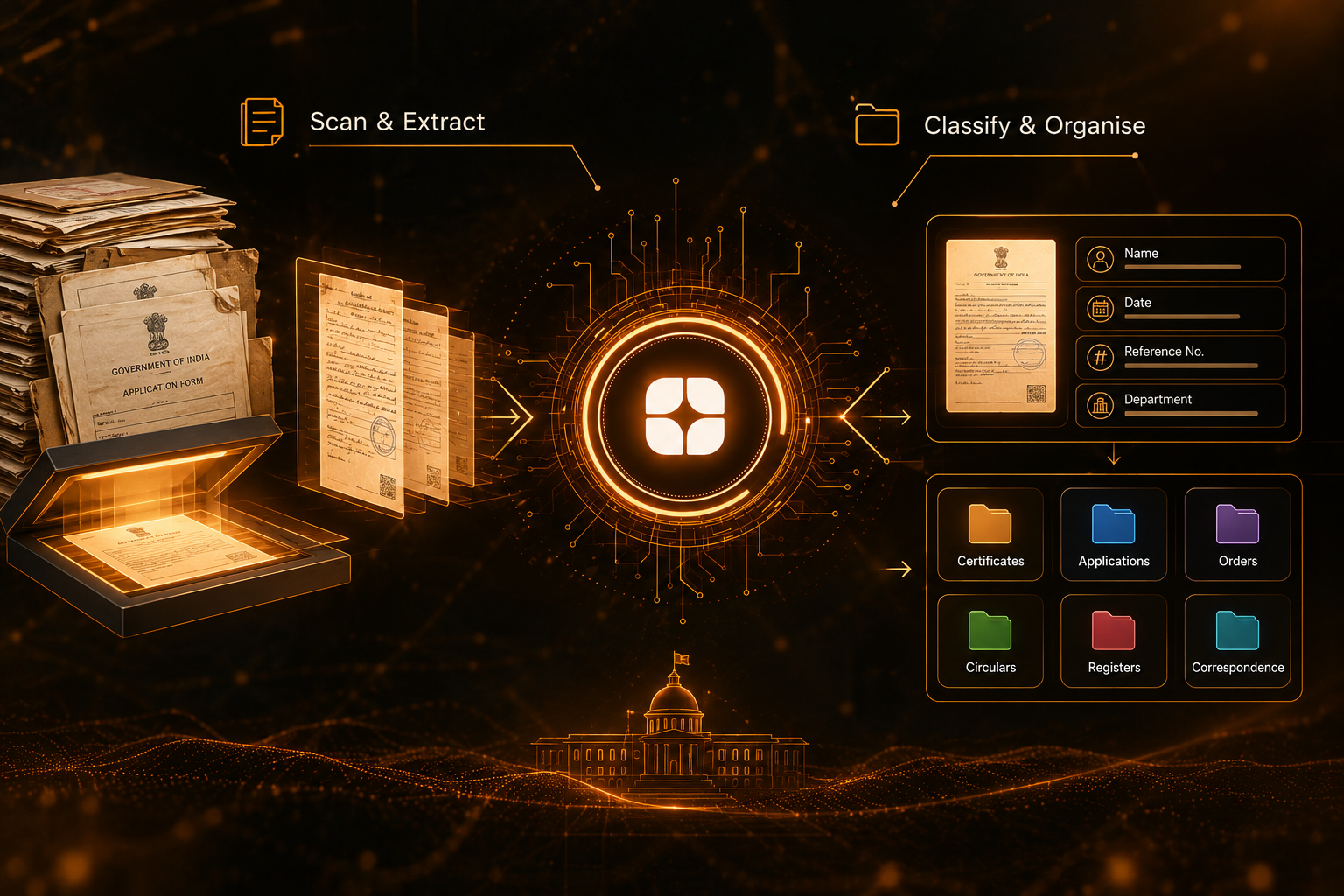
Many government offices still hold decades of paper: permits, certificates, applications, registers, circulars, and bundles of correspondence. Moving that archive into searchable, structured form is a major data job for the public sector, and AI is increasingly used to do it. But a model can only read and sort these records well if it learned from examples that were labeled correctly.
That is the core of government document digitisation: turning scans into text, fields, and categories that a system can trust. The reading step gets the attention, yet the sorting step, known as administrative record classification, is where many projects quietly go wrong. This post looks at what makes public records hard to annotate and what good public sector AI training data looks like.
Digitising a record involves two connected tasks.
The first is extraction. The model reads printed text, handwriting, tables, stamps, and form fields, and turns them into structured data such as a name, a date, or a reference number.
The second is classification. Every record is assigned to a category: a record type, a department, a series, a confidentiality grade, or a retention class. These categories decide where a record is stored, who sees it, and how long it is kept.
Both tasks need labeled examples, since a model that reads perfectly but files records in the wrong place is of little use.
Government documents do not behave like clean forms from a modern app. Several features make annotation difficult.
Layouts change by office and by era: The same type of certificate may look different across departments, regions, and decades. Annotators must recognize one record type under many appearances.
Pages carry more than printed text: Stamps, seals, signatures, and handwritten margin notes often sit on top of the printed words. An annotator has to know which marks are part of the record and which are noise, and whether a stamp carries meaning, such as the date a record was received.
Several scripts can share a page: In multilingual countries, a form may mix an official language, a regional language, and English. Handwriting adds another layer. Annotators who read only one of these will misread the rest.
Scan quality is uneven: Folds, faded ink, carbon copies, and bleed-through from the reverse side are common in older archives. Labelers must judge what a faded character most likely was.
Administrative language has its own conventions: Reference numbers, file notes, enclosures, and cross-references follow patterns that insiders understand. A reference number is not just a string of characters. It can reveal the department, the year, and the file it belongs to.
Classification mistakes are subtle because the documents often look alike.
Similar record types are confused: A circular, an order, and a notification may share a letterhead and layout while serving different purposes. Without a clear definition, they get mixed together.
Attachments lose their parents: A bundle may contain a main letter, several enclosures, and a covering note. If each page is labeled alone, the model never learns which pages belong together.
Page boundaries are missed: Scans of a long file arrive as one continuous stream. Someone has to decide where one record ends and the next begins.
Drafts and finals are treated as the same: A draft with edits and the signed final version can look nearly identical, yet they may be filed very differently.
Sensitivity is overlooked: Some records carry a confidentiality grade or contain personal details. If a label ignores this, the archive may expose restricted material.
Strong labeling for this work follows the structure of the office the records came from.
People who know how government offices work read these records differently. They recognize common document types, understand how files are built up over time, and can tell a routine stamp from one that changes a record's meaning. They can also read the scripts and languages involved, which matters when handwriting is mixed with print.
This knowledge shapes the guidelines as well as the labels. Specialists can write classification rules that match a department's real filing logic, so the output fits the systems that will use it. This reflects Globik AI's approach of using verified domain experts for work that depends on judgment, and it supports the audit-ready standards that public sector projects expect: every label can be traced to a rule and a reviewer.
Before starting a document digitisation project, settle these points:
Digitising government records is about more than reading old paper. It is about placing each record correctly within a system built over many years. Models trained on carefully labeled examples, shaped by people who understand public administration, can read the page and file it where it belongs. That combination is what makes government data annotation useful to the offices that depend on it.
It is the process of converting paper and scanned public records into searchable, structured data that AI systems can read and sort.
It is the assignment of each record to a category such as record type, department, confidentiality grade, or retention class.
They mix printed text, handwriting, stamps, and several scripts, and their layouts vary widely by office and era.
Records often arrive as bundles, so a model needs to learn which pages belong together and where each record ends.
They understand administrative formats and filing logic, so they can apply consistent, traceable rules across large archives.