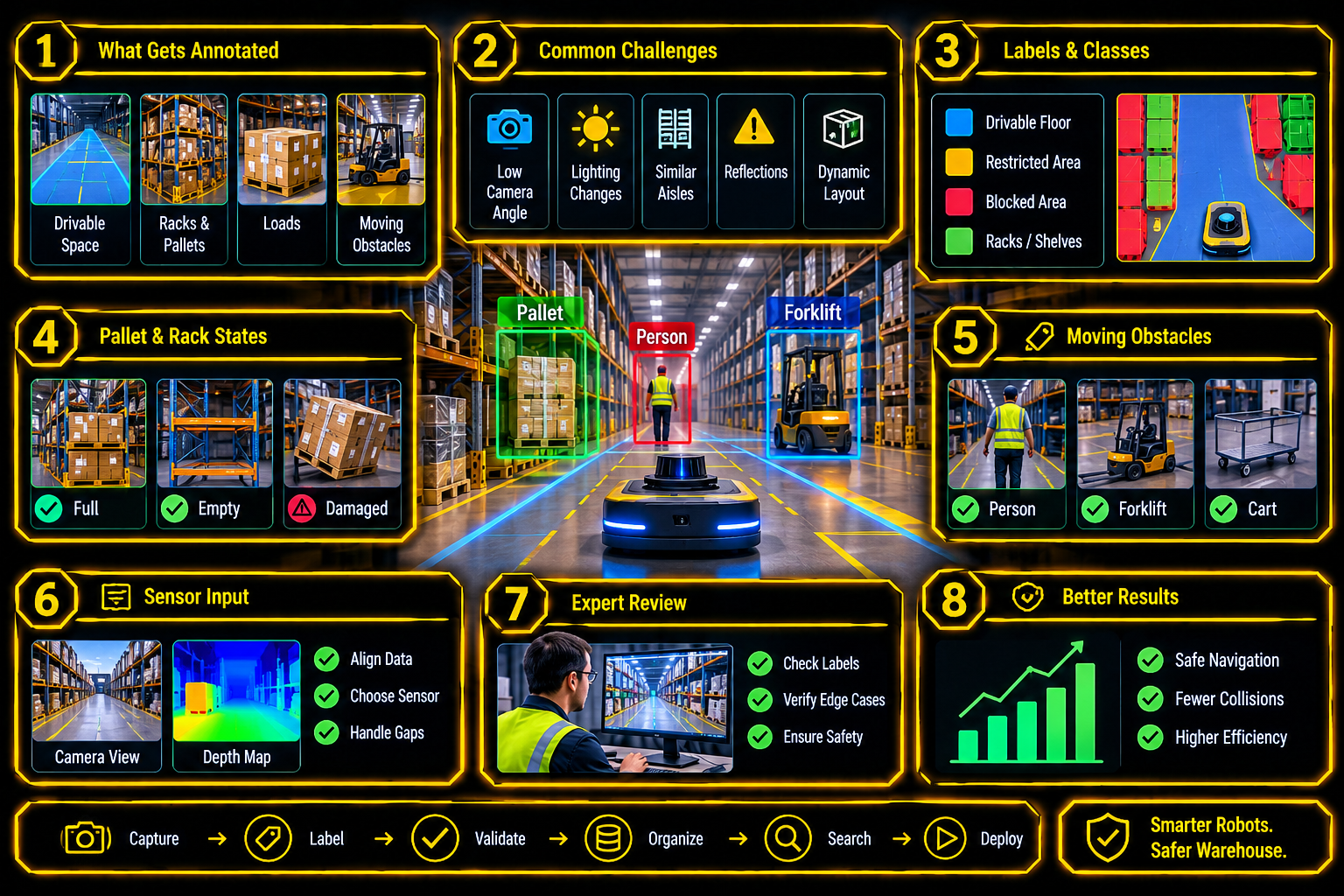
A mobile robot in a warehouse must answer a few questions every second. Where can I drive? What is in my way? Is that pallet where it should be? Forklifts, people, and other robots share the same floor, and the layout changes by the hour. Cameras and depth sensors give the robot its view, and AI turns that view into decisions.
That AI learns from labeled data. Good mobile robot navigation annotation means marking floors, racks, pallets, and obstacles the same way every time. This post explains what the work covers, why it is hard, and what manufacturing AI training data needs to get right.
Annotation for warehouse navigation usually has four parts:
Models trained on these labels support route planning, safe stopping, pallet pickup, and shelf checks. This is the basis of warehouse navigation data labeling.
A warehouse looks orderly, but the view from a robot is not.
Annotators need rules for areas that cannot be judged. A “free floor” label on a patch hidden by glare teaches the model a false lesson.
The floor label looks simple, but it needs careful rules. Is the painted walkway drivable? What about a ramp? Marked zones, such as pedestrian lanes and charging areas, may be open to some robots and closed to others.
The guide should define each floor class, such as free, restricted, and blocked, and state which marks decide it. It should also say where the boundary sits, since an edge drawn too far out can send a robot into a rack.
Annotators may mark the rack frame, each slot, and what sits in it. Labelers should record pallet position, facing, and whether it is damaged or leaning. Stacked loads need a height rule, and overhanging loads need a rule for the true edge. An empty slot, a full slot, and a half-fitted pallet are three different states, and each needs a definition and an example.
These two labeling jobs fail in different ways.
The static scene covers floors, racks, and pillars. Labels can be checked against a floor plan, and errors come from glare, repeating aisles, and layout changes. Moving obstacles are people, forklifts, and carts. Labels must follow an object across frames, and errors come from blocked views, fast motion, and objects that stop and start.
A single guide for both would blur these differences. Each needs its own definitions, examples, and reviewers.
A robot must slow near a person, and a missed person is the costliest error. Annotators should label people even when only a leg or an arm shows, and mark partly hidden ones as occluded, not absent.
Useful labels include object type, direction of travel, and whether the object is stopped or moving. Forklift forks, which stick out low and thin, need their own class. Where the view cannot show what an object is, an “unknown obstacle” label is safer than a guess.
Many robots pair cameras with depth or laser sensors. Data must line up in time, since small clock offsets can place an obstacle in the wrong spot. The guide should say which sensor decides when they disagree.
Most footage shows clear aisles, so collect extra examples of busy hours, night shifts, spills, and blocked aisles. Keep data from the same route, shift, or site on one side of the train and test split, and test on a warehouse the model has never seen.
Some frames cannot support a safe label. Give annotators a “cannot judge” option and send doubtful frames to an expert. A false stop wastes time, while a missed obstacle can cause a collision, so the rules should say how each is handled. We describe a related inspection task in our guide to assembly step verification video annotation.
People with warehouse and robotics experience know how aisles are laid out, how pallets are stored, and where robots tend to fail. They can tell a pedestrian lane from a drive lane, and a stable stack from a risky one.
Specialists write the floor classes, set the obstacle rules, and review doubtful frames. Because footage shows workers, they also help set privacy rules for what is masked and who sees raw video. This reflects Globik AI’s approach of using verified domain experts for work that depends on judgment, where a generalist would be guessing.
Before starting a navigation project, settle these points:
A mobile robot is only as safe as the labels it learned from. Strong mobile robot navigation annotation uses clear floor definitions, firm rules for pallets and racks, careful labeling of people and vehicles, and reviewers who know how warehouses run. With that foundation, robots can move through busy floors with confidence.
It is the labeling of camera and sensor data so robots can recognize drivable floor, racks, pallets, and obstacles. Annotators follow written rules based on the site layout.
It is labeled data showing where racks, slots, and pallets are, and whether each slot is empty, full, or half-fitted. Robots use it for pickup and shelf checks.
People and forklifts change position across frames, so labels must follow them over time. A missed person is the costliest error, so these labels get extra review.
Repeating aisles, glare on floors, low camera angles, and changing layouts make scenes hard to read. A cannot-judge option keeps guesses out of the data.
Specialists know aisle layouts, pallet storage, and common robot failures. They write clear floor and obstacle rules and review doubtful frames.