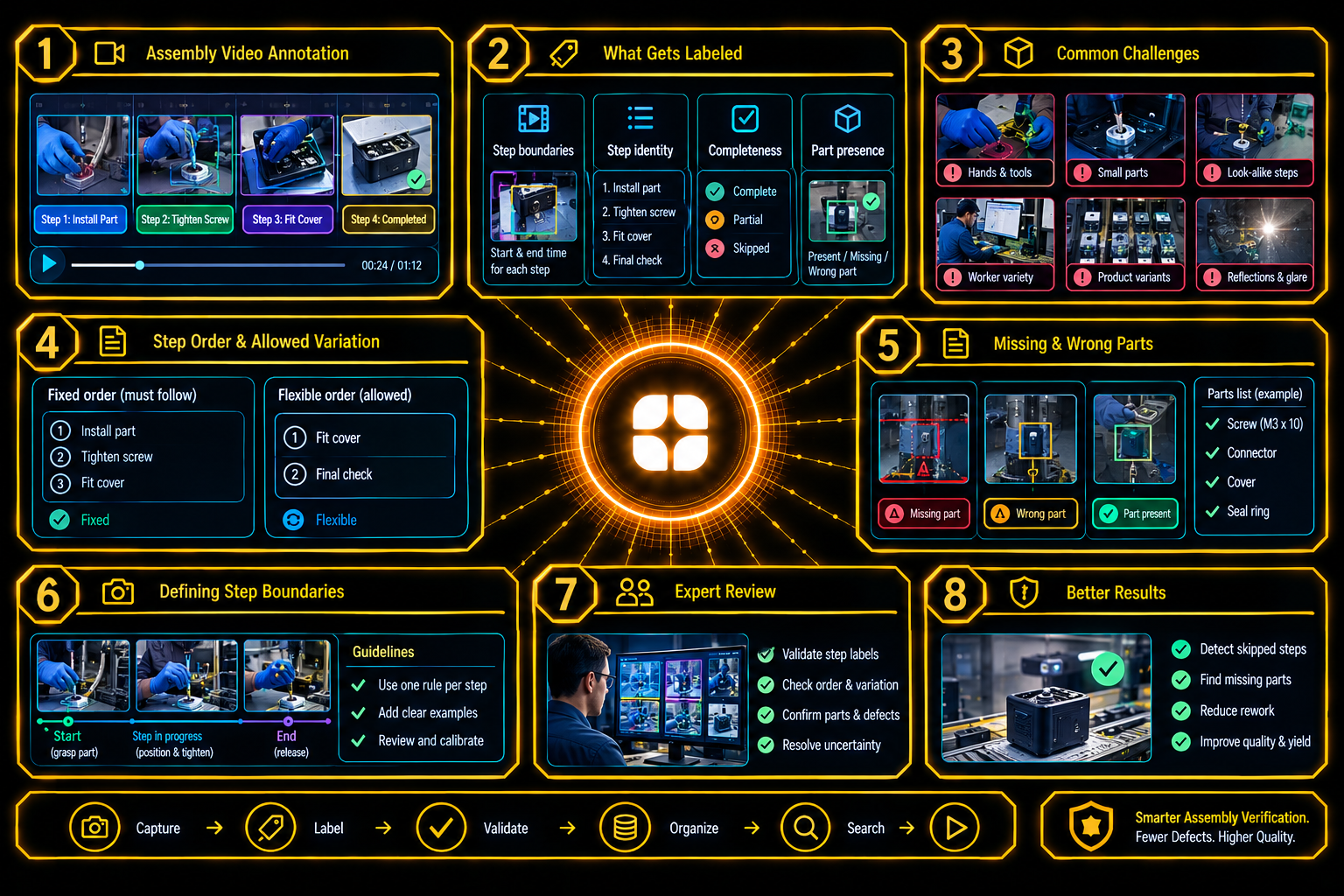
On an assembly line, a product is built in steps. Parts go in a set order, screws are tightened, and covers are fitted last. Skip a step or forget a part, and the fault may only show up at the customer’s door. Cameras above the workstation can watch every cycle, and AI can check that each step was done.
That AI learns from labeled video. Good assembly step verification video annotation means marking steps, order, and missing parts the same way every time. This post explains what the work covers, why it is hard, and what manufacturing AI training data needs to get right.
Annotation for assembly video usually has four parts:
Models trained on these labels can alert a worker when a step is skipped, confirm a finished unit, and show where cycles slow down.
Real workstations are not clean demonstrations.
Annotators need rules for moments when the action cannot be seen. A label that says “step skipped” when the part was only hidden by a hand teaches the model a false lesson.
A work instruction gives the expected order, but real work is not always rigid. Some steps must follow a fixed order, such as fitting a seal before a cover. Others can swap places with no harm.
The guide should mark which steps are fixed and which are flexible, so labelers can tell a real order error from an acceptable variation. It should also cover repeats: if a worker redoes a step, the label should say so and not count a second correct step.
These two checks ask different questions.
Step order asks whether actions happened in the right sequence. Labels attach to time ranges, so the key work is placing start and end points and naming the step. Completeness asks whether the result is correct. Labels attach to the product state, such as a part present, a screw seated, or a clip closed, and reviewers check the final view, often in a single frame.
A single guide for both would blur these differences. Each needs its own definitions, examples, and reviewers.
A missing part is hard to label because the thing to find is an absence. Annotators need the parts list or a reference image for each product variant. They should also label wrong parts, such as the wrong screw length or a part fitted backward, since these look like a finished step. Where one part hides another, the guide should say whether to mark it present, absent, or cannot verify.
Boundaries are the hardest timing decision. Does a step begin when the worker reaches for the part or when it touches the product? Pick one rule for each step, with examples. Have two reviewers label the same clips and refine the rules until they agree. Without this, step lengths vary, and the model learns noise.
A shift produces hours of near-identical cycles, so labeling all of it is rarely needed. Sample across workers, shifts, variants, and lighting, and collect extra examples of rare events such as skipped steps and rework. Keep all clips from one worker session or station on the same side of the train and test split, or scores will look better than they are.
Sometimes the camera cannot show the result. Give annotators a “cannot verify” option and send doubtful clips to an expert. A false alarm stops the line, and a miss may ship a faulty unit, so the rules should say how each is handled. We describe a related inspection task in our guide to PCB and solder joint inspection annotation.
People who have worked on assembly lines know which steps must be done in order and what a correctly finished unit looks like. They can tell a pause from a skipped step, and rework from a mistake.
Specialists write the step definitions, mark fixed and flexible orders, and review doubtful clips. Because the video shows workers at their jobs, they also help set privacy rules: what is masked, who sees raw footage, and labels that describe steps and parts, not individual workers. This reflects Globik AI’s approach of using verified domain experts for work that depends on judgment, where a generalist would be guessing.
Before starting an assembly verification project, settle these points:
An assembly check depends on knowing what should happen, in what order, and what the finished product should hold. Strong assembly step verification video annotation uses clear step boundaries, rules for allowed variation, parts lists for each variant, and reviewers who know the line. With that foundation, models can catch skipped steps and missing parts before a unit leaves the station.
It is the labeling of workstation video so AI can recognize each assembly step, its order, and whether it was completed. Annotators follow the product’s work instruction.
Annotators mark the start and end of each step and name it from the work instruction. Rules say which steps must stay in order and which may swap.
It is labeled video or images showing whether each required part is present at the end of a cycle. Annotators use a parts list or reference image for each product variant.
Hands and tools block the view, parts are small, and workers vary in style. A cannot-verify option keeps guesses out of the training data.
Specialists know the required step order, normal motions, and what a finished unit looks like. They write clear rules and review doubtful clips.