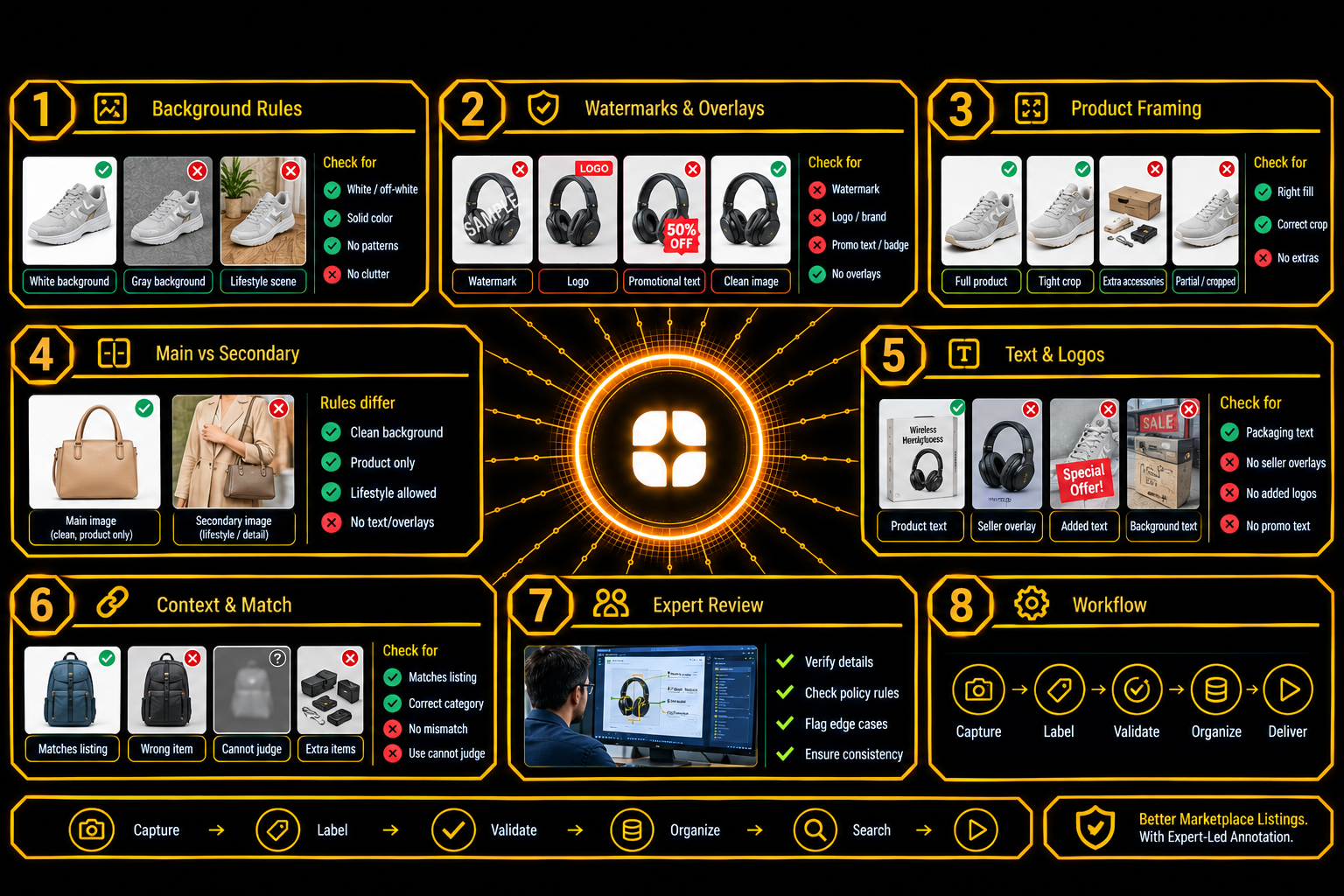
Every online marketplace has rules for product photos. The main image may need a plain white background. Watermarks, logos, and promotional text may be banned. The product may need to fill most of the frame. Sellers upload millions of images, and no review team can check each one by hand.
AI can help, but only if it learns from images labeled against the marketplace’s actual rules. That makes marketplace listing image compliance a labeling task where the rule matters as much as the picture. This post explains what the work covers, why it is hard, and what e-commerce and retail AI training data needs to get right.
Compliance labeling usually has four parts:
Models trained on these labels can flag a listing before it goes live, tell the seller what to fix, and send borderline cases to a human reviewer.
The rules sound simple, but real images are not.
Annotators need rules for borderline cases. Without them, two people label the same image differently, and the model learns the disagreement.
Marketplaces differ, and so do categories within one marketplace. Clothing may allow a model wearing the item, while electronics may require a product-only shot. Rules also change over time.
Every label should therefore be tied to a written rule, a policy version, and a category. A label that says “non-compliant” is not enough. It should say which rule was broken. This lets teams update the data when a policy changes, and it lets the model give sellers a useful reason.
Where a rule has a measurable limit, such as the share of the frame the product must fill, the guide should state how to measure it and how much tolerance is allowed.
Main images and secondary images follow different rules, so they need different labeling.
Main images are the strictest. They usually need a clean background, a clear view of the product, no added text, and no extra items. Labelers check each rule one by one, and a single failure can make the image non-compliant.
Secondary images are looser. They may show lifestyle scenes, close-ups, size charts, or infographics. Labelers focus on different rules, such as whether the image is misleading, shows banned content, or is too low in quality.
Using the main-image guide for every image would mislabel many acceptable secondary images as failures.
Overlays cause many disputes. A seller’s logo in a corner, a “best seller” badge, a website address, or a promotional banner may all be banned on a main image, yet allowed elsewhere.
Annotators need a clear way to separate three things: text that is part of the product, such as a brand name printed on a bottle; text added over the image by the seller; and text in the background scene. Guides should include examples of each, plus a rule for faint or partly hidden overlays. Rules for reading small text in photos are covered in more depth by general scene text practice.
Some rules are about meaning, not appearance. An image may show a product that does not match the listing, a stock photo used for a different item, or a set of items that suggests more is included than is sold.
These cases need a reference to the listing itself, such as the title and category. Labelers should have a way to mark “cannot judge from the image alone” instead of guessing. Our guide to warehouse and fulfillment imagery annotation covers a similar need to separate look-alike products and mark views that cannot be verified.
Compliance labels also cover safety and content rules. These include restricted items, adult content, and images with people. Such labels need extra care, since a wrong flag can block a legitimate seller and a missed one can expose buyers.
Rules should be written clearly, with examples, and reviewed by someone who knows the marketplace’s policy. Appeals and reviewer notes help the team learn from disputed cases.
Most uploads are compliant, so rule-breaking examples can be thin. Teams should count examples per rule and per category, and collect more of the rare ones early. Hard borderline images should be kept in a separate group for testing, so scores are not inflated by easy cases.
Images from the same seller or listing should stay on the same side of the train and test split, or the model will seem better than it is.
People who know marketplace operations understand how policies are applied in practice. They know which rules are strictly enforced, which are judged by context, and how categories differ. Reviewers with product knowledge can tell a printed brand mark from an added logo, and a real accessory from a styling prop.
Specialists write the rule definitions, set tolerances, and review disputed cases. This reflects Globik AI’s approach of using verified domain experts for work that depends on judgment, where a generalist would be guessing.
Before starting a listing compliance project, settle these points:
A compliance label is a judgment against a written rule, so the rule must be clear before the first image is labeled. Strong marketplace listing image compliance data ties every label to a policy version, treats main and secondary images separately, defines overlays carefully, and uses reviewers who know how the rules are applied. With that foundation, models can check listings quickly and give sellers clear feedback.
It is the labeling of product images against a marketplace’s photo rules, such as background, watermarks, and framing. Each label records which rule was met or broken, so AI can flag problems before a listing goes live.
The main image is the first thing buyers see, so marketplaces often require a clean background, no added text, and a clear product view. Secondary images can show lifestyle scenes and details, so they follow looser rules.
Annotators separate text printed on the product from overlays added by the seller and text in the background scene. Guides give examples of each and a rule for faint or partly hidden marks.
A pass or fail label gives the model and the seller no reason. Naming the rule and policy version helps sellers fix the image and lets teams relabel data when policies change.
Specialists know how marketplace policies are applied in practice and how categories differ. They write clear rule definitions, set tolerances, and review disputed images, making the data more reliable.