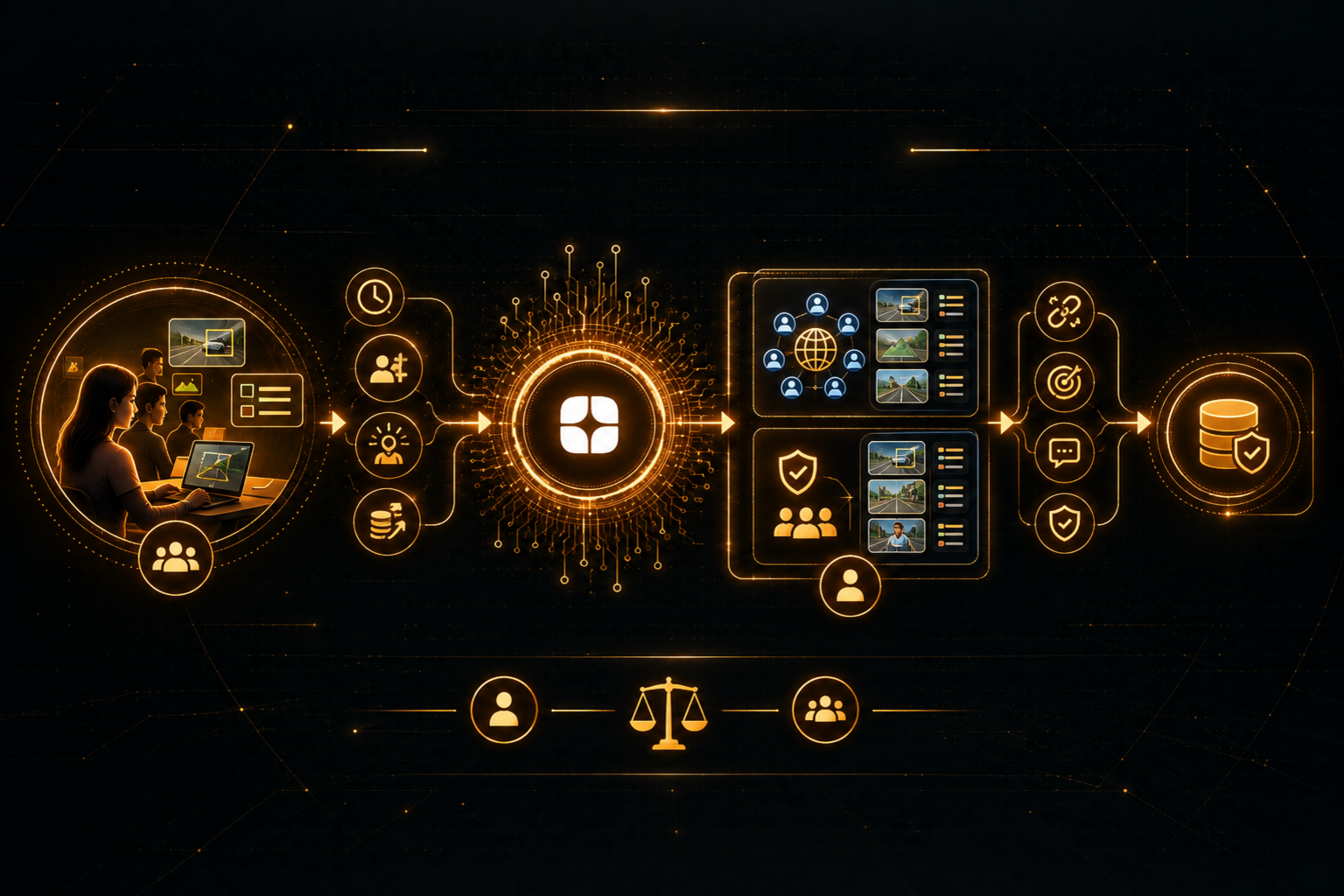
Every AI team eventually asks the same question: should we label our own data, or should we outsource it? The answer sounds simple at first. But most teams don't run into problems on day one. They run into problems when they try to scale.
This post breaks down what actually happens with in-house vs. outsourced annotation as your data needs grow, and where each approach tends to break down.
In-house annotation means your own team labels the data. This could be your ML engineers, a hired annotation team sitting inside your company, or even subject matter experts pulled in from other departments.
The appeal is obvious. You have full control. You know exactly who is labeling the data. You can walk over to someone's desk and ask a question. Communication is fast because everyone is on the same team.
But this only works smoothly at small scale. When you need a few hundred labeled examples, an in-house team can handle it without much trouble. The trouble starts when you need thousands, or when the labeling has to happen every week, not just once.
Outsourced annotation means you hire an outside company to label your data. But "outsourced" isn't one single thing; it actually splits into two very different models, and mixing them up is where most of the confusion around outsourcing comes from.
Model 1: Crowdsourced marketplaces: Large platforms with thousands of anonymous, task-based workers. Anyone can sign up, work is bid on or picked up freely, and vetting is usually minimal or self-reported.
Model 2: Managed annotation partners: Smaller, dedicated providers who source and verify domain-expert annotators, run the work inside a structured, quality-controlled pipeline, and assign accountability to a real point of contact, not a rotating, anonymous pool.
The appeal of outsourcing in general is obvious: you don't need to hire, manage, or train an internal team, and you can scale up or down depending on your project. But which of these two models you're actually getting matters enormously once you try to scale.
In-house teams usually run into three problems as data volume grows.
This is usually the point where teams start looking at outsourcing.
Outsourcing solves the scaling problem, but the crowdsourced-marketplace version of it creates a new one: quality control.
So the real challenge with annotation outsourcing isn't outsourcing itself. It's which version of outsourcing you picked, and most teams don't realize the difference until they're deep into a project with a marketplace that can't guarantee consistency.
This is really a data team scaling problem, not just an annotation problem. As your AI project grows, you need three things at the same time:
In-house teams struggle with the first point. Crowdsourced marketplaces struggle with the second and third. This is exactly why many teams end up frustrated with both options and assume there's no good middle ground.
There is one , and it's neither "cheap crowdsourced outsourcing" nor "hire everyone in-house." It's a managed annotation partner: a provider who sources and verifies domain-expert annotators, runs the work through a calibrated pipeline with proper guideline management and multi-layer QA, and gives you a single accountable point of contact essentially, outsourcing done with the same rigor and consistency an in-house team would apply, minus the hiring headache.
Here's a simple way to think about it:
The goal isn't choosing in-house or outsourced as a permanent label. The goal is choosing whichever setup gives you consistent, high-quality labeled data at the volume you actually need, without breaking your budget or your team.
Annotation outsourcing isn't the problem, and hiring in-house isn't automatically the safer choice either. What actually breaks at scale is a lack of consistency : the same verified people, the same guidelines, and the same quality checks, batch after batch. Whichever model you choose, that consistency is what decides whether your labeled data helps your model or quietly holds it back.
A: In-house data annotation means your own team labels the data, giving you full control and fast communication. Outsourced data annotation means an outside provider labels the data for you . This in-house vs outsourced annotation split then depends heavily on whether that outside provider is a crowdsourced marketplace or a managed, verified partner.
A: In-house annotation becomes difficult at scale because hiring and training new team members takes time, repetitive labeling work leads to burnout and turnover, and the true cost per labeled example rises once salaries and management overhead are included.
A: Outsourced annotation produces poor-quality data mainly with crowdsourced marketplaces, where a rotating pool of workers with minimal vetting labels data without consistent training, especially in specialized fields like healthcare, legal, or finance.
A: Annotation outsourcing can be safe for sensitive data if the provider has proper verification, data handling, and compliance practices in place. Large, loosely managed crowdsourced platforms carry more risk, while managed annotation partners with security protocols and accountability are generally safer for sensitive projects.
A: For a growing AI project, a managed, verified annotation partner is usually better than either a fully in-house team or a generic crowdsourced marketplace, since it combines scalability with consistent quality and domain expertise.