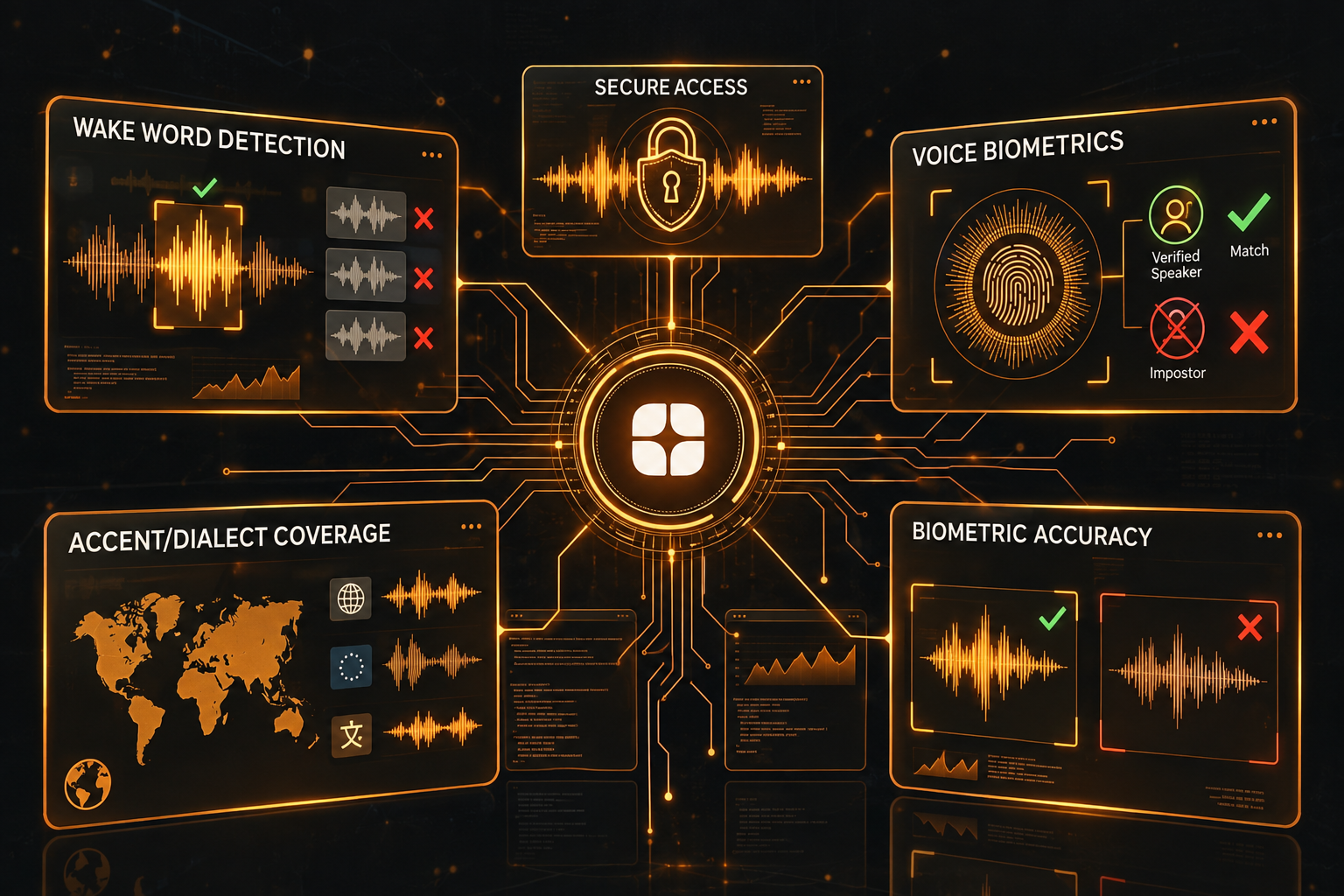
Two voice technologies get almost no attention next to chatbots and transcription, but they sit on some of the highest-stakes decisions in consumer and enterprise voice AI: wake word detection and voice biometrics. One decides whether a device should start listening. The other decides whether the person speaking is really who they claim to be. Both run on training data that is far more specialized than most teams assume.
Wake word detection and voice biometrics solve different problems, but they share a failure point: both depend on audio annotation precise enough to capture tiny acoustic differences that generic transcription work never has to deal with.
Wake word detection is the always-listening layer behind “Hey Siri,” “Alexa,” or any custom trigger phrase. The model isn’t transcribing full sentences it’s scanning a constant stream of ambient audio for one short phrase, instantly, while ignoring everything else: background noise, overlapping speech, similar-sounding words. Two failure modes matter equally here. A missed wake word frustrates the user. A false trigger the device activating on a word that merely sounds similar is worse, because it erodes trust in the product entirely.
Voice biometrics verifies identity from the acoustic properties of a person’s voice: pitch, cadence, resonance, pronunciation patterns a voiceprint, not unlike a fingerprint. Banks, insurers, and call centers use it to confirm “you are who you say you are” without a password. The two failure modes here are a false accept (a fraudster gets verified as the real account holder) and a false reject (a genuine customer gets locked out). In financial and healthcare contexts, either one carries real cost.
Neither system can be trained on loosely labeled, inconsistent audio data. Both need annotation that captures acoustic nuance most labeling pipelines are never asked to handle.
A wake word model is only as good as its negative examples. It’s not enough to label thousands of clean recordings of someone saying “Hey Siri.” The dataset needs:
This is detailed, repetitive, judgment-heavy work. A rotating, generalist labeling pool with no continuity across batches tends to drift on exactly this kind of boundary consistency and that drift shows up later as inconsistent real-world trigger behavior.
Voice biometric systems need something more specific still: audio annotated and organized so the model can learn what distinguishes one person’s voice from another’s, while staying robust to the normal variation within a single person’s voice over time.
Get any of this wrong at the labeling stage, and the model doesn’t just underperform it makes confidently wrong identity decisions, which is a materially different kind of failure than a chatbot giving an unhelpful answer.
Both wake word and biometric annotation sit in a category where native-speaker and domain-aware annotation isn’t a nice-to-have it’s the difference between a model that works in the real world and one that only works in the test set.
A generalist crowd platform, working without continuity between batches and without annotators who understand regional pronunciation patterns, will systematically mislabel exactly the edge cases that matter most: the near-miss phrases, the dialect variation, the adversarial samples. The aggregate accuracy numbers can still look fine, because the dataset is dominated by easy, unambiguous samples. The failures concentrate in the harder, rarer cases which, for wake words and biometrics, are often the security-critical ones.
This is where Globik’s approach to voice and speech data differs: native-speaker annotators working across 40+ languages, dialect-aware labeling practices, and continuity across batches so the same standards apply from the first sample to the ten-thousandth the same foundation behind Globik’s broader multilingual data labeling services. For audio work this precise, that consistency isn’t a quality-of-life improvement it’s the thing that determines whether the model behaves predictably once it’s live.
If you’re building or fine-tuning a wake word or voice biometric system, a few checkpoints are worth running before you scale data collection:
Wake word detection and voice biometrics look like narrow, specialized corners of voice AI but they’re also where the cost of bad training data shows up fastest and most visibly: a device that won’t stop triggering, or a verification system that locks out real customers. Both need audio annotation built around acoustic precision, dialect awareness, and continuity, not generic labeling at volume.
Wake word detection is the always-listening system that recognizes a specific trigger phrase, like “Hey Siri,” while ignoring all other ambient speech and noise.
Voice biometrics verifies a person’s identity using unique vocal characteristics, commonly used by banks and call centers to confirm identity without a password.
Negative examples teach the model which near-miss phrases are not the trigger, reducing false activations without sacrificing real trigger accuracy.
False rejects often come from under-labeled intra-speaker variation or dialect patterns the model wasn’t trained to recognize as normal.
Without dialect-aware training data, both systems systematically under-perform for speakers outside the dominant accent represented in the dataset.