Fashion is one of the hardest things to sell online, because shoppers cannot touch it. They rely on photos, filters, and search. A shopper who types "short-sleeve floral midi dress" expects the results to show exactly that, and a shop that tagged its dresses carelessly will not deliver.
AI can read fashion photos and fill in those details at scale. It learns from labeled images, and fashion images are full of traps. Fashion image annotation is the work of marking what a garment is and how it looks, accurately enough that search and filters can be trusted. This post explains what the labels need to capture and why fashion knowledge matters.
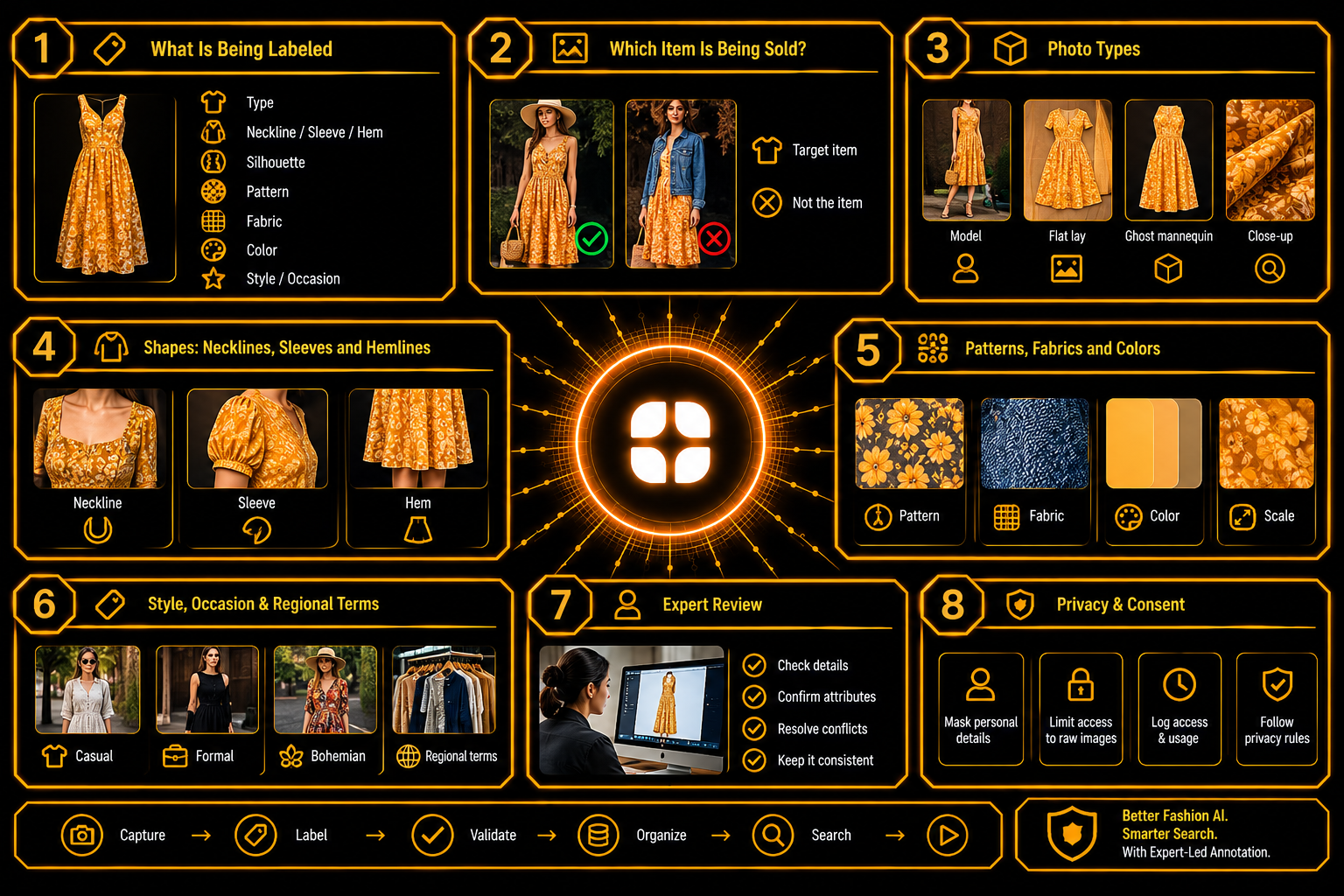
A single garment photo can carry a long list of labels:
Many fashion photos show a whole outfit. A model wears a jacket over a shirt, with trousers, a bag, and shoes. The listing sells only one of them.
Annotators must know which garment is the product, and label that one. A jacket label that picks up the color of the shirt underneath teaches the model the wrong thing. Projects should pass the listing title or category to the annotator, or mark the target item in the image.
The same garment appears in several kinds of photo. A model shot shows how it falls on a body. A flat lay shows its shape but not how it drapes. A "ghost mannequin" image shows the shape without a body. A close-up shows fabric and detail.
Each photo type hides something. A model's folded arms hide the sleeve. A flat lay hides how the garment fits. An annotator should know which attributes each photo can support, and a "not visible" label should be available for the rest. Where several photos of one item exist, the labels should be consistent across them.
Fashion vocabulary has fine boundaries. A neckline can be round, V-shaped, square, or high, and in-between shapes are common. Sleeve length runs from sleeveless to full length, with cap, short, three-quarter, and others in between.
Worn garments complicate this. Annotators need rules for how to label what is shown versus what the garment is designed to be, and definitions that say where "short" ends and "three-quarter" begins. Without those, two annotators put the same dress in different boxes.
Patterns look simple. In photos they are slippery. A stripe seen at an angle bends. A floral print can be tiny or huge, and its scale changes how a shopper would describe it.
Labels should say whether a pattern covers the whole garment or part of it, and whether more than one is present. For prints, scale is worth recording.
A camera cannot test fabric. It can only show how fabric looks. Satin has a sheen, denim has a visible weave, and knitwear has a surface structure.
For this reason, apparel attribute labeling should record what the fabric appears to be, and keep it separate from the fabric stated in the listing. When the two disagree, the disagreement is useful information. A project that merges them hides it.
Color seems easy until someone has to name it. Lighting changes how a garment appears. Photos are edited. Cream, ivory, and off-white overlap, and so do navy and black.
A fixed palette helps. The project defines a set of color names, shows an example of each, and asks annotators to pick the nearest. For multicolor items, the labels should distinguish the main color from secondary ones, and say how to handle a print with many colors.
Labels like casual, formal, bohemian, and minimal are useful for search and recommendation. They are also subjective. Two annotators will disagree about what makes a dress "elegant."
Garment attribute tagging for style needs written definitions, examples for each term, and permission to assign more than one. Occasion labels, such as work, party, or beach, benefit from the same treatment.
Names for the same garment change from place to place. What one market calls a sweater, another calls a jumper or a pullover. A guide should pick a standard vocabulary and map local terms to it.
Fit is the one thing a photo rarely settles. A single model photo shows how a garment looks on one body, not how it fits yours. Labels about fit should be based on stated measurements or clear visual evidence, and otherwise left open.
People who work in fashion merchandising, styling, or buying read these photos differently. They know the vocabulary, can tell similar necklines apart, and recognize how a garment is meant to be worn even when the photo shows it differently. They know how shoppers search.
They write the rules that keep a team consistent: the attribute definitions, the color palette, the style terms, and the handling of outfit photos. This matches Globik's approach of using verified domain experts for work that depends on judgment. For fashion e-commerce AI training data, that eye is what makes filters and search results trustworthy.
Before a fashion labeling project starts, a team can settle five things:
Fashion AI works when labels target the right garment, respect what each photo shows, use fixed definitions for shapes, colors, and styles, and keep what the photo shows apart from what the listing claims. For a related question, whether two listings describe the same item, see our guide on product matching and duplicate listing annotation: are these two listings the same product? Strong fashion image annotation depends on people who know how clothes look and sell.
Fashion image annotation is the labeling of garment photos with attributes such as neckline, sleeve length, pattern, fabric look, and color.
Outfit photos show several garments, so labels must describe only the product the listing sells.
Fashion colors shift with lighting and editing, so a fixed palette with main and secondary color rules keeps labels consistent.
A photo shows how fabric looks, not what it is made of, so labels should record appearance separately from the listing's stated fabric.
Style terms such as casual or elegant are subjective, so definitions and examples keep different annotators aligned.