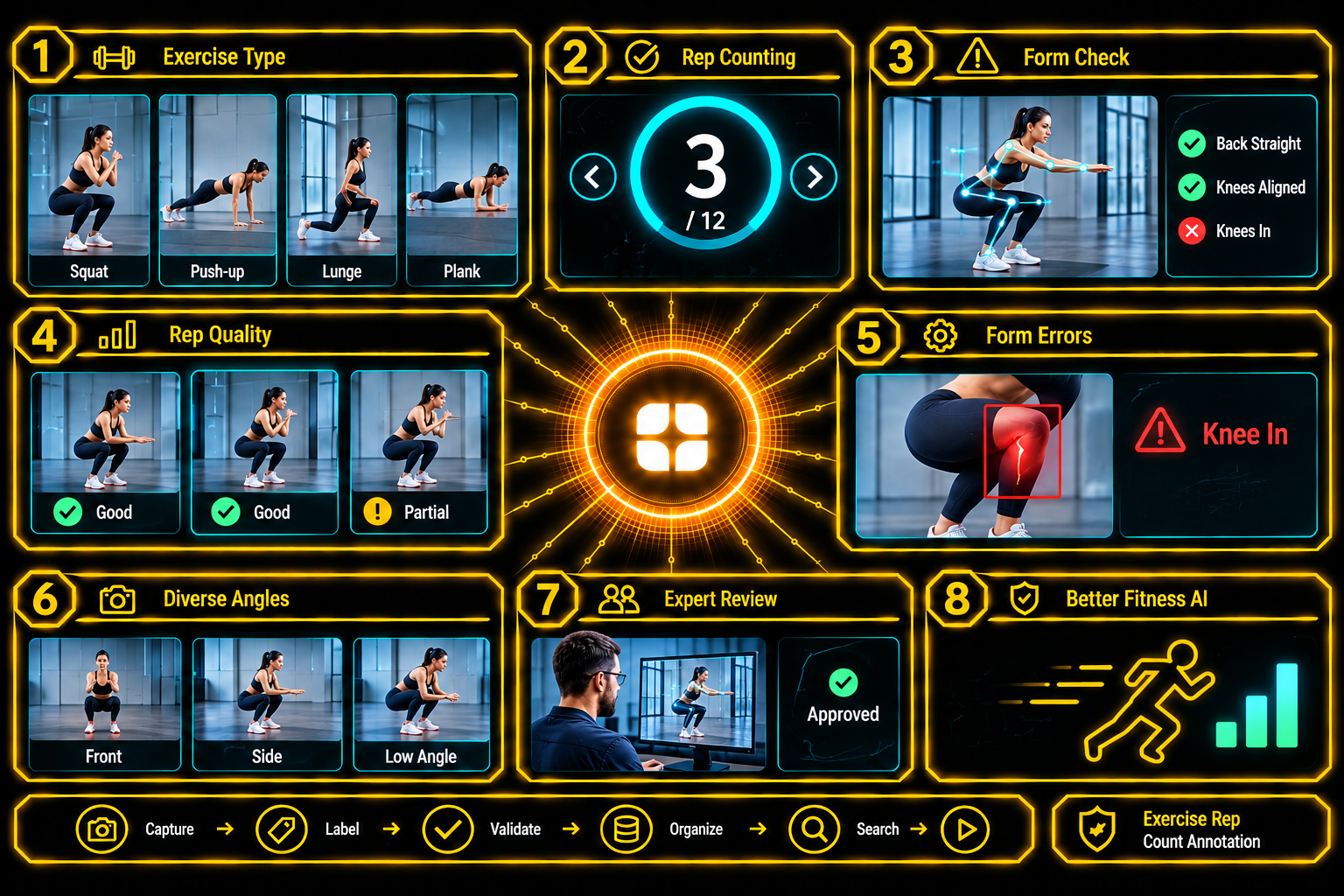
Millions of people now work out at home with a phone propped against a wall. Fitness apps promise to count their reps, check their form, and give feedback in real time. For that to work, the app must see a squat, a push-up, or a lunge the way a trainer would, from a camera that is often low, tilted, and badly placed.
That skill is learned from labeled video. Good exercise rep count annotation means marking each repetition and each form error the same way every time. This post explains what the work covers, why it is hard, and what media and entertainment AI training data needs to get right for everyday exercise.
Annotation for fitness video usually has four parts:
Models trained on these labels can count reps, give cues, and track progress over weeks. Some also use body keypoints, which are marked joints such as shoulders, hips, and knees, as a base layer for judging movement.
Home video is nothing like a studio.
Annotators need rules for frames where the body cannot be seen well. A “good form” label on a rep with a hidden knee teaches the model a false lesson.
A rep needs a clear start point and a clear end point. For a squat, does it begin when the hips start to drop or when the knees bend? Does it end at standing or at full lockout? Pick one rule for each exercise, and give examples.
Several tricky cases need rules as well:
Without these rules, two annotators count the same set differently, and the model learns the disagreement.
Counting asks how many reps were done. Labels attach to time ranges, so the key work is placing start and end points, and errors come from pauses, bounces, and half reps. Form checking asks how well each rep was done. Labels attach to body positions within a rep, so the key work is judging angles and alignment, and errors come from bad camera angles and hidden joints.
A single guide for both would blur these differences. Each needs its own definitions, examples, and reviewers.
Form labels need the most care, because users may act on the feedback. A wrong flag can make someone doubt a safe movement, and a missed flag can leave a risky habit unchecked.
Labels should describe movement, not give medical advice. An “uncertain” route that sends doubtful reps to a qualified reviewer keeps guesses out of the data.
The dataset must show each exercise from many angles, such as front, side, diagonal, and low, and across different rooms, clothing, and body types. Collect extra examples of partial reps and common faults, and keep all clips from one person on one side of the train and test split, or scores will look better than they are.
Some apps pair video with wearable data. Our guide to wearable and sensor data labeling for athletes explains how activity segments are marked, and the same timing care applies when video and sensor streams are aligned.
People with training in exercise coaching know what a safe squat looks like, how form changes with fatigue, and which differences are personal style and which are real faults. They can tell a deliberate pause from a stall.
Specialists write the rep definitions, set the fault thresholds, and review doubtful clips. Because home video shows people in their living spaces, they also help set privacy rules for masking faces and backgrounds and limiting who sees raw video. This reflects Globik AI’s approach of using verified domain experts for work that depends on judgment, where a generalist would be guessing.
Before starting a fitness annotation project, settle these points:
A fitness app is only as helpful as the labels behind its counts and cues. Strong exercise rep count annotation uses clear start and end rules, careful form definitions, honest handling of poor camera angles, and reviewers who understand exercise. With that foundation, apps can count accurately and give feedback people can trust.
It is the labeling of workout videos so AI can count repetitions and mark where each one starts and ends. Annotators follow written rules for each exercise.
Annotators mark faults, such as knees caving in, at the point in the rep where they appear. Each fault has a definition, a threshold, and a rule to label only what the camera can show.
A phone on the floor or at the side can hide joints and distort movement. Annotators need rules for unclear views, and the dataset must include many angles.
It depends on the app’s standard. The guide should set a clear depth or range rule for each exercise so annotators count the same way.
Specialists know safe technique and how form changes with fatigue. They write clear rep and fault rules and review doubtful clips.