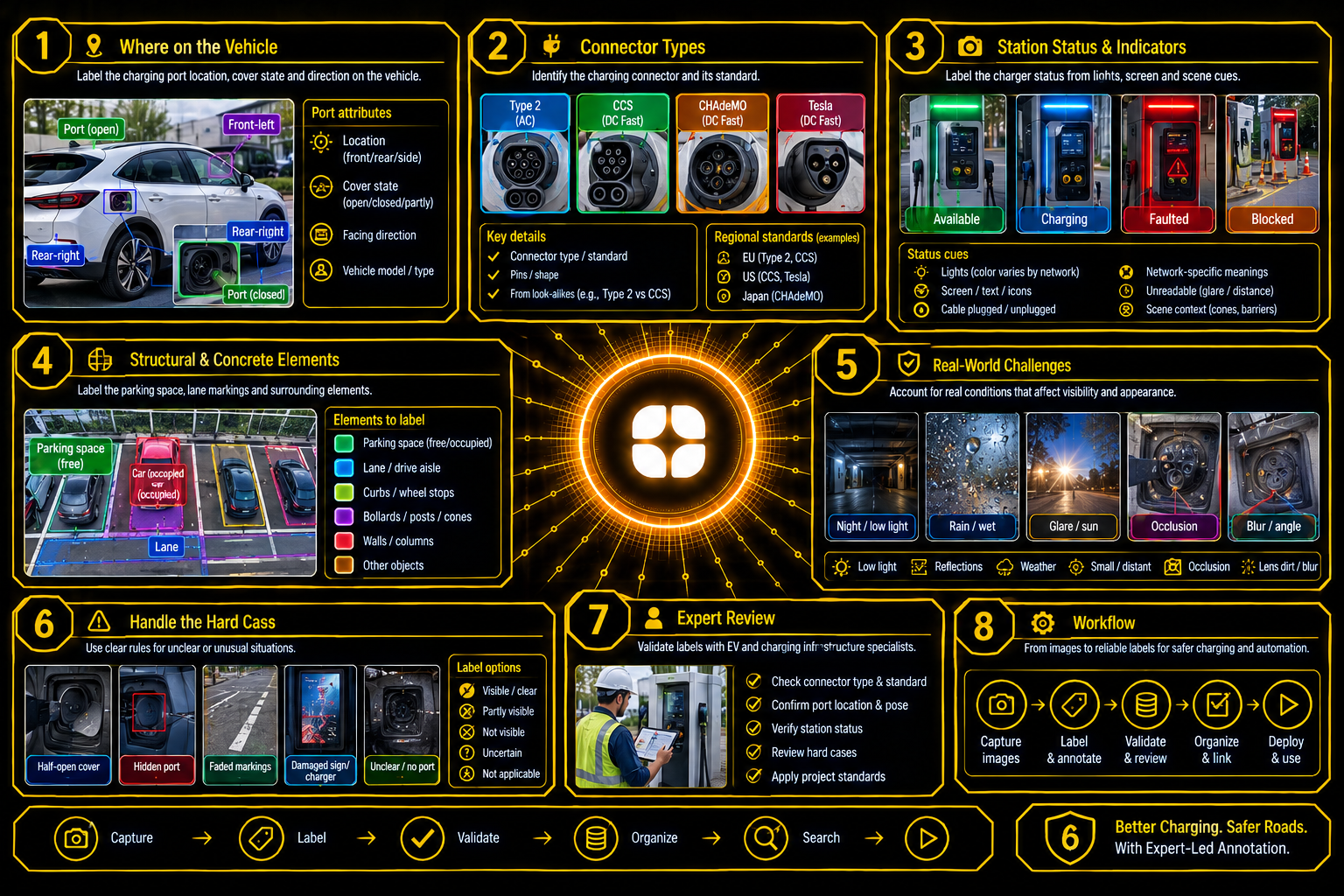
Charging an electric vehicle sounds simple: find the port, pick the right plug, and connect. For a machine, each step is a vision problem. The robot or vehicle must find the port on the car, tell which connector it needs, and judge whether the station is free, busy, or broken.
Automated charging, robotic chargers, and driver apps all depend on models that can see these details. That makes EV charging port detection a labeling task where small differences matter. This post explains what the work covers, why it is hard, and what autonomous driving training data needs to get right for charging scenes.
Charging annotation usually has four parts:
Models trained on these labels support robotic charging arms, automated parking and charging, station finders, and fleet depots.
Connector types vary by region and by charging speed. Some plugs are used for slower alternating-current charging, and others add extra pins for fast direct-current charging. Some regions use one standard, while others use several side by side. Cables from different standards can look similar from a few meters away.
Annotators need to know which standards apply in the images they label. A wrong class is not a small error, because a robot may try to insert the wrong plug. The class list should follow the region’s actual standards, with reference photos of each connector from several angles and a clear note on its closest look-alike.
A shared challenge appears in other regional work. Our guide to traffic sign annotation across countries and conditions shows why a country tag and a clear schema stop similar-looking classes from merging.
Port position differs between vehicle models. It may sit at a front corner, a rear corner, behind a flap, or behind a sliding door. For a robot, knowing that a port exists is not enough. It needs the exact position and the direction the opening faces.
Labelers may mark a box, a set of key points, or an outline, depending on the task. A robotic arm usually needs key points, such as the center of the opening and the orientation of the pins. Teams should set one method early and apply it the same way across images. Mixed methods in one dataset confuse training.
Labeling the vehicle port and the station connector are different jobs.
The vehicle port is a fixed opening on a car body. Its challenges are covers that are open, closed, or half open, dirt and water in the opening, and the large variety of car shapes and colors. Labels focus on the opening, its cover state, and its pose.
The station connector is a plug on a cable, often held in a holster or hanging loose. Its challenges are cable bends, a plug partly hidden by a hand or a holster, and a cable lying on the ground. Labels focus on the plug type, whether it is in use, and its position.
A single guide for both would blur these differences. Each needs its own examples and its own reviewers.
Charging sites are not clean test benches.
Annotators need rules for images where the port is hidden or too dark to judge. A label of “no port” on a hidden port teaches the model that ports can vanish.
Station status is often shown on a screen, a light, or a label near the charger. A green light may mean available, blue may mean charging, and red may mean fault, but colors differ between networks. Screens may show text, icons, or a charge percentage.
Annotators need a status list tied to the charging network’s own meanings, not a guess based on color alone. They also need a way to mark a status that is unreadable because of glare or distance. Where text appears on a screen, rules for transcription and language help keep labels consistent.
Status can also come from the scene. A cable plugged into a car suggests the charger is in use, and a cone in front of a bay suggests it is blocked. These cues need clear definitions so annotators agree on what counts.
Charging happens near people, cars, and live equipment. If a model drives a robot arm, a wrong label can lead to a damaged port or a stalled session. For this reason, teams should include an “uncertain” route and send doubtful images to an expert.
Charging scenes also show license plates, faces, and phone screens, so teams should decide early what is masked and who sees raw footage.
People who work with electric vehicles and charging networks know the connector standards, how ports differ across models, and what station lights and screens mean. They can tell a half-open cover from a closed one, and they know which look-alike plugs matter most.
Specialists write the class lists, choose the pose method, and review hard cases. This reflects Globik AI’s approach of using verified domain experts for work that depends on judgment, where a generalist would be guessing.
Before starting a charging annotation project, settle these points:
Charging is a chain of small visual decisions, and a model only gets them right if the labels are right. Strong EV charging port detection data uses a clear connector list, one consistent pose method, status rules tied to each network, and reviewers who know how charging works in practice. With that foundation, machines can find the port, choose the plug, and read the station with confidence.
It is the labeling of images so AI can find the charging inlet on an electric vehicle and mark its position, angle, and cover state. These labels help robotic chargers and automated systems connect to the car.
It is the labeling of charging plugs by type, position, and state. Annotators name the connector standard and mark whether it is in use, so models can pick the right plug and avoid mismatches.
A robot needs the exact location and direction of the opening to reach it. Key points or outlines give this detail, while a plain box only shows that a port exists nearby.
Annotators read lights, screens, and scene cues, such as a plugged-in cable, and match them to the network’s own meanings. Unreadable status is flagged instead of guessed.
Specialists know connector standards, port layouts, and station signals. They write clear class rules and review look-alike plugs, which helps models avoid mistakes that could damage a vehicle.