Esports matches draw millions of viewers, and every match produces hours of video. Fans want highlights within minutes. Broadcasters want clips tagged by moment. Teams want to review how a round was won. No crew can watch and tag everything by hand, so AI is used to help.
AI learns from labeled footage. Good esports match annotation means marking events, screen elements, and game state the same way every time. This post explains what the work covers, why it is hard, and what media and entertainment AI training data needs to get right.
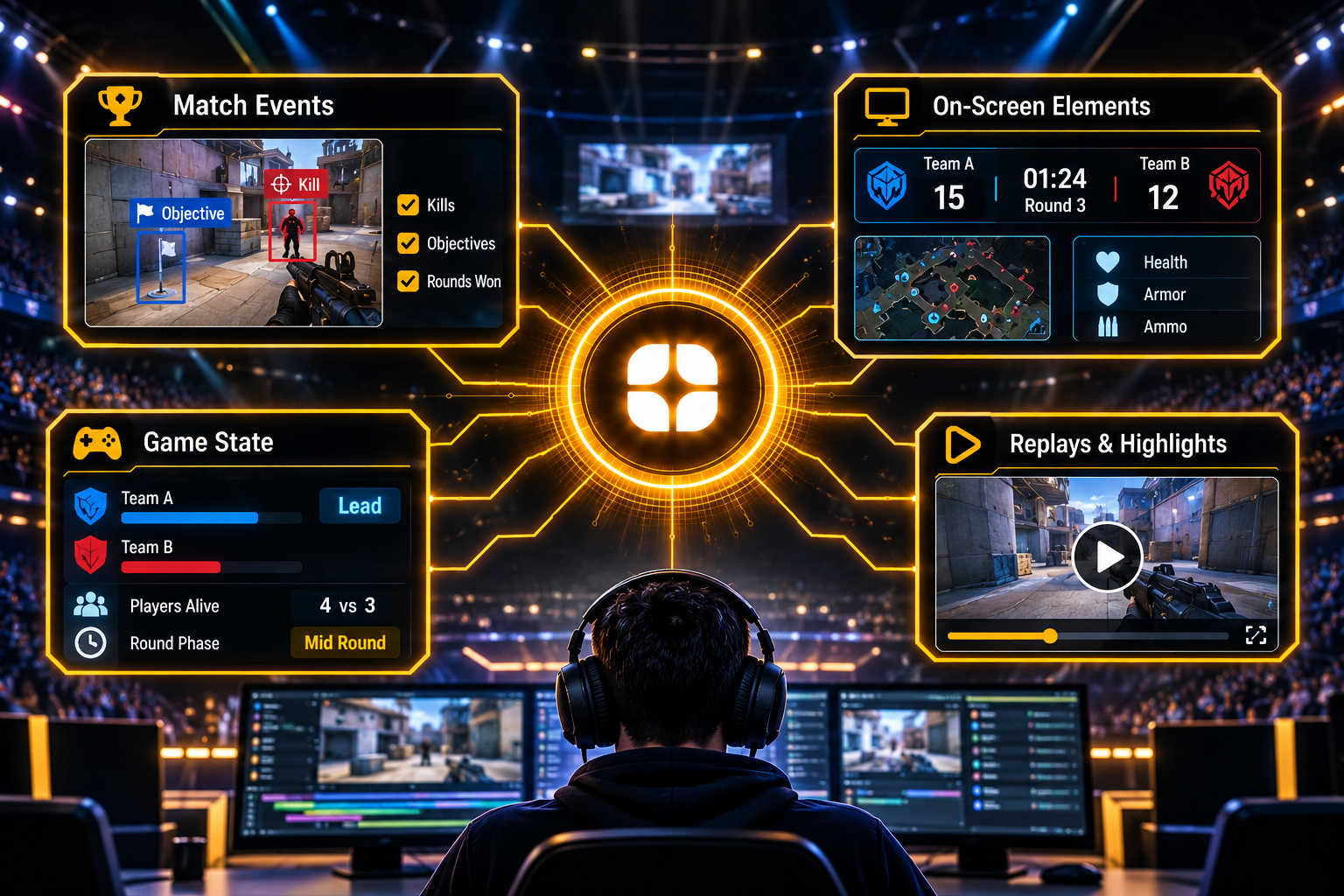
Annotation for esports video usually has four parts:
Models trained on these labels can build highlight reels, power live stats, and help coaches search for moments.
A match looks busy even to a fan.
Annotators need rules for moments that cannot be judged. A “no event” label on a fight hidden by effects teaches the model a false lesson.
The hardest decision is what counts as an event. A kill is simple to name, but a “team fight” is not. When does it start, and when does it end? Does a retreat count as part of it?
Each event type needs a written definition with a start rule, an end rule, and examples. Events also depend on the game and its version, so labels should record both. Have two reviewers label the same clips and refine the rules until they agree. Without this, event lengths vary and the model learns noise.
Overlays carry exact facts: the score, the clock, who was eliminated, and what was bought. Annotators may box each element, transcribe its text, or both.
Guides should say how to record numbers, player names, and icons, and how to handle partly hidden or flickering elements. Overlays differ between the game’s own interface and the broadcaster’s added graphics, so the label should record which one it is. Overlays also change between tournaments, so a model trained on one broadcast style may fail on another. A clock that disagrees with the game state should be flagged, not silently fixed.
Live play and replays need different treatment.
Live play shows events as they happen, so labels feed live stats and alerts. Reviewers check timing against the match clock. Replays show the same event again, often slowed, from another angle, and with different overlays. If replays are labeled as new events, the model counts one kill twice.
A single guide for both would blur these differences. Each needs its own definitions, examples, and reviewers.
Some labels are not about a single moment but about the situation. Who is ahead? Which side holds an advantage? Is a round in its early, middle, or late stage?
These labels depend on reading several overlay elements together, plus game knowledge. The guide should say which source decides the state when the screen is unclear, and allow “cannot determine.” Because games change with updates, each batch should record the game version and patch date, so older labels are not mixed with new rules.
Most footage is quiet play, and the best moments are rare. Collect extra examples of close fights, comebacks, unusual plays, and every overlay style. Include different teams, maps, and broadcast setups, and both amateur and professional matches, since they look different on screen.
Keep all clips from one match on the same side of the train and test split, since neighboring frames look nearly identical. Testing on a tournament the model has not seen gives a more honest score.
Some frames cannot support a label. The effects may cover the action, or the camera may show a crowd at the key moment. Give annotators a “cannot judge” option and send doubtful clips to an expert. We cover a related timing task in our guide to exercise form and rep-count annotation for fitness apps, where start and end rules matter in the same way.
People who play and follow the game know which moments matter, how a round normally flows, and what an overlay change means. They can tell a real comeback from a routine swing, and a replay from live play. They also know the slang casters use, which helps when commentary is matched to events.
Specialists write the event definitions, set the overlay rules, and review doubtful clips. This reflects Globik AI’s approach of using verified domain experts for work that depends on judgment, where a generalist would be guessing.
Before starting an esports project, settle these points:
An esports match moves faster than any crew can tag, so the labels must be clear about what counts as an event. Strong esports match annotation uses written event rules, careful overlay reading, separate handling of replays, and reviewers who know the game. With that foundation, models can find the moments fans want to see.
It is the labeling of esports video so AI can recognize events, on-screen elements, and game state. Annotators follow written rules for each game.
It is marking key moments, such as kills or objectives, with start and end points. Each event type has a definition so labels stay consistent.
A replay shows an event that already happened. If it is labeled as new, the model counts the same event twice.
Fast action, visual effects, changing interfaces, and small text hide what is happening. A cannot-judge option keeps guesses out of the data.
Specialists know the game, which moments matter, and how interfaces change. They write clear rules and review doubtful clips.