Every quarter, companies hold earnings calls, and thousands of news stories follow. Analysts and investors want to know what management expects, how confident they sound, and what changed since last time. No one can read every transcript, so AI is used to sort and summarize them.
That AI only works if it learns from labeled text. In finance, tone and wording carry meaning that plain sentiment tags miss. Good earnings call annotation marks what was said, how firmly, and by whom. This post explains what the work covers, why it is hard, and what finance and banking AI training data needs to get right.
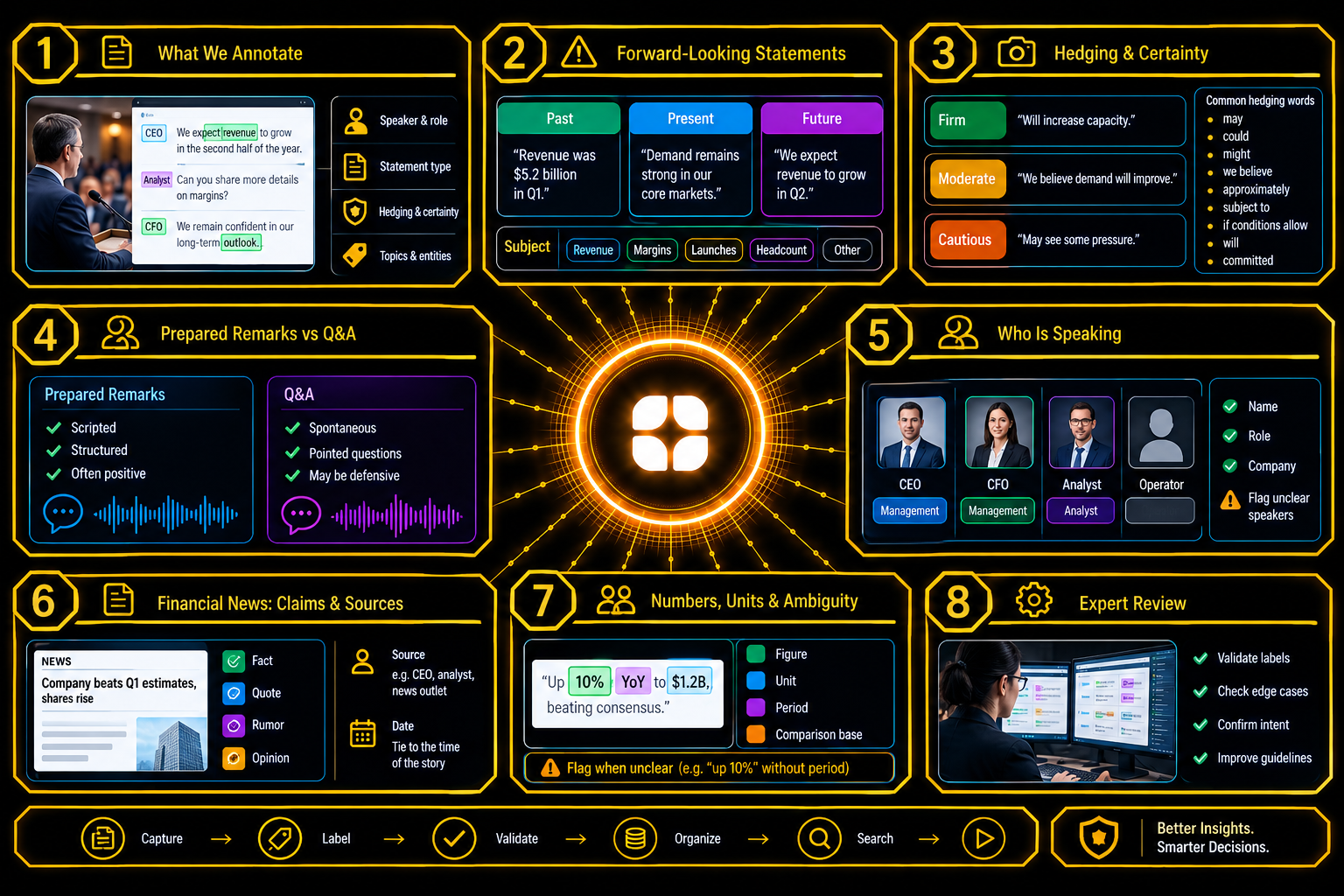
Annotation for calls and news usually has four layers:
Models trained on these labels can summarize a call, track how language shifts over time, and help analysts find the passages that matter. This is the base of financial news labeling as well, where sources, quotes, and claims need the same care.
Financial text looks plain, but it hides a lot.
Annotators need rules for these cases. A generic positive or negative tag often misses what a finance reader would see.
A forward-looking statement says something about the future: expected revenue, planned launches, or likely conditions. These matter because markets react to expectations, and companies often add a notice that such statements carry risk.
Labelers must separate three kinds of sentence. Past facts describe what happened. Present statements describe current conditions. Future statements describe what is expected or planned. A sentence like “we expect demand to stay firm” is forward-looking, while “demand was firm” is not. Some sentences mix both, so the guide should say how to split or mark them.
The label should also record the subject of the outlook, such as revenue, margins, or headcount, and whether a number or range is given.
Managers rarely speak in absolutes. Words such as “may,” “could,” “we believe,” “approximately,” and “subject to” soften a claim. Others, such as “will” and “committed,” make it firmer.
A useful scheme grades certainty on a short scale, such as firm, moderate, and cautious, with examples at each level. It should also cover qualifiers that cancel a statement, such as “if conditions allow.” Without a written scale, one annotator will call a sentence firm and another will call it cautious, and the model learns noise.
An earnings call has two parts that behave differently.
Prepared remarks are scripted. Sentences are clean, planned, and positive in tone, and labels focus on statement type, topics, and guidance. Question-and-answer is spontaneous. Analysts ask pointed questions, and managers may answer partly, deflect, or change the subject. Labels focus on whether the question was answered, how firm the reply was, and who spoke.
A single guide for both would blur these differences. Each needs its own examples and its own reviewers.
Speaker labels sound easy, but they carry weight. A statement from the chief executive has different standing from an analyst’s assumption. A line in a transcript may be missing a name, or two speakers may share a title.
Annotators should record each speaker, their role, and their company, and mark when a speaker is unclear. They should also separate what an analyst claims in a question from what management confirms in the answer. If these are mixed, a model may credit a company with a view that only an analyst stated.
News needs its own rules. A story may report a fact, repeat a rumor, quote an executive, or give a journalist’s opinion. Labels should separate these, and record who is the source of each claim.
Dates matter too. A story about expected results must be tied to the time it was written, since the outlook may later prove wrong. Headlines also need care, since they can be stronger than the body text.
Figures carry units and bases. “Up 10%” could mean year on year or quarter on quarter. Amounts may be in different currencies or scales. Guides should say how to record the figure, the unit, the period, and the comparison. Where the text does not make this clear, annotators should flag it as unclear instead of guessing.
Spoken statements often refer to reported figures and filings. Matching them depends on clean field labels in the source documents, which we explain in our guide to cheque and handwritten form annotation, where amounts and fields need the same careful rules.
People with finance training read these texts differently. They know which phrases are standard cautionary language and which signal real caution. They understand sector terms, can tell guidance from a passing comment, and spot when a manager avoids a question.
Specialists write the statement and certainty scales, set the speaker rules, and review doubtful items. This reflects Globik AI’s approach of using verified domain experts for work that depends on judgment, where a generalist would be guessing.
Before starting an earnings or news project, settle these points:
In finance, how something is said matters as much as what is said. Strong earnings call annotation separates past from future, grades certainty with a clear scale, tracks who is speaking, and uses reviewers who understand financial language. With that foundation, models can help analysts find the signals in a sea of words.
It is the labeling of call transcripts so AI can identify speakers, statement types, topics, and how firm each claim is. Annotators follow written rules built with finance experts.
It is marking sentences that describe expectations or plans, not past results. Annotators separate them from facts and record the subject, such as revenue, and any figures given.
Words like “may” and “will” change how firm a claim is. A written certainty scale helps annotators grade wording the same way, so the model learns consistent signals.
A chief executive’s statement carries different weight from an analyst’s assumption. Labels should record each speaker and role so the model does not credit management with an analyst’s view.
Specialists know standard cautionary phrases, sector terms, and how managers answer pointed questions. They write clear scales and review doubtful passages.