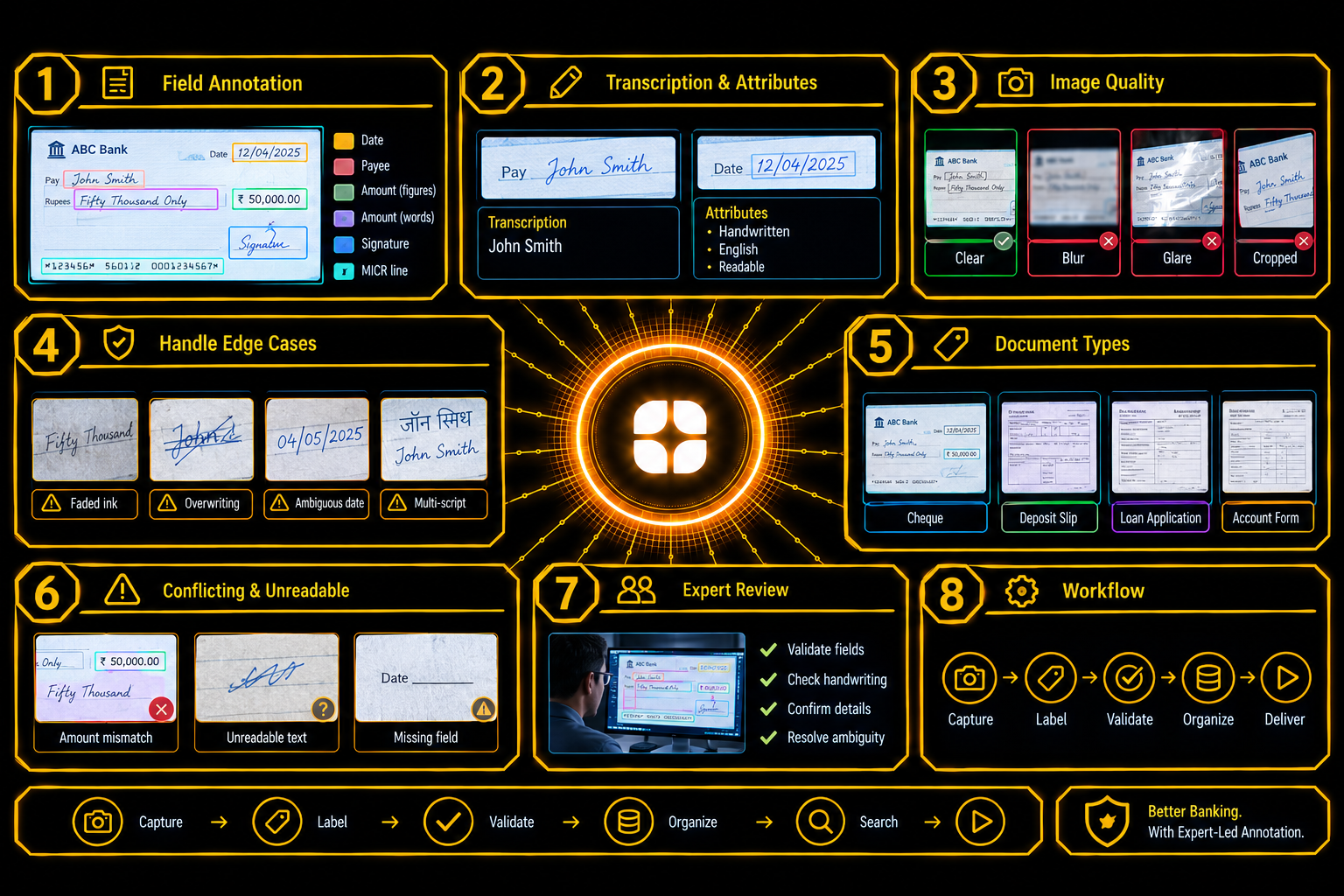
Banks still process cheques, deposit slips, loan applications, and account forms filled in by hand. Each one carries a few fields that matter a great deal: who gets paid, how much, and on what date. Reading those fields by machine saves hours of manual entry, but only if the model has learned from carefully labeled examples.
That makes cheque annotation a task where small details carry real weight. A misread digit changes an amount. This post explains what the work covers, why handwriting is hard, and what finance and banking AI training data needs to get right.
Annotation for cheques and handwritten forms usually has three parts:
Models trained on these labels support automated data entry, faster clearing, and checks that flag unclear items for a person to review. This is the basis of handwritten form annotation in banking.
Handwriting varies more than any printed font.
Annotators need rules for text that cannot be read with certainty. A guessed digit is worse than a flagged one.
A cheque carries the amount twice: in numerals and written out in words. The two should agree, and that agreement is what makes the amount trustworthy.
Figures can be crowded with commas, decimal points, and currency symbols that look like stray marks. Words can be misspelled, abbreviated, or written in a regional language. Some people add a filler line to stop extra digits from being added.
The label should record each version separately. Guidelines should say how to type the figure, how to record the words exactly as written, and how to handle minor units. Treating the two as one field hides the very mismatches that matter most.
Printed fields, such as the bank name and the number line along the bottom, follow fixed formats. Mistakes come from smudges, skew, and cut-off edges, and reviewers check characters against the image.
Handwritten fields, such as the payee, amount, and date, change with every writer. Mistakes come from ambiguous strokes and guessing, so reviewers need more examples, clearer rules, and a way to mark doubt.
A single guide for both would blur these differences. Each needs its own examples and its own reviewers.
Dates are a quiet source of errors. They can be written day first or month first, with slashes, dashes, or words. Labelers need a rule for how each style is recorded, so the same date means the same thing across the dataset.
Payee names bring titles, initials, and spelling variants. Guidelines should say whether to record a name exactly as written or in a standard form.
For signatures, the label should mark where the signature is and whether one is present. Judging whether it is genuine is a separate job.
Many forms mix English with a regional language, so a payee, an amount in words, and figures may use three scripts. Annotators must read every script involved, and the label should record the language of each field.
Some fields cannot be read, and some disagree. The words say one amount and the figures say another. A date may be missing, or a cross-out may hide the original entry.
A good workflow gives annotators clear options: unreadable, conflicting, or blank. These records go to an expert or are kept in a separate group so the team can see how often they occur. Forcing a guess teaches the model false confidence on exactly the items that most need human attention.
Banks rarely handle forms in isolation. A handwritten form is often matched with an identity document. Our guide to KYC and ID document annotation covers how fields, document types, and image quality are labeled, and the same care applies when documents are matched.
Cheques and forms carry names, account details, and signatures. Decide early what is masked, who may view raw images, and how access is logged. Raw files should stay in controlled systems.
People who have worked in bank operations know how amounts are usually written out, which date styles are common in the region, and how a cross-out or filler line is meant to be read. They also know which fields drive downstream decisions, so they can set stricter rules where errors cost the most.
Specialists write the field definitions, set the transcription rules, and review doubtful items. This reflects Globik AI’s approach of using verified domain experts for work that depends on judgment, where a generalist would be guessing.
Before starting a cheque or form project, settle these points:
On a cheque or form, one misread character can change the meaning. Strong cheque annotation treats words and figures as separate fields, sets clear rules for handwriting and dates, gives annotators an honest way to mark unreadable items, and uses reviewers who know banking paperwork. With that foundation, models can read the fields that matter and pass the doubtful ones to people.
It is the labeling of cheque images so AI can find each field and read what is written. Annotators mark regions, transcribe text, and flag unreadable items.
The two versions should match, and a mismatch is a useful signal. Separate labels let the model learn to read each one and flag disagreements for human review.
Handwriting varies by person, letters join together, ink fades, and people overwrite. Clear transcription rules and a way to flag doubt keep guesses out of the data.
Mark them as unreadable, blank, or conflicting instead of guessing. Expert review then decides what to do, which keeps false confidence out of the training set.
Specialists know how amounts are written, which date styles apply, and which fields matter most. They write clear rules and review doubtful items.