A mobile operator may run thousands of tower sites. Each one carries antennas, radio units, cables, and mounts, and what is actually up there often differs from what the records say. Sending a crew to climb every tower is slow, costly, and risky, so operators increasingly photograph their sites and use AI to read the images.
The model can only read what it was taught to see. Cell tower inspection annotation is the work of labeling tower images so AI can inventory equipment, check how it is set up, and spot installation problems. This post explains what those labels need to capture and why the work suits people who know telecom sites.
Most people picture inspection as hunting for damage. On a tower, a large share of the value lies in a simpler question: what is installed, and where?
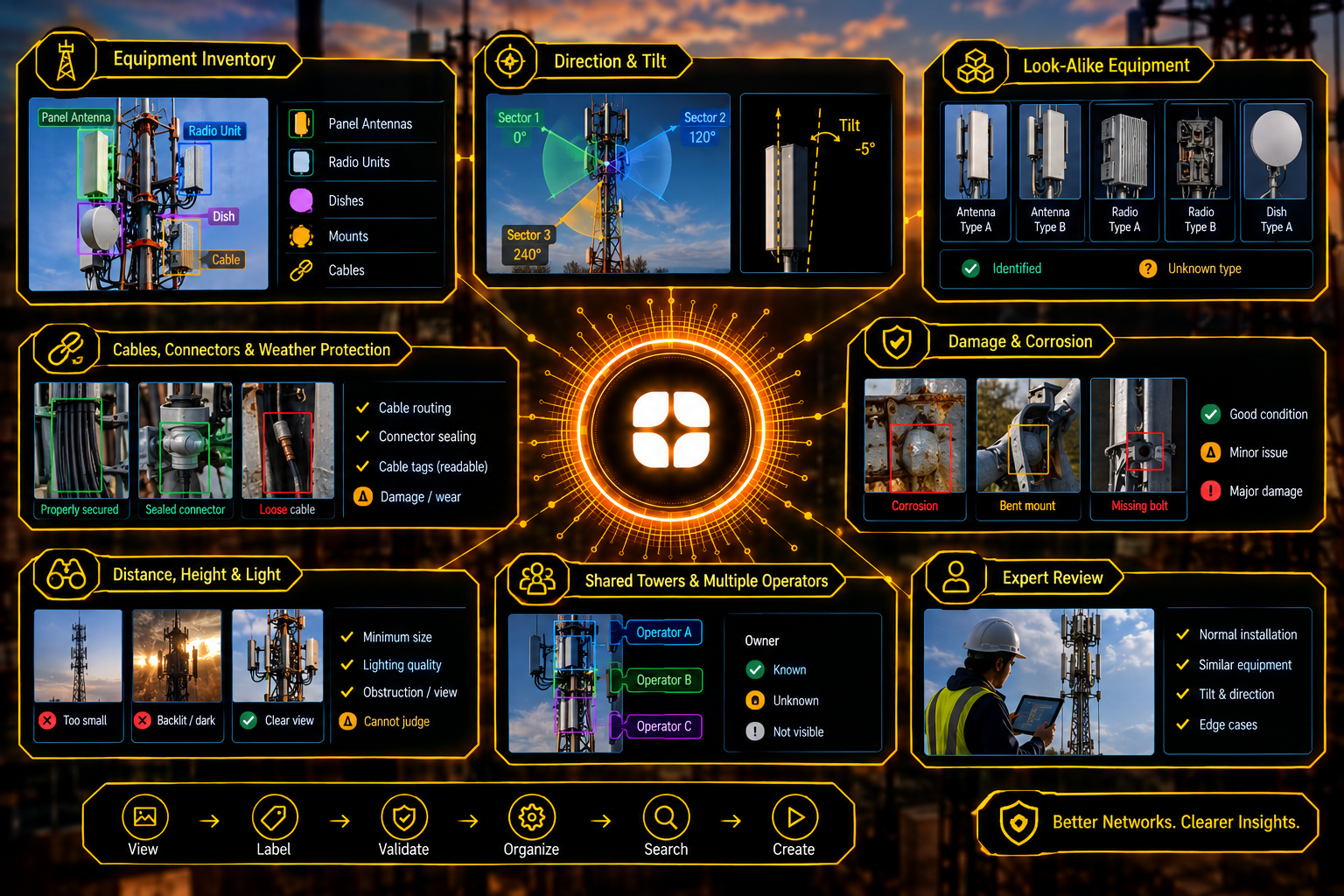
Annotators label the main equipment types: panel antennas, microwave dishes, radio units, mounts, and cable runs. The model can then count equipment on each site and compare it with the operator's records. A site with one more antenna than expected, or one fewer, is worth a closer look.
Antennas on a tower are usually grouped into sectors, each pointing in a different direction to cover a different slice of the surrounding area. Checking that each group faces the right way is a common inspection goal.
Reading direction from an image is harder than it sounds. A photo shows which way the antenna faces relative to the camera, not relative to north. Annotators need rules for recording direction: relative to the camera, relative to the tower, or against a known reference point in the scene.
Many projects record direction in coarse steps and include a "cannot judge" option for views where it is unclear.
Antennas are tilted slightly downward to aim signal at the ground where users are. A small change in tilt can change how far a site reaches.
Tilt is also hard to read from photographs. It shows clearly in a side view and becomes distorted from below or from an angle. The perspective of the camera can make a correctly tilted antenna look wrong, or the reverse.
Good antenna tilt labeling handles this by recording the viewing angle and marking when it is too oblique to judge tilt. Annotators should label tilt only when the view supports it. A label made from a poor angle teaches the model to be confident at the moments it should be cautious.
Telecom equipment looks similar across vendors and generations. A radio unit from one generation may resemble another from a different one. Panel antennas come in many sizes, and some combine functions that used to need separate units.
An annotator without telecom experience will group these together or split them arbitrarily. People who work with these sites know the visual cues: shape, size, connectors, and mounting style.
Projects should supply a reference catalog with example images for each equipment class. They should also allow an "unknown type" label, so annotators can mark equipment they cannot confidently classify.
Cables run up the tower and into equipment, and their installation matters. Cable runs can be left loose, bent too sharply, or poorly fastened. Connectors are usually wrapped or sealed against weather, and a poor seal can lead to problems later.
Labels in this area need clear definitions: what counts as a loose cable, what a properly sealed connector looks like, and where the line sits between acceptable and not acceptable. These are installation standards, and annotators need to know them or have them written down.
Cable tags and markers add another layer. If they are readable, they can be tied to equipment. Rules should say when to transcribe a visible tag and when to mark it as unreadable.
As on any outdoor structure, metal parts age. Rust, bent brackets, missing bolts, and damaged covers are all worth labeling.
The difficulty is telling real problems from surface appearance. A rust-colored stain on a bracket may be cosmetic, while a bent mount may be serious. The guidelines should include examples of each and a way to flag unclear cases for review by someone with field experience.
Tower images are rarely ideal. Equipment sits against bright sky, so it often appears as a dark silhouette with little detail.
Annotators need rules for what is too small, too dark, or too blocked to label. If everything gets a label regardless of quality, the model learns to guess.
Many towers host equipment from more than one operator. From an image alone, it is often impossible to say which antenna belongs to whom.
Projects should decide how to handle this. One approach is to label all equipment by type and add an "owner unknown" field, unless the image clearly shows an identifying marker. Annotators should not assume ownership from position alone.
People who have worked on towers or in field engineering see these images differently. They know what a normal installation looks like, can tell similar equipment apart, and understand why tilt, direction, and cable routing matter to the network. They can also spot when an image is too poor to trust.
They help write the rules that keep a large team consistent: the equipment catalog, the direction and tilt conventions, and the handling of unclear images. This matches Globik's approach of using verified domain experts for work that depends on judgment. For telecom infrastructure AI training data, that field knowledge keeps inventories and checks accurate.
Before a tower imagery project starts, a team can settle five things:
Tower imagery AI works when labels cover what is installed as well as what is damaged, treat direction and tilt with caution, and admit when an image cannot be judged. For the signal side of the same networks, see our guide on radio signal and interference labeling: teaching AI to read the spectrum. Strong cell tower inspection annotation depends on people who know what a good site looks like.
It is the labeling of tower images so AI can identify equipment, check its setup, and spot installation problems.
Camera angle distorts how tilt appears, so annotators should label it only from views that support it.
Backlit, distant, or blocked views cannot be read reliably, and guessing teaches the model false confidence.
Radios, antennas, and dishes from different vendors and generations look alike, so annotators need a reference catalog.
They know normal installations and can tell similar equipment apart, which keeps inventories accurate.