Bridges, tunnels, and concrete buildings age quietly. Water gets in, steel inside the concrete rusts, and small cracks widen over the years. Inspectors visit these structures on a schedule and photograph what they find, and the photos pile up across hundreds or thousands of assets.
AI can sort those photos and flag the ones worth a closer look. It learns from labeled images, and concrete is a difficult subject. Bridge inspection imagery annotation is the labeling work behind it. This post explains what the labels need to capture, which marks look like damage but are not, and why bridge and structures experience matters.
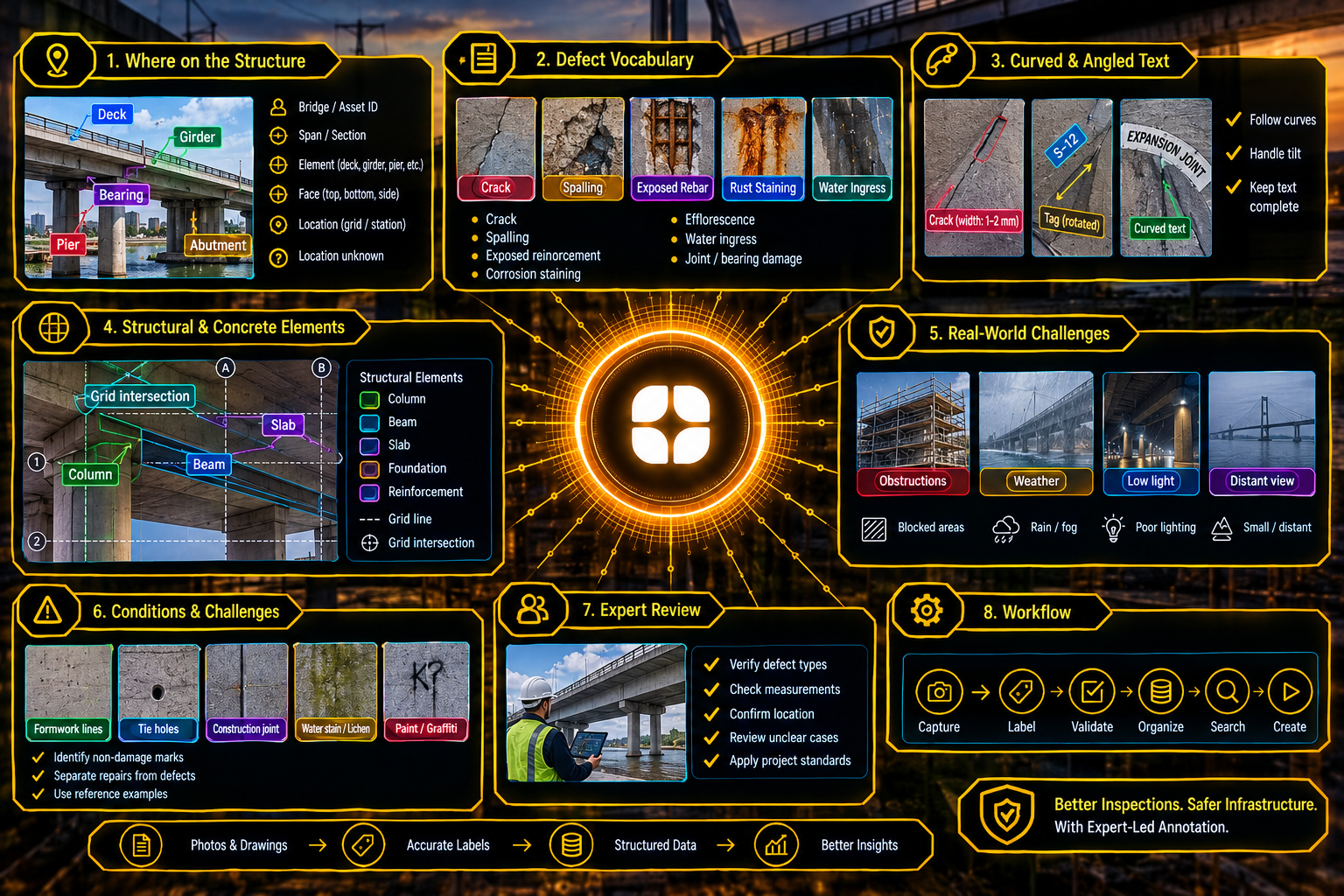
A defect label is only useful if someone can find the defect again. Every image should be tied to a place on the structure: which bridge, which span, which element, and which face.
Bridges have a standard vocabulary of parts: deck, girders, piers, abutments, bearings, joints, and railings. A crack in a deck slab and a crack in a pier cap mean different things, and engineers track them separately. Annotators need the project's element list and a method for recording location, with a "location unknown" option for photos that cannot be placed.
Images taken from below, in shadow, with no landmarks in frame, are hard to place.
Inspection work uses a particular set of terms:
A model that only knows "damage" cannot support an engineer's decisions. The labels for spalling and rebar exposure labeling and the other types need to name what is seen.
Cracks are the hardest and most important label. Their meaning depends on width, direction, and pattern. A fine crack running along a member differs from a wide one cutting across it. A web of fine cracks across a surface is a different finding from a single long one.
Width is the difficulty. Cracks are often a fraction of a millimeter wide, and a photo can show them only if taken close enough with enough resolution. Annotators need a way to estimate width, such as a reference scale in the image, and rules for banding it into ranges. When the photo does not allow it, the label should say "width not measurable."
Shape matters too. Cracks are thin and winding, so boxes are of little use. Lines or narrow masks follow them better, and the rules should say how to trace one that continues across several photos. Concrete crack annotation that breaks a long crack into unconnected fragments loses the pattern that engineers care about.
These three often belong to one progression. Water reaches the steel, which rusts and expands. Rust staining appears, then cracks, then pieces of concrete break off, and finally the bars become visible.
Labels should capture the stage. Staining alone is an early warning. Spalling with exposed bars is advanced. Annotators who know the sequence label each image with care, and the data can show how a structure is changing across inspections.
Concrete surfaces carry many marks that resemble defects:
A tie hole is not a defect, and a construction joint is not a crack. Repairs deserve their own label, because a patch means someone has already dealt with a problem.
A photograph shows the surface. Some of the most serious problems sit beneath it: concrete that has separated from the steel but has not yet broken away, or corrosion inside a section.
Engineers find these by other means, such as tapping or testing. Photos can only hint at them, through patterns of fine cracks, staining, or patches. Labels should record what is visible and may mark an area as "suspect" when the surface suggests a hidden problem. They should never claim a hidden condition as fact. Condition ratings and repair decisions belong to qualified engineers.
Structures are hard to photograph. Undersides are dark, high elements are far away, and the best views may require ropes or lifts.
Resolution decides what can be judged. A fine crack that is visible in a close-up vanishes in a wide shot. Annotators need a rule for when an image is too coarse for a given label, and the data should record how each photo was taken. Treating a wide shot as proof that a surface is sound teaches the model a false lesson.
People who inspect structures read these photos differently. They know how corrosion progresses, can tell a tie hole from a defect, and understand why a crack's width and direction matter. They recognize repairs and know where to look for the early signs. They also write the rules that keep a large team consistent: the element list, the defect vocabulary, the width bands, and the handling of unclear images.
This matches Globik's approach of using verified domain experts for work that depends on judgment. For infrastructure inspection AI training data, that knowledge is what turns a pile of photos into evidence an engineer can use.
Before a structure imagery project starts, a team can settle five things:
Structure inspection AI works when labels record where a defect is, name its type and stage, trace cracks properly, and separate original features and repairs from damage. For another look at how structures are documented, see our guide on floor plan and structural drawing annotation: reading rooms, walls, and dimensions. Strong bridge inspection imagery annotation depends on people who know how concrete ages.
It is the labeling of photos of bridges and concrete structures so AI can find cracks, spalling, and exposed steel.
Cracks can be a fraction of a millimeter wide, so annotators need image scale and a "not measurable" option.
They are often stages of one process, as rusting steel expands and breaks the concrete away.
Tie holes, construction joints, water stains, lichen, and chalk marks can all resemble defects.
They know how corrosion progresses and can tell real defects from original features and repairs.