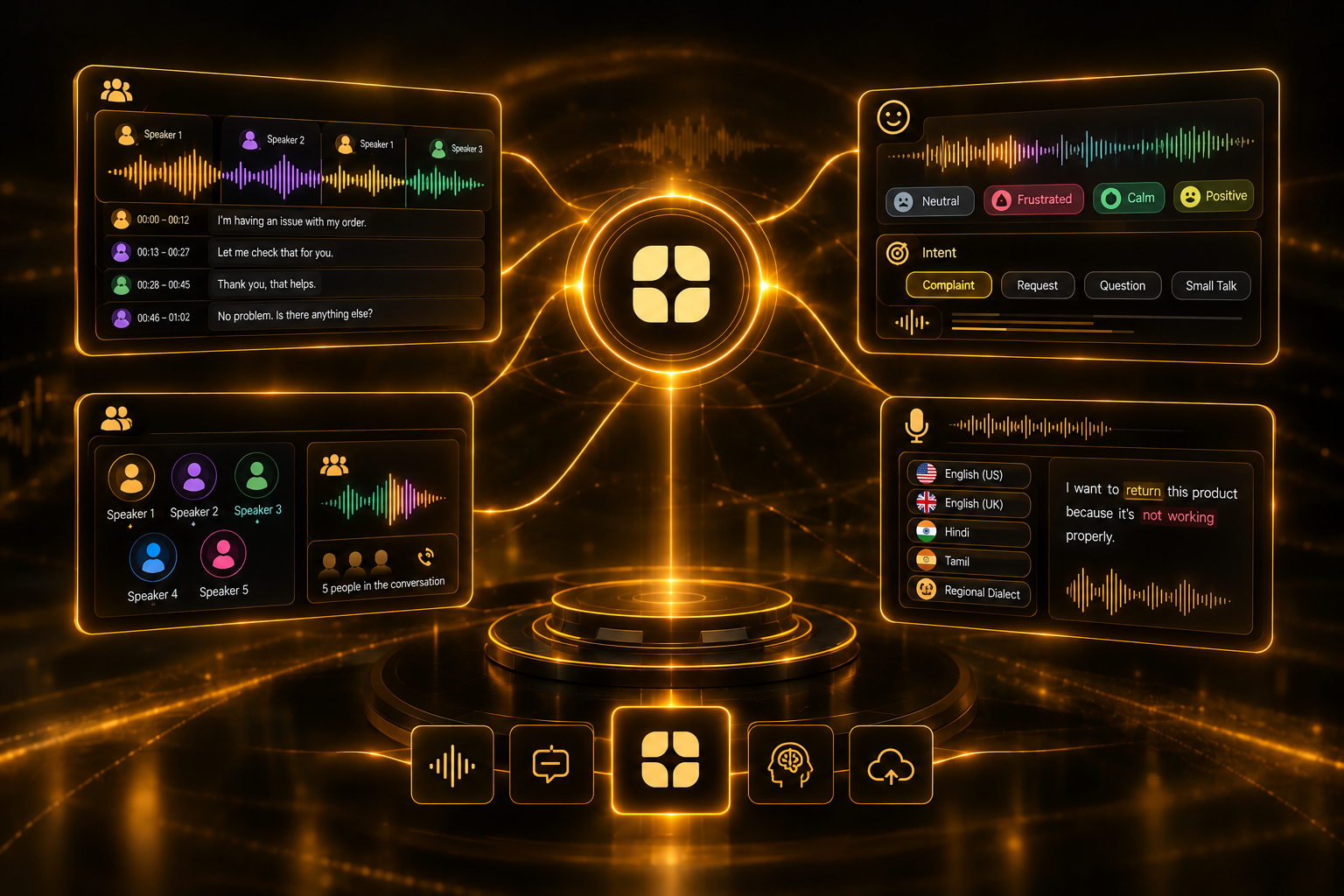
A perfectly transcribed sentence still leaves a voice AI system half-blind. It knows what was said. It has no idea who said it, how many people were in the conversation, or whether the speaker was calm, frustrated, or about to hang up. For voice AI to actually work in production- in a call center, a voice assistant, a meeting tool- transcription is only the first layer of a much deeper annotation problem.
This is where a lot of voice AI deployments quietly fall short. Teams invest heavily in transcription accuracy and treat it as the finish line, when transcription is really just the input to everything that matters downstream: knowing who’s speaking, what they want, and how they feel about it.
Transcription converts sound into text. It does not tell a system whether that text came from one speaker or five, whether the tone was polite or escalating, or whether a vague sentence like “I guess that’s fine” actually signals satisfaction or quiet frustration. A customer service AI that transcribes a call perfectly but misses that the customer’s tone shifted from neutral to angry halfway through has still failed at the one thing that mattered.
This gap is exactly why speech annotation has to go well beyond converting audio to text. Three capabilities sit on top of transcription, and each one requires its own dedicated, carefully built training data.
Speaker diarization is the process of segmenting an audio recording by speaker, identifying which stretches of audio belong to which distinct voice, without necessarily knowing anyone’s name, just that these are separate speakers. In a two-person customer service call, this sounds straightforward. In a five-person meeting recording with overlapping speech, similar-sounding voices, and people talking over each other, it becomes genuinely difficult.
Automated diarization tools struggle precisely in these harder cases: overlapping speech, speakers with similar vocal characteristics, and noisy audio environments. Getting diarization right at scale requires annotators who can carefully label speaker boundaries and verify edge cases that automated systems get wrong, not a tool left to guess unsupervised.
Knowing what someone said is different from knowing what they meant or how they felt saying it. Sentiment labeling on audio captures tone, urgency, and emotional state, information that’s often carried in pacing, pitch, and emphasis rather than the literal words themselves. Intent labeling captures what the speaker actually wants: a complaint, a request to cancel, a genuine question, versus small talk.
This matters enormously for real deployments. A voice assistant that correctly transcribes “that’s fine” but misses the sarcasm or resignation behind it will respond as if the interaction went well, when it didn’t. Annotators trained specifically to recognize emotional tone and intent, consistently and across many hours of varied audio, are what make this layer usable rather than guesswork.
Even the transcription layer itself isn’t a solved problem. ASR accuracy drops meaningfully for non-English languages, regional dialects, and accented speech, one of the harder unsolved challenges in voice AI. A transcription produced by a non-native speaker, or a native speaker unfamiliar with a specific regional dialect, introduces systematic errors that compound across an entire training dataset rather than appearing as isolated mistakes.
Validating speech-to-text accuracy means checking transcription output against real native-speaker judgment, not just measuring word-error rate against a generic benchmark. This is especially important for low-resource and regional languages, where crowd platforms often struggle to source verified native speakers at all.
Each of these three pillars depends on annotators who bring something a generic crowd workforce typically can’t: native-speaker fluency for accurate dialect-aware transcription, consistent judgment for labeling emotional tone across long stretches of varied audio, and the patience to carefully resolve genuinely ambiguous speaker boundaries rather than approximating them.
Consistency matters as much as individual accuracy here. A sentiment label that means one thing from one annotator and something slightly different from another introduces noise that a model has no way to correct for on its own. This is why rigorous voice and speech annotation depends on clear, dialect-aware guidelines, measured inter-annotator agreement, and ongoing quality validation, not a one-time labeling pass. The same native-speaker-first principle applies across text, image, and video data too, which is covered in more depth in our guide to multilingual data labeling services.
Customer service call analytics: Understanding not just what customers said across thousands of calls, but who said it, how many people were on the line, and how satisfaction or frustration trended across the conversation.
Voice assistants and smart devices: Distinguishing between household members, understanding intent behind ambiguous commands, and responding appropriately to tone, not just transcribed words.
Meeting transcription and collaboration tools: Accurately attributing statements to the right participant in multi-speaker recordings, a task that gets dramatically harder with more speakers and more natural, overlapping conversation.
Healthcare voice documentation: Accurately distinguishing clinician from patient speech, and capturing tone and urgency in ways that can matter for care quality and record accuracy.
Don’t treat transcription accuracy as the finish line. It’s the input layer, not the whole system. Budget and plan for diarization, sentiment, and intent annotation as distinct, necessary layers of the data pipeline.
Ask vendors how they validate transcription accuracy specifically for dialects and accents relevant to your users, not just an aggregate word-error rate across a generic benchmark.
Look for native-speaker annotation, not translated guidelines. A labeling process built around native fluency and genuine regional grounding will consistently outperform one built around translated instructions applied by non-native annotators.
Prioritize consistency measurement across annotators, especially for sentiment and intent labeling, where subjective judgment calls need to be aligned through clear guidelines and ongoing agreement tracking, not left to individual interpretation.
Voice AI that only transcribes accurately is voice AI that’s only half-built. The systems that actually work in production, that correctly separate speakers, catch frustration before it escalates, and understand intent beyond literal words, are built on annotation that goes well beyond converting speech to text. That means speaker diarization, sentiment and intent labeling, and dialect-aware transcription validation, done by native-speaker annotators working to clear, consistent guidelines.
For organizations building voice AI meant to work across real accents, real emotional range, and real multi-speaker conversations, this deeper annotation layer isn’t an enhancement. It’s the actual foundation the system runs on.
Speaker diarization is the process of identifying who spoke when in an audio recording, segmenting it by distinct speaker.
Audio sentiment labeling captures tone and emotion from how something is said, not just the words themselves, which text alone can't convey.
Because most ASR models are trained on limited accent data, so unfamiliar accents and dialects produce compounding transcription errors.
Native-speaker annotators, dialect-aware guidelines, and measured transcription accuracy, not generic crowd labeling.