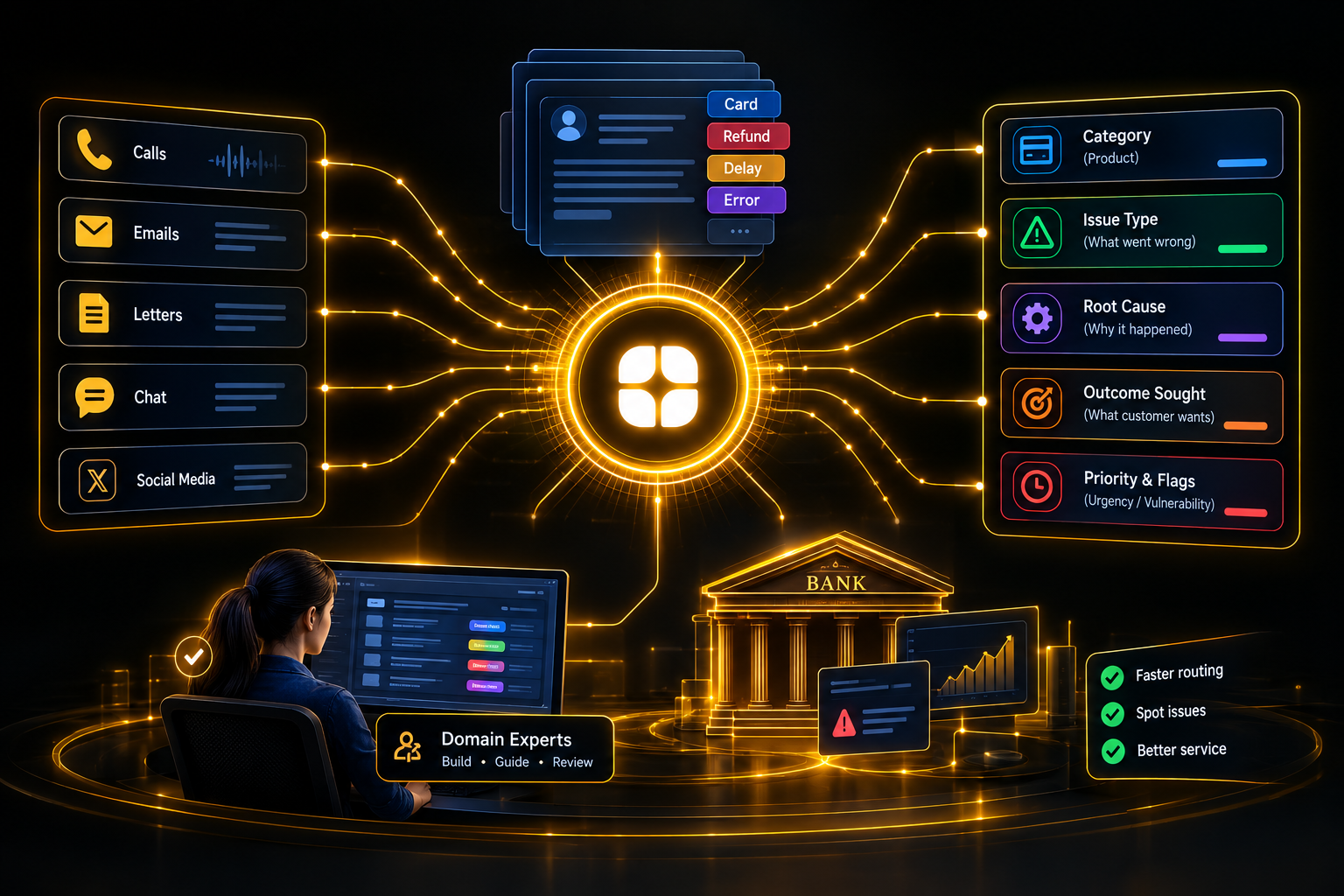
Banks receive complaints through calls, emails, letters, chat, and social media. Some are small, such as a late statement. Others are serious, such as a disputed charge. Each must be sorted, routed, and answered within a set time. At large volumes, sorting by hand is slow, so banks use AI to help.
AI learns from labeled complaints. Good bank complaint classification means giving similar cases the same category, cause, and priority every time. This post explains what the work covers, why it is hard, and what finance and banking AI training data needs to get right.
Annotation for complaints and disputes usually has five parts:
Models trained on these labels can route cases, spot rising problems, and show managers what upsets customers. This is the basis of dispute classification data.
Customers do not write in neat categories.
Annotators need written rules for each of these. Without them, two people label the same message differently, and the model learns the disagreement. Emotion should be labeled separately from the issue, so a calm message about a serious problem is not ranked below an angry message about a small one.
The first decision is the boundary. The label guide should follow the bank’s own policy on what counts as a formal complaint, with examples of borderline cases, such as a customer who is annoyed but asks for nothing.
A disputed transaction is a related but separate case. It asks the bank to review a specific payment, so it needs its own labels, such as the dispute type and the stage reached.
These two labels are often confused.
Issue type is what the customer says went wrong. It comes from the message, so labelers read the text and pick the matching category. Root cause is why it happened. It often comes from case notes or the outcome, so it may only be known after the bank investigates.
If a project mixes the two, the model learns to guess causes from complaint wording, which is unreliable. The guide should say which source each label uses, and allow “root cause not yet known.”
A list that is too short hides useful differences. One that is too long leaves annotators choosing between near-identical options. A strong scheme has levels: product family, issue type, and, where known, root cause. Each category needs a definition, examples, and a note on its closest look-alike, such as a fee dispute versus an unclear-terms complaint. It should also follow the bank’s own case system, so labels can be joined to resolution data.
Some customers need extra care. Signs may include bereavement, illness, money trouble, difficulty understanding a product, or distress in the message. A flag can send the case to a trained person.
This is sensitive labeling. A missed flag may mean someone does not get help. A false flag may waste time or treat a customer unfairly. Guidelines should:
Labels should record the signal seen, not a diagnosis or a judgment of the customer. Complaints also contain names, account details, and personal circumstances, so decide early what is masked and who may view raw cases. Vulnerability flags need the strictest access controls.
Complaints often point back to earlier calls and documents. Matching them depends on consistent text labels, which we explain in our guide to earnings call and financial news labeling, where speakers and statement types need the same clear rules.
People who have worked in bank complaint handling know which wording signals a real complaint, how root causes are usually found, and what vulnerability looks like in practice. They also know how cases are routed and resolved, so labels fit the real workflow.
Specialists write the category list, set the vulnerability rules, and review doubtful cases. This reflects Globik AI’s approach of using verified domain experts for work that depends on judgment, where a generalist would be guessing.
Before starting a complaint classification project, settle these points:
A complaint is a customer asking to be heard, and the label decides who hears it and how fast. Strong bank complaint classification uses a clear category scheme, keeps issue and cause apart, handles vulnerability flags with care, and relies on reviewers who know how banks resolve cases. With that foundation, models can route complaints well and help teams fix the problems behind them.
It is the labeling of customer complaints by product, issue, cause, and priority so AI can route and analyze them. Annotators follow written rules built with banking experts.
It is a labeled set of complaints and disputed transactions, each with a type, stage, and outcome. Models trained on it can sort new cases and spot patterns.
Issue type is what the customer says went wrong. Root cause is why it happened, often learned only after investigation. Keeping them separate stops the model from guessing causes.
It is marking messages that show signs a customer may need extra care, such as distress or money trouble. Labels record the signal seen, and doubtful cases go to trained reviewers.
Specialists know how complaints are defined, routed, and resolved, and what vulnerability looks like in practice. They write clear rules and review sensitive cases.