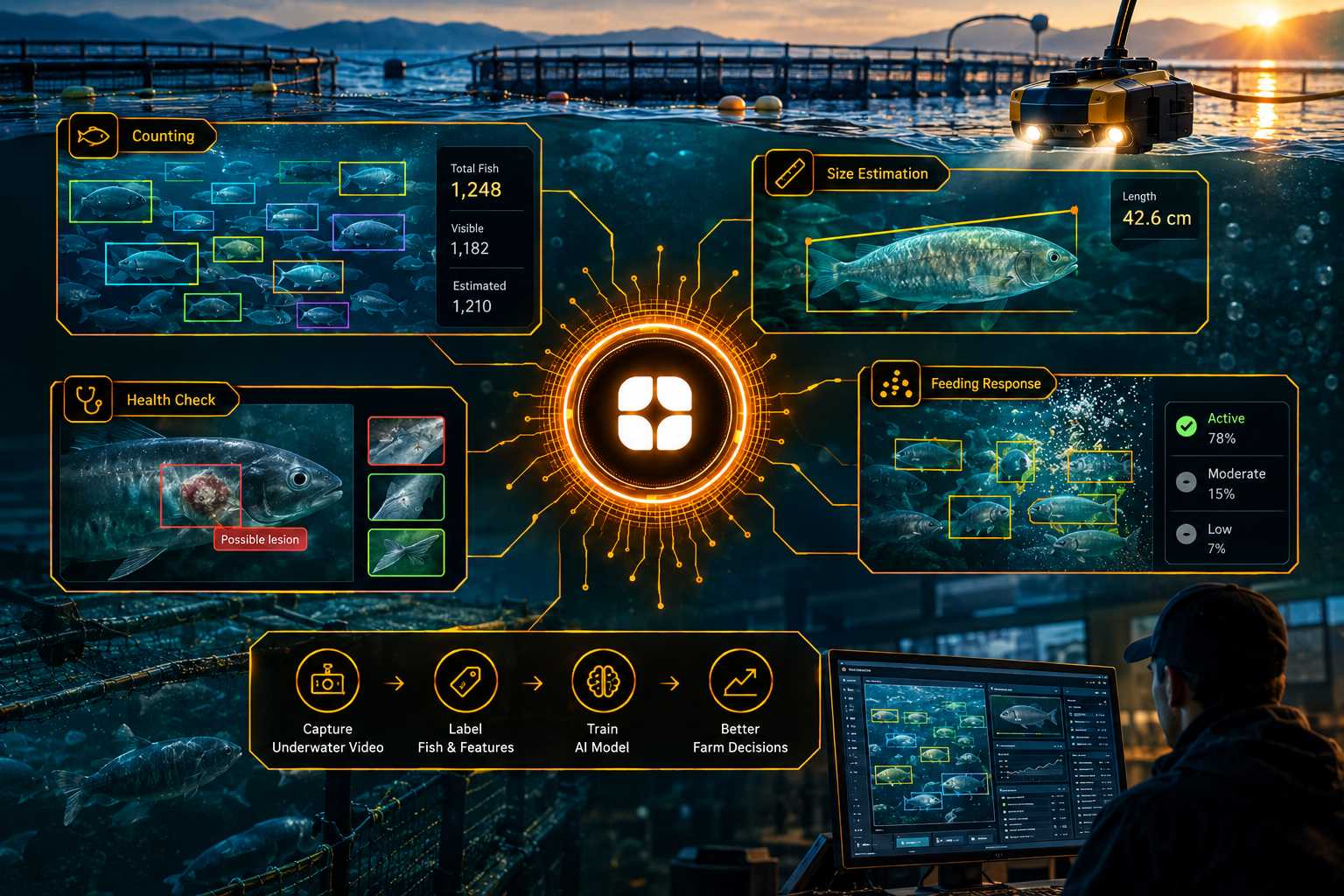
On a land farm, a person can walk the fence line and look at the animals. On a fish farm, the animals live underwater, often in cloudy water, in pens or tanks that hold far more fish than anyone can count by eye. Farmers still need to know how many fish they have, how large they are, whether they are healthy, and whether they are eating.
Underwater cameras and computer vision can answer those questions around the clock. But the model is only as good as its labels. Aquaculture monitoring annotation turns underwater footage into labeled data that captures counts, size, and health correctly. This post explains why that work is harder than it looks and why it needs people who understand fish.
Most projects focus on four jobs: counting fish, estimating their size, spotting signs of poor health, and judging how fish respond to feed. Count and size together feed into estimates of how much fish is in a pen, which in turn guide feeding and harvest decisions.
Underwater footage rarely looks like a clean photograph. Light fades with depth. Particles in the water scatter it. Air bubbles from aeration streak across the frame, and algae can build up on a lens over days. Near the surface, glare and reflections change how fish look.
A fish that is close and well lit is easy to label. A fish further away fades into gray-blue haze, and its outline disappears. Annotators need a rule for how clearly a fish must be visible before it counts, and a way to mark a frame or a region as unusable.
Fish swim in three dimensions. In a single frame, one fish may sit in front of another, and a third may be half hidden behind both. A count that treats the image as flat will miss the ones in back.
Fish counting annotation therefore needs clear definitions:
Counting setups also differ. Some systems count fish as they pass through a narrow channel, where they move roughly in single file. Others look into a full pen, where fish overlap constantly. The guidelines should be written for the actual setup.
Size matters because it drives feeding and harvest planning. Estimating it from video means labeling the points that define length, such as the snout and the fork of the tail.
This is where angle becomes critical. A fish swimming toward the camera looks short. A fish that is curved or turning gives a distorted length. Annotators need rules for which views are acceptable, and they must skip fish that are not roughly side-on.
Good fish size estimation data also depends on how the camera was set up. A stereo setup or a calibrated scene can turn pixel measurements into real lengths. Where the team has physical measurements of sample fish, those belong in a separate field linked to the footage, so the model can be checked against real sizes instead of against labels alone.
Many signs of poor health are small. They include lesions, damaged fins, deformities, and visible parasites. At a distance they are a few pixels, and in cloudy water they can vanish.
Look-alikes make the job harder. Scale loss from handling, reflections off the body, specks of debris, and lens dirt can all resemble a real problem. An annotator without fish knowledge may flag all of them.
Careful health labeling works within what a camera can show. It uses categories such as "visible mark, possible concern" rather than a diagnosis, and it relies on an aquaculture or veterinary specialist to review the doubtful cases. A label that claims more certainty than the image supports teaches the model the same overconfidence.
How fish react when feed enters the water says something about appetite. They may rise toward the surface, spread through the pen, or ignore the feed and drift away.
Labeling this requires a defined scale and reference examples, because a lively response in one setup may look quite different in another.
A model built for one kind of farm does not carry over without work. Net pens in the sea, land-based tanks, ponds, and recirculating systems each have different water clarity, lighting, and camera positions. Species differ in body shape, swimming style, and how they gather.
Labeling guides should be written for the species and the system in front of the camera.
People who work in fish farming see these images differently. They know what normal swimming looks like for a species, how a healthy fin or skin appears, and how feeding response changes over time. They can tell real damage from a lighting artifact, and they know which views are good enough for measuring.
They also write the rules that keep a large team consistent: how visible a fish must be, which angles count for length, and how to treat doubtful health marks. This matches Globik's approach of using verified domain experts for work that depends on judgment. For underwater video annotation, that experience is what keeps labels reliable when the footage is far from perfect.
Before an aquaculture labeling project starts, a team can settle five things:
Aquaculture AI works when labels handle murky water, crowded schools, awkward angles, and small signs of illness honestly. For another example of labels built around what a camera can and cannot show, see our guide on produce grading and harvest-readiness annotation: teaching AI what a buyer actually accepts. In both fields, aquaculture monitoring annotation and visual labeling in general work best in the hands of people who know the subject.
It is the labeling of underwater footage so AI can count fish, estimate their size, and spot signs of poor health.
Light fades, particles and bubbles scatter the view, and distant fish blur, so annotators need clear visibility rules.
Annotators label each visible fish by a fixed rule and tie fish across video frames so none are counted twice.
A fish seen head-on or curved looks shorter, so only side-on fish should be used for length labels.
They can tell real lesions and parasites from scale loss, debris, and lighting, and they review doubtful cases carefully.