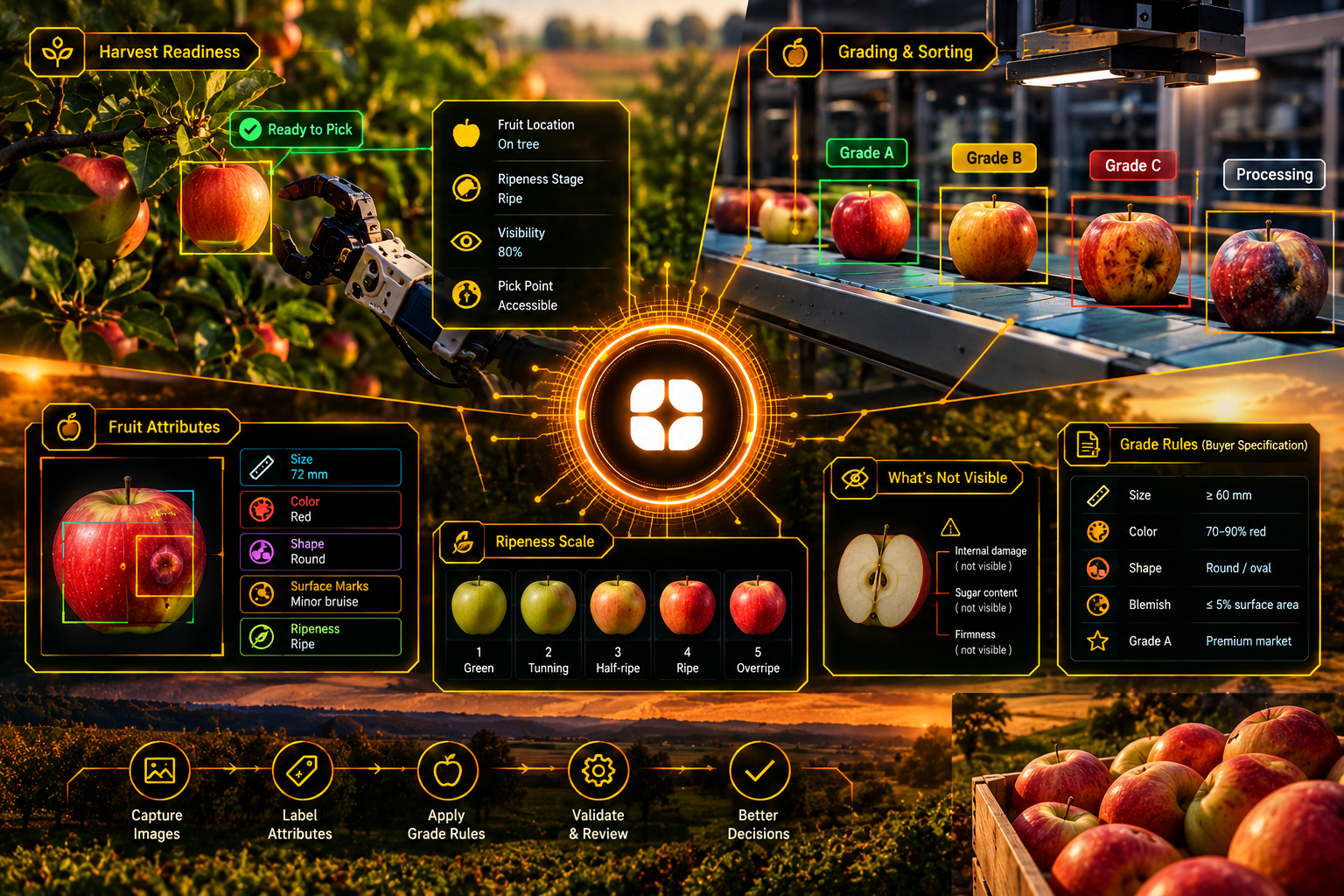
A packhouse can run thousands of pieces of fruit past a camera in minutes. Each one needs a verdict: which grade it earns, which buyer it goes to, or whether it goes to processing instead. Out in the orchard, a picking robot faces a related question: is this fruit ready to pick now?
Both decisions rest on what the model learned from labeled images. Produce grading annotation and harvest-readiness labeling look easy, because everyone knows what a good apple looks like. In practice, the labels must capture buyer rules, ripeness scales, and views the camera cannot see. This post explains what that takes.
A grade is not a quality score that exists in the fruit. It is a set of limits written by a buyer, a market, or a standards body: minimum size, accepted color range, allowed shape, and how much surface blemish is tolerated.
The same piece of fruit can be top grade for one buyer and second grade for another. A generic annotator who simply picks "good" or "bad" is applying a personal opinion, and the model learns that opinion. For fruit sorting AI training data, the labels have to follow the written specification, with image examples for each grade boundary.
A single fruit carries several things worth labeling: size, color, shape, surface marks, and ripeness. Some projects collapse them into one grade label. A stronger approach labels each attribute separately and lets the grade come from the rules.
This pays off when specifications change. If a buyer tightens the color range, a team with separate attribute labels can adjust the rule. A team that labeled only final grades has to relabel the data from scratch.
Fruit ripeness labeling is harder than it sounds. Ripeness is a gradual change, and the stages blur into each other. Some varieties change color well before they are ready, and others stay green while ripe.
Good labels use a defined scale, with a reference image or color chart for each stage and a rule for the borderline between two stages. Lighting also matters, because the same fruit looks different under warm and cool light. Where possible, a reference card in the frame gives annotators something fixed to compare against.
Without a scale, two annotators may call the same fruit "ripe" and "almost ripe," and the model learns to split the difference.
On a sorting line, fruit rolls or spins under the camera so several views can be captured. That helps, because a bruise on the underside is invisible from the top.
It also creates a labeling problem. Several images belong to one piece of fruit, so annotators need a way to tie them together. The guidelines should say whether the grade comes from the worst view, from all views combined, or from some other rule. Glare on shiny skin and wet surfaces can look like marks, and annotators need examples of both so they can tell the difference.
A camera sees the outside. It cannot see internal damage, sugar content, or firmness, and decay that has started inside may not show on the surface at all.
Labels should be honest about this. A visual grade is a visual grade, and it should not be presented as a statement about the whole fruit. When a lab measurement exists for the same sample, it belongs in a separate field linked to the image. That way the team can see how far the visual grade can be trusted, and the model is not asked to learn something the picture does not contain.
Harvest-readiness work moves the camera into the orchard, the field, or the greenhouse. The fruit is no longer neatly presented. Leaves, branches, and other fruit hide parts of it, and clusters overlap.
Harvest-readiness detection data usually needs several kinds of labels:
Annotators need a rule for fruit that is mostly hidden. Is it labeled with a best guess, marked as "cannot judge," or skipped? A model that learns to guess ripeness from a sliver of fruit will guess wrong in the field.
Varieties look different at the same stage of ripeness. A color that signals ready in one variety may mean unripe in another. Regional buyers also differ in what they accept.
For this reason, a grading guide should be treated as a versioned document. Each labeled batch should record which version of the guide it followed. When a buyer changes a rule, the team can see exactly which data was labeled under the old one.
People who work in packhouses and orchards read fruit differently. They can tell natural skin marks from damage, know how a particular variety looks when it is ready, and understand why a buyer rejects a certain blemish. They also know which marks are cosmetic for one market and disqualifying for another.
Specialists write the rules that keep a large team consistent, covering grade limits, ripeness scales, and the handling of uncertain fruit. This matches Globik's approach of using verified domain experts for work that depends on judgment, where a generalist would be guessing. For agriculture AI training data, that knowledge is what lets labels match what a buyer will actually accept.
Before a produce labeling project starts, a team can settle five things:
Produce grading and harvest-readiness AI works when labels follow the buyer's written rules, treat ripeness as a scale, and admit what a picture cannot show. For another example of labeling where context decides meaning, see our guide on sustainability and emissions report data extraction: a number means little without its context. In both cases, strong produce grading annotation depends on people who know the subject.
It is the labeling of fruit and vegetable images against written grade rules so AI can sort produce the way buyers expect.
Separate labels for size, color, shape, and marks let a team adjust when buyer specifications change, without relabeling everything.
Ripeness is a gradual scale that varies by variety and lighting, so annotators need reference images and clear stage boundaries.
They cannot show internal damage, sugar content, or firmness, so a visual grade should be recorded as only that.
Annotators mark fruit location, ripeness, how much of the fruit is visible, and sometimes the pick point.