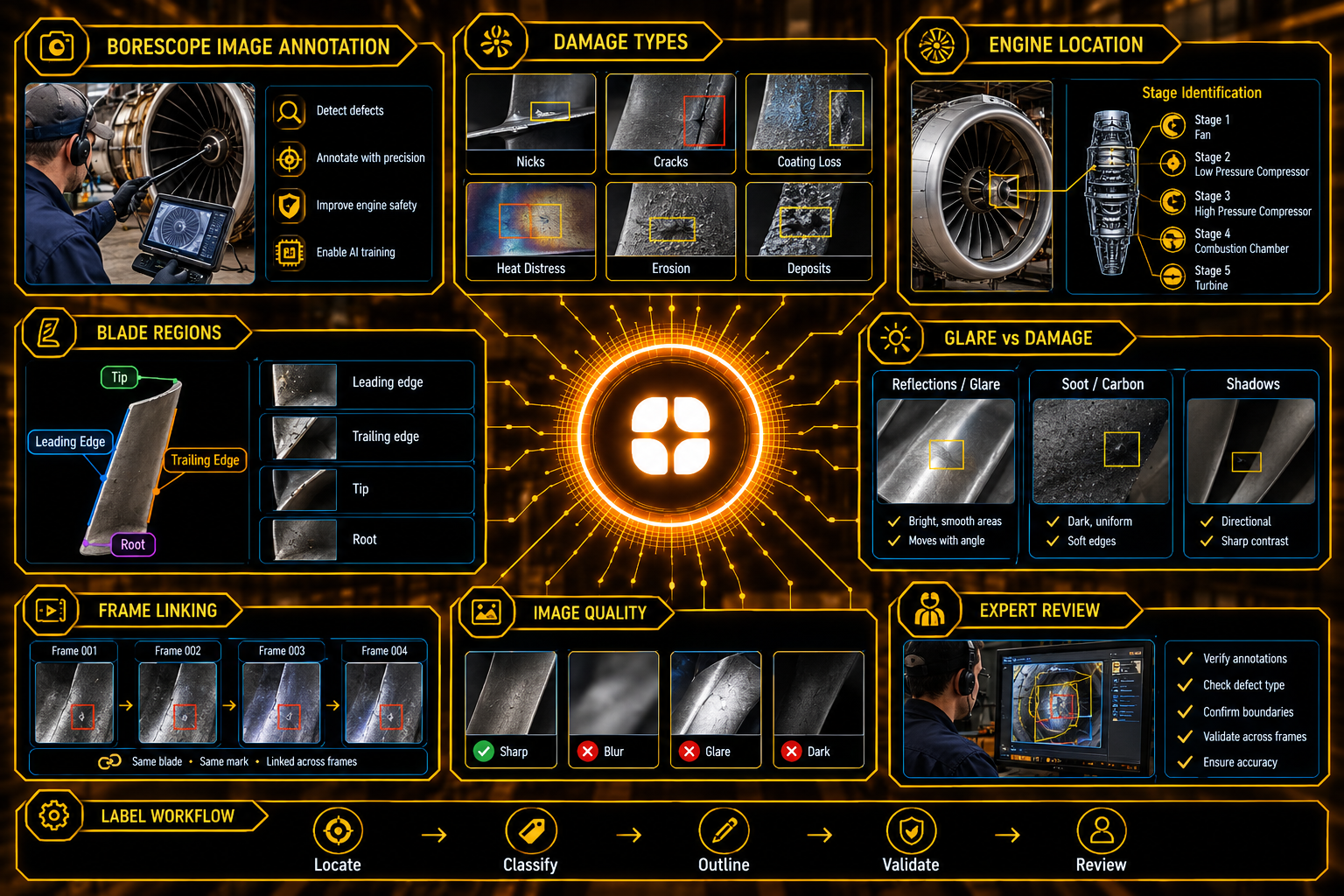
An aircraft engine is a tightly packed machine, and its most important parts sit deep inside. Blades in the compressor and turbine spin at high speed in heat and pressure, and they wear. Taking an engine apart for every check would be slow and costly, so inspectors use a borescope: a thin, flexible or rigid camera pushed through a small port to look at the parts in place.
The images are valuable and hard to read. AI can help find damage, but it learns from labeled images, and these images are unlike ordinary photographs. Borescope image annotation is the labeling work behind it. This post explains what the images look like, what the labels need to capture, and why knowledge of engine interiors matters.
A borescope image is close-up, brightly lit at the center, and dark around the edges. A small light on the tip is the only illumination. The lens often has a wide angle, so straight edges curve and distances look stretched.
An engine has sections, and each section has stages of blades and vanes. A damage mark means something different depending on where it is. A mark on one stage may be routine, while the same mark on another needs attention.
Because the images show so little context, location usually comes from the inspection record: which port, which stage, and which blade. Labels should carry that information, and annotators need a way to link each image to its place in the engine.
Blade identity adds a second layer. During inspection the engine is turned slowly so each blade passes the camera. Annotators may need to count blades from a reference point to say which one is in view. When they cannot place an image, a "location unknown" label is better than a guess.
Inspectors look for a set of conditions:
Engine blade damage labeling has to name the type. A model that only knows "damage present" cannot tell a minor nick from a crack, and the two lead to very different follow-up.
Within one blade, the position of a mark matters. The leading edge, trailing edge, tip, and root each face different loads and different conditions. A small nick on a forgiving part of the blade is not the same as one in a sensitive area.
Labels should record the location on the blade, using a defined set of regions with a diagram.
Whether a given mark is acceptable is decided by qualified inspectors using the engine's maintenance documentation. The labels describe what is visible and where it is, so those inspectors can apply the limits.
Shiny metal under a point light creates problems. Bright reflections can hide a crack or imitate one. Shadows from the blade's own shape fall across the surface. Oil films and soot can look like damage, and damage can hide under soot.
Heat gives particular trouble. Some color change on blades is normal aging, and some signals real heat distress. Telling them apart requires experience, and a label that treats all discoloration as damage will flag healthy engines.
Borescope inspections often produce video or a series of frames as the engine turns. The same blade appears in several frames, from slightly different angles.
If each frame is labeled in isolation, one nick becomes five. Annotators need a way to link frames showing the same blade, and the same mark, so that damage is counted once. The guidelines should say how to handle a mark seen clearly in one frame and faintly in others.
A borescope camera is close to the surface, and the distance changes as the operator moves the tip. There is no ruler in the picture, so size is hard to judge.
Known features give some help, such as the thickness of a blade edge or a recognizable fitting. Where those are missing, the right label is "size uncertain," not an estimate presented as a measurement.
Borescope images vary a great deal. Some are sharp and well lit. Others are blurred by motion, washed out by glare, or too dark at the edges.
Annotators need a clear rule for unusable images, and a way to mark a frame as "cannot judge." If every frame must carry a label, the model learns from guesses.
People who inspect engines read these images differently. They know the layout of the engine sections, recognize blade regions on sight, and understand which marks are routine and which are worrying. They can separate heat distress from normal aging and tell soot from damage. They know that a good image of the wrong blade is not much use.
They write the rules that keep a large team consistent: the damage list, the blade region diagram, and the handling of poor images. This matches Globik's approach of using verified domain experts for work that depends on judgment. For aerospace engine inspection AI training data, that knowledge is what makes the labels dependable.
Before a borescope labeling project starts, a team can settle five things:
Engine inspection AI works when labels record where an image sits in the engine, name the damage type, tell wear from glare and soot, and avoid counting one mark many times. For another example of labeling things the eye cannot easily see, read our guide on non-destructive testing scan annotation for composite parts: labeling what the eye cannot see. Strong borescope image annotation depends on people who know the inside of an engine.
It is the labeling of images taken inside engines so AI can find damage on blades and other parts.
The same mark means different things on different stages and blade regions, so each image needs its place recorded.
They are close-up and shiny, with glare, shadows, distortion, and very little surrounding context.
Otherwise one mark is counted several times as the engine turns past the camera.
They know the engine layout, can tell heat distress from normal aging, and write consistent rules.